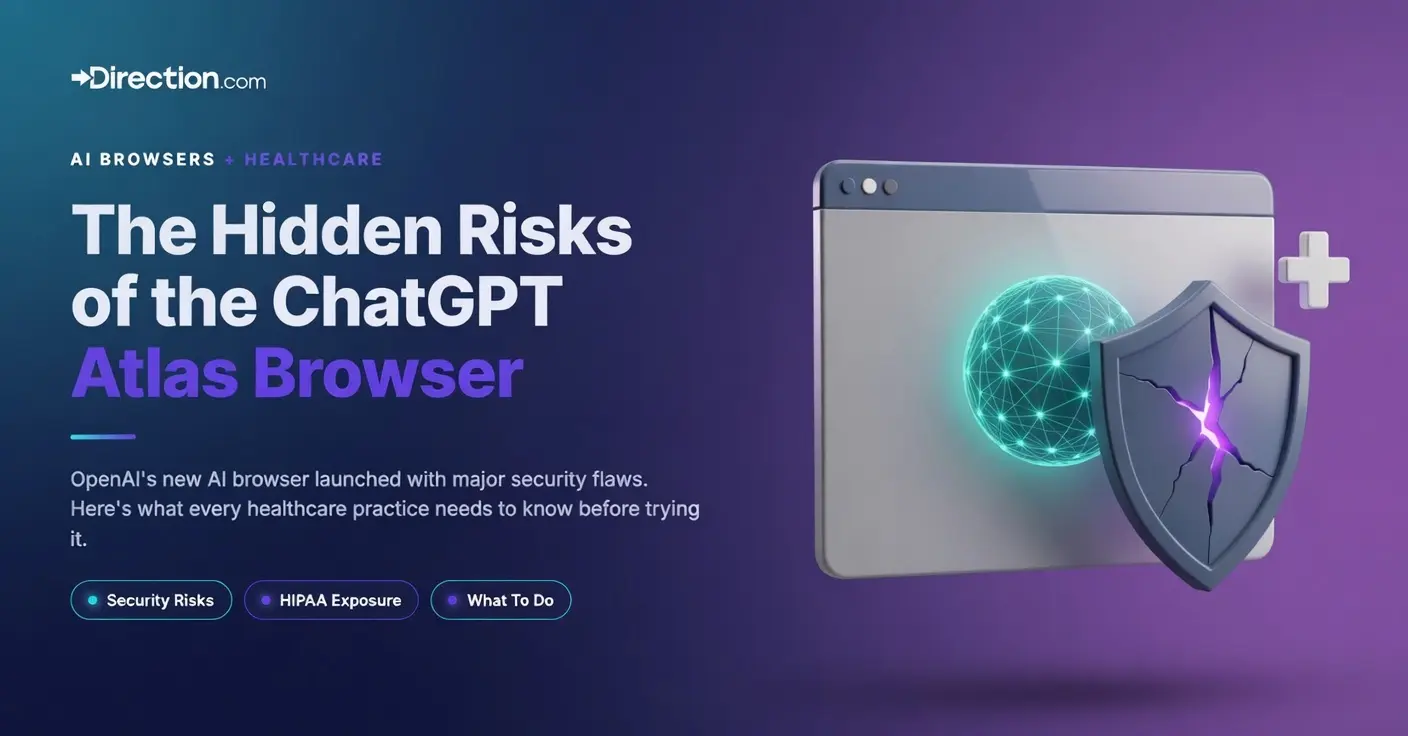
Tuesday morning, OpenAI launched ChatGPT Atlas, their new AI-powered web browser that promises to revolutionize how we interact with the internet.
And honestly? The concept is genuinely cool – an AI that remembers your browsing, completes tasks for you, understands context across every webpage you visit. There’s a ton of potential here.
But by Wednesday afternoon, a security researcher had already demonstrated a successful cyberattack that could hijack users’ clipboards and redirect them to phishing sites.
As Hackernoon writes, “…one brave security engineer chillingly put it, ‘simply summarising a Reddit post could result in an attacker being able to steal money or your private data.'”
Twenty-four hours. That’s how long it took for the hype to meet reality (and, yes, obviously this is still early and OpenAI will advance and improve on security measures… But, wow, 24 hours!)
Now, I’m “supposed” to be writing you a different article right now. You know the one – “Why Atlas Will Change SEO Forever (And How We Can Help).”
Every SEO agency with a pulse is cranking out that content as we speak, positioning themselves to sell you optimization packages before most people have even heard of the thing.
But here’s the truth: the agencies rushing to sell you solutions to problems you don’t have yet are usually the same ones who’ll ghost you when the next shiny object appears.
And as someone who’s watched countless “game-changing” platforms come and go – remember when everyone said voice search would kill traditional SEO? – I’ve developed a fairly reliable BS detector.
So instead of selling you on Atlas adoption, I’m going to do what Direction has always done: tell you what’s actually happening, what it means for your healthcare practice, and when (if ever) you should care.
Because while the marketing world is losing its mind over how Atlas might affect Google’s dominance, cybersecurity experts are using words like “insurmountably dangerous” and “canyon-sized privacy holes” to describe the security implications.
And if you’re running a healthcare practice bound by HIPAA regulations, that should get your attention faster than any promise of better search visibility.
- What ChatGPT Atlas actually is and how it works (beyond the marketing hype)
- The documented security vulnerabilities discovered within 48 hours of launch
- Why healthcare practices face unique compliance and liability risks with AI browsers
- What Atlas means for your SEO strategy – the honest assessment without the upsell
- How Direction’s comprehensive approach already covers AI visibility without chasing buzzwords
- When to actually pay attention to new platforms versus when to focus on fundamentals
What Actually is the ChatGPT Atlas Browser?
Let’s start with what Atlas actually does, because the marketing materials make it sound more revolutionary than it really is.
ChatGPT Atlas is OpenAI’s first web browser, built on the same Chromium engine that powers Google Chrome. Currently available only on macOS (with Windows, iOS, and Android “coming soon”), it integrates ChatGPT directly into your browsing experience through three main features:
1. Browser Memory
Atlas tracks which websites you visit, how you interact with them, and what you do across sessions. This creates a personalized context that ChatGPT uses to make its responses more relevant.
Ask it “What was that recipe site I looked at last week?” and it should remember. The feature is opt-in, theoretically, but enabled by default during setup.
2. Agent Mode
This is where things get interesting and concerning simultaneously.
In agent mode, ChatGPT can actually browse websites for you, fill out forms, add items to shopping carts, and interact with pages on your behalf. Available only to Plus and Pro subscribers (for now), it’s essentially giving an AI assistant the keys to your logged-in web sessions.
3. Sidebar Chat
On any webpage, you can open a ChatGPT sidebar to summarize content, answer questions, or help with writing.
It’s similar to Chrome extensions that add ChatGPT functionality, as well as the ChatGPT widget on the side of this blog, except it’s baked into the browser itself and has access to your full browsing context.
Now, is this revolutionary? Not really.
- Perplexity launched their Comet browser with similar features back in July.
- Google has been integrating Gemini into Chrome since September.
- Arc browser has had AI features for months.
What makes Atlas notable isn’t the technology – it’s that OpenAI has 800 million ChatGPT users who might actually adopt it.
That’s the real story here. Not that Atlas does something magical, but that it has the distribution to potentially matter. Eventually. Maybe.
So, What Are the Security Vulnerabilities Nobody's Talking About in Marketing Circles?
Here’s where things get uncomfortable, especially if you’re reading this as a healthcare practice owner.
Within 24 hours of Atlas launching, security researcher @elder_plinius demonstrated a “clipboard injection” attack.
By embedding hidden instructions on a webpage, they tricked the Atlas agent into copying a malicious link to the user’s clipboard. When that user inevitably pastes something later – maybe into an email, maybe into a patient chart – they’re pasting the attacker’s link instead.
That’s not theoretical. That happened on day one.
But it gets worse. The vulnerability isn’t a bug in Atlas specifically – it’s a fundamental problem with how AI agents interact with web content, called “indirect prompt injection.”
Basically, an AI that’s designed to read and act on web content can’t always tell the difference between legitimate instructions from you and malicious instructions hidden in a webpage it’s viewing.
Simon Willison, a programmer and security researcher based in the UK, published a blog post that should be required reading for anyone considering Atlas.
His assessment?
“The security and privacy risks involved here still feel insurmountably high to me. I’d like to see a deep explanation of the steps Atlas takes to avoid prompt injection attacks. Right now, it looks like the main defense is expecting the user to carefully watch what agent mode is doing at all times.”
Read that again. The main security feature is hoping you’re paying attention.
Brave Software, the company behind the Brave browser, published a detailed report on October 21st (literally the day before Atlas launched) documenting these vulnerabilities across multiple AI browsers, including Perplexity’s Comet. They found that malicious instructions embedded in screenshots could manipulate AI assistants to steal credentials, access authenticated sessions, and exfiltrate sensitive data.
OpenAI knows about these issues. Dane Stuckey, OpenAI’s Chief Information Security Officer, acknowledged in a lengthy post that “prompt injection remains a frontier, unsolved security problem, and our adversaries will spend significant time and resources to find ways to make ChatGPT agent fall for these attacks.”
Translation: We launched it anyway.
Why do Healthcare Practices Face Unique Risks With AI Browsers?
Now let’s connect this to your world, because this isn’t just about theoretical security vulnerabilities – it’s about HIPAA compliance, patient safety, and legal liability.
Imagine this scenario…
One of your staff members adopts Atlas because it seems useful for research. They’re browsing patient education materials while logged into your EHR system in another tab. Atlas’s browser memory feature is tracking everything – the medical conditions they’re researching, the patient portal they’re accessing, the pharmaceutical sites they’re visiting.
All of that context is being stored and processed by OpenAI’s systems. Yes, they claim they’re not using it to train models unless you opt in. Yes, they say they have filters for sensitive information.
But here’s the question that should keep you up at night: Is that enough to satisfy HIPAA requirements?
Because HIPAA doesn’t care about OpenAI’s privacy policy. HIPAA cares about whether you’ve allowed Protected Health Information to be transmitted to a third party without proper safeguards.
And “browser memories” that track healthcare-related searches while an employee is logged into patient systems?
That’s a compliance audit waiting to happen.
But it gets more complex with agent mode. Let’s say someone asks Atlas to “summarize the patient notes from this morning’s appointments.” If they’re logged into your EHR, the agent could theoretically access that information.
OpenAI says the agent “will pause to ensure you’re watching it take actions on specific sensitive sites such as financial institutions.” But it doesn’t specifically mention healthcare systems. And even if it did, “pausing to make sure you’re watching” isn’t exactly a robust security control.
The liability question isn’t just “what if the AI makes a mistake?” It’s “what if the AI is successfully attacked while accessing patient information?” Because those prompt injection vulnerabilities we talked about? They’re specifically designed to make the AI do things it shouldn’t do. Like exfiltrate data from authenticated sessions… Like medical records.
The password keychain vulnerability is particularly troubling.
Atlas asks users to opt in to share their saved passwords with ChatGPT. For many healthcare practices, that keychain includes credentials for EHR systems, billing platforms, prescription databases, and patient portals. One successful attack against an employee using Atlas could potentially compromise your entire practice’s access credentials.
And before you think “well, we just won’t let staff use Atlas” – remember that BYOD (Bring Your Own Device) policies and work-from-home arrangements mean you probably don’t control what browser someone uses on their personal laptop when they’re accessing work systems remotely.
This isn’t fear-mongering. This is risk assessment. And the risk profile for healthcare organizations using AI browsers with known security vulnerabilities is significantly higher than for, say, a retail business or a marketing agency.
What Does Atlas Actually Means for Healthcare SEO?
Alright, let’s talk about what you probably came here to learn: What does ChatGPT Atlas mean for your practice’s search visibility and patient acquisition?
The short answer? Right now, almost nothing. In six months, probably still nothing. In 12-24 months, maybe something worth paying attention to.
Here’s why the timeline matters: Atlas is currently available only on macOS. That’s roughly 15% of the desktop market in the US. Of those Mac users, how many will actually download and switch to a brand-new browser when they’re already comfortable with Chrome or Safari? Early adoption estimates suggest single-digit percentage points at best.
Compare that to Google Chrome’s 3+ billion users globally. Or the fact that Google still commands over 91% of the search market. The gap between “OpenAI launched something” and “this materially affects your patient acquisition” is measured in years, not months.
But here’s where I need to be careful, because there’s a difference between dismissing something entirely and being realistic about timelines. Atlas represents one move in a larger chess game that’s been playing out for the past two years – the shift from traditional search engines to AI-mediated discovery.
That shift is real. It’s happening. But it’s not happening overnight, and it’s not happening through a single platform.
Think about it this way: When voice search became the hot topic in 2017, every SEO agency started selling “voice search optimization” packages. They predicted that by 2020, 50% of all searches would be voice-based.
They were wrong.
Voice search usage plateaued at around 20-25%, and the “optimization” techniques they sold? Turns out they were just good SEO practices that worked for all search types anyway.
I see the same pattern emerging with AI browsers. Agencies are rushing to create artificial urgency around these types of browser experiences specifically, when what actually matters is building content and digital presence that works across all forms of AI-mediated search – whether that’s ChatGPT, Google’s AI Overviews, Perplexity, or whatever comes next.
So what should healthcare practices actually be thinking about?
Not this: “We need to optimize our website specifically for ChatGPT Atlas before our competitors do.”
But this: “How do we create content and digital authority that gets cited and recommended regardless of which AI system someone’s using?”
The answer to that second question? You probably already know it, because it’s the same answer it’s been for the past decade: Create genuinely authoritative, comprehensive content that demonstrates expertise and answers real patient questions better than anyone else.
Yes, E-E-A-T Remains Critical
Google’s E-E-A-T guidelines (Experience, Expertise, Authoritativeness, Trustworthiness) weren’t created for AI search, but they’re exactly what AI systems look for when deciding which sources to cite.
- Clear, well-structured information that addresses user intent? That works in traditional search and AI search. P
- roper schema markup that helps machines understand your content? Relevant in both contexts.
- Fast, accessible, mobile-friendly websites? Essential everywhere.
Here’s what I’ve learned after watching the AI search landscape evolve over the past two years: The practices that built strong, comprehensive digital authority before ChatGPT launched are the ones getting cited in AI responses now.
The ones that chased quick wins and thin content? They’re invisible in AI search just like they’re increasingly invisible in traditional search.
When AI Browsers Actually Matter for Healthcare Marketing
So if Atlas doesn’t matter right now, when will it? And more importantly, what should you actually be doing to prepare for the broader shift toward AI-mediated search?
Let’s start with a realistic timeline. For Atlas specifically – or any single AI browser – to materially impact your patient acquisition, you need three things to happen:
1. Security improvements that make it viable for sensitive use cases.
Right now, the vulnerabilities we discussed make Atlas a non-starter for healthcare contexts. Until OpenAI solves the fundamental prompt injection problem (which they’ve acknowledged is “frontier, unsolved”), recommending Atlas to healthcare practices would be irresponsible.
2. Meaningful market adoption beyond early tech enthusiasts.
We’re talking 10%+ browser market share, not the 1-2% you might see with curious early adopters. That takes time – Firefox has been around since 2004 and has never cracked 10% market share. Browser switching is harder than it looks.
3. Clear differentiation that makes it superior to existing options.
Right now, Atlas offers convenience features that Chrome + ChatGPT extension can mostly replicate. Until there’s a compelling reason for average users to switch, adoption will remain limited.
My realistic timeline? 18-24 months before Atlas has enough adoption to show up in your analytics meaningfully. Maybe longer if security concerns persist or if Google successfully integrates Gemini deeply enough into Chrome that there’s no reason to switch.
But here’s the thing – whether it’s Atlas, Comet, Chrome with Gemini, or something that hasn’t launched yet, the trend is clear: Search is becoming more conversational, more personalized, and more AI-mediated. That’s not a single-platform issue. That’s a fundamental shift in how people find information online.
So what should you actually be doing? Focus on the platform-agnostic strategies that work regardless of which AI system someone’s using:
Time-Tested Optimization Strategies
Build comprehensive, authoritative content that answers complete questions.
AI systems prefer citing single, thorough sources over cobbling together information from multiple thin pages. That 500-word blog post about “5 Tips for Healthy Teeth”? Not getting cited. The 3,000-word comprehensive guide to preventing periodontal disease with sections on causes, prevention, treatment options, and ongoing maintenance? That’s what AI systems recommend.
Implement proper structured data and schema markup.
This isn’t about any specific platform – it’s about making your content machine-readable. When an AI system is deciding which source to cite for local orthodontist services, schema markup helps it understand exactly what you offer, where you’re located, and what makes you qualified to provide that information.
Establish genuine expertise and authority in your specialty.
This means author bios that showcase real credentials, published research if applicable, speaking engagements, professional affiliations – the markers of expertise that both humans and AI systems recognize as credible. AI language models are actually quite good at detecting thin, manufactured authority versus genuine subject matter expertise.
Keep core content regularly updated rather than constantly publishing new thin content.
There’s interesting data suggesting that AI systems show a “freshness bias” – they prefer citing recently updated information. But that doesn’t mean publishing daily blog posts. It means maintaining a smaller number of comprehensive resources and keeping them current. Think Wikipedia model, not content mill model.
Optimize for answer engine optimization (AEO), not just traditional SEO.
This means structuring content to directly answer questions, using clear headers that match how people actually phrase queries, and providing concise, accurate answers upfront before diving into detail. The pattern of “question in header, clear answer in first paragraph, detailed explanation below” works for both traditional and AI search.
Notice what’s not on that list? Anything Atlas-specific. Anything that requires you to chase individual platforms. Anything that would become obsolete if Atlas fails to gain traction.
That’s intentional. Because the practices that will thrive in an AI-mediated search landscape are the same ones that thrive in traditional search: Those that build real authority, create genuinely helpful content, and establish themselves as trusted sources in their field.
Here's What We're Recommending for Healthcare Practices (and Doing for our Clients)
You came here looking for guidance on ChatGPT Atlas and what it means for your practice. So let me give you the most direct, actionable advice I can.
What to do right now: Nothing Atlas-specific. Seriously. If your current SEO strategy is built on solid fundamentals – comprehensive content, technical excellence, genuine authority building – you’re already positioned for whatever AI search landscape emerges. Don’t let anyone convince you that you need emergency Atlas optimization or that you’re falling behind by not acting immediately.
What to monitor over the next 6-12 months: Atlas adoption rates among your target patient demographics. Security improvements and whether the prompt injection vulnerabilities get solved. Your own analytics – if you start seeing meaningful traffic from Atlas, that’s when it deserves attention. Expert assessments from security researchers about whether it’s safe for healthcare contexts.
What to avoid entirely: Panic-driven investment in platform-specific optimization. Agencies that create artificial urgency around Atlas without addressing security concerns. Any service that promises “Atlas rankings” or “guaranteed visibility in AI browsers” – those aren’t real metrics yet. Implementing browser memory features or agent mode in any healthcare context until security issues are resolved.
What deserves your investment instead: The fundamentals that work everywhere. Comprehensive E-E-A-T content strategy. Technical SEO excellence that makes your site fast, accessible, and machine-readable. Local SEO dominance in your geographic market. Schema markup and structured data that helps all systems understand your content. Regular content audits and updates to keep your best resources current.
Here’s the question to ask any agency that pitches you Atlas-specific services: “Can you explain the security implications of this strategy, particularly around HIPAA compliance and patient data protection?” If they can’t – or worse, if they dismiss the question – find a different agency. Because the ones manufacturing urgency around a 48-hour-old browser with documented vulnerabilities aren’t thinking about your long-term success. They’re thinking about their own revenue.
At Direction, we’ve been watching the AI search landscape evolve for over two years now. We’ve seen our clients show up in ChatGPT responses, Perplexity results, and Google AI Overviews. Not because we sold them platform-specific optimization packages, but because we built comprehensive digital authority that works everywhere.
That’s not a sales pitch – it’s just reality. When you do SEO right, focusing on genuine value creation and technical excellence, the visibility follows naturally across whatever platforms emerge. You don’t need a separate strategy for every new browser or AI tool. You need one solid strategy that’s platform-agnostic and built on fundamentals that don’t change every time someone launches a new product.
The agencies rushing to sell you Atlas optimization right now? They’ll be selling you something else in six months when the next platform launches. The cycle never ends. But the fundamentals remain constant.
The Bigger Picture: AI Search Evolution and Your Long-Term Strategy
Let me zoom out for a moment, because Atlas is really just one chapter in a much larger story about how healthcare marketing is evolving.
We’re watching search transform from “go to Google, click a blue link” to “ask an AI system, get a synthesized answer with citations.” That transformation is real, it’s significant, and it’s going to continue regardless of whether Atlas succeeds or fails.
Google’s AI Overviews already appear on a significant percentage of searches. ChatGPT has 800 million users who ask it questions instead of Googling. Perplexity is growing. Microsoft Copilot is integrated into Windows. The trend is clear even if the specific platforms are still competing for dominance.
For healthcare practices, this creates both challenges and opportunities. The challenge is that you’re no longer just competing for rankings – you’re competing to be the source that AI systems cite and recommend. The opportunity is that if you build genuine authority and comprehensive content, you can show up across all these platforms simultaneously without platform-specific optimization.
Think about Wikipedia for a second. Wikipedia doesn’t optimize specifically for ChatGPT or Perplexity or Google AI Overviews. But it gets cited constantly by all of them because it provides exactly what AI systems look for: Comprehensive, well-structured, regularly updated information with clear authority signals.
That’s the model healthcare practices should be thinking about. Not “how do we optimize for Atlas?” but “how do we become the definitive source for information about our specialty in our market?”
Here’s what that looks like in practice:
Fewer, better resources instead of constant content churn. Stop publishing three mediocre blog posts per week. Start maintaining five comprehensive guides that cover your core services better than anyone else in your market. Update them quarterly. Make them genuinely useful to patients researching their options.
Real expertise, not manufactured authority. Feature your actual doctors, their actual credentials, their actual experience. AI systems are getting increasingly sophisticated at detecting authentic expertise versus SEO-optimized content written by freelancers who’ve never practiced medicine. The practices with genuine authority will win in an AI-mediated landscape.
Platform-agnostic technical excellence. Fast load times help in traditional search and AI search. Mobile optimization matters everywhere. Clean code and proper structure benefit all systems. Accessibility isn’t just ethically important – it’s technically important for machine readability. These fundamentals don’t go out of style.
Local dominance, not just generic visibility. For most healthcare practices, being the definitive source for “dermatology in Austin” matters more than ranking nationally for “skin care tips.” AI systems understand local intent and geography. They recommend local providers to local searches. Build that local authority systematically and you show up regardless of platform.
Answer completeness, not keyword density. AI systems aren’t looking for pages that mention “dental implants” 15 times. They’re looking for pages that comprehensively answer every question someone might have about dental implants – cost, process, recovery, alternatives, success rates, when they’re necessary, when they’re not. Complete answers win.
This is Direction’s approach to the AI search evolution. We’re not chasing Atlas or any other individual platform. We’re building digital authority that works everywhere because it’s built on fundamentals that transcend specific platforms.
Does this mean our clients show up in ChatGPT? Yes. In Perplexity? Yes. In Google AI Overviews? Yes. Will they show up in Atlas if it gains meaningful adoption? Almost certainly. But not because we’re doing Atlas-specific optimization. Because we’re doing comprehensive optimization that works across the entire digital landscape.
That’s the difference between chasing shiny objects and building lasting value. And it’s why Direction can write an article that honestly addresses both the limitations and opportunities of a new platform without trying to manufacture urgency around it.
We don’t need to sell you Atlas optimization because our comprehensive approach already covers it. We don’t need to create panic about falling behind because the fundamentals we focus on don’t become obsolete when new platforms launch. We don’t need to repackage existing services with new names every time the industry gets excited about something new.
What we need is for healthcare practices to understand that sustainable digital marketing success comes from playing the long game, not reacting to every new platform announcement with panic and checkbook in hand.
Atlas will either succeed and become relevant over time, or it won’t. Either way, practices that built strong digital authority won’t be scrambling to catch up. They’ll already be there.
Final Thoughts: Strategic Patience Over Manufactured Urgency
I started this article talking about how OpenAI launched Atlas on Tuesday and security researchers found exploits by Wednesday. That 24-hour timeline tells you everything you need to know about the difference between marketing hype and operational reality.
The marketing wants you to believe this is urgent, revolutionary, that you need to act now or get left behind. The reality is that this is one more step in a gradual evolution toward AI-mediated search, and the best preparation for it is the same solid SEO fundamentals you should already be implementing.
I’ve been in this industry long enough to recognize the pattern. Voice search was going to change everything. Mobile-first indexing was going to revolutionize rankings. Core Web Vitals were going to completely reshape the SERP. Each time, agencies manufactured urgency, sold specialized services, and… the fundamentals remained fundamentals.
Don’t get me wrong – those things mattered. Voice search is real. Mobile optimization is critical. Page speed affects rankings. But the practices that succeeded through each evolution were the ones that incorporated new best practices into their existing solid foundation, not the ones that panicked and threw money at the latest trend.
That’s what I want you to remember about ChatGPT Atlas. Monitor it. Stay informed. Be ready to adapt if it gains meaningful adoption. But don’t panic. Don’t make rushed decisions based on a 48-hour-old browser with documented security concerns. And definitely don’t let anyone pressure you into urgent investment in platform-specific optimization.
The best time to panic is never. The best time to prepare is always. And preparation means building solid fundamentals, not chasing shiny objects.
At Direction, we’ve spent years helping healthcare practices build digital authority that works across every platform and search evolution. Not through constant upselling of rebranded services, but through comprehensive strategies built on proven fundamentals. That’s how our clients show up in traditional search, AI search, local search, and yes – when it eventually matters – probably Atlas search too.
If you’re tired of agencies that manufacture urgency every time a new platform launches, tired of being upsold separate packages for things that should be included in good SEO anyway, tired of panic-driven marketing advice that ignores security and compliance concerns… we should talk.
Because while everyone else is rushing to sell you Atlas optimization, Direction is doing what we’ve always done: focusing on strategies that work today, tomorrow, and regardless of which browser or AI system ends up winning the current platform wars.
That’s not sexy. It’s not urgent. It won’t make you feel like you’re on the cutting edge of some revolutionary new technology. But it works. And in the end, that’s what actually matters.