 A patient found you on Google last Tuesday. You ranked, your page loaded clean, and they booked the other doctor anyway.
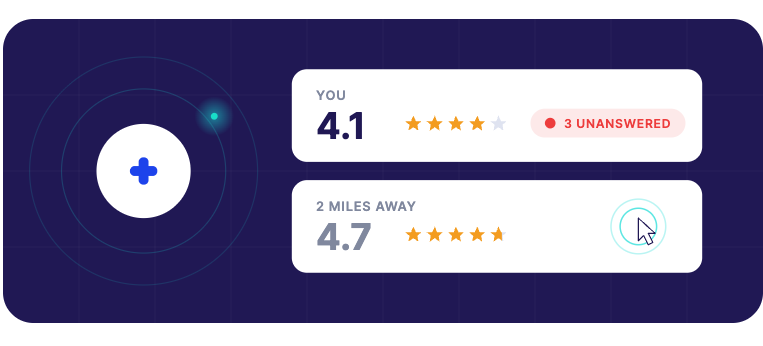
They’d put your 4.1 next to the practice two miles away sitting at 4.7, skimmed three one-star replies you’d never answered, and decided. You never saw it happen, and you never will.
That’s what reviews do in healthcare now. They settle the choice before a patient picks up the phone, days before anyone reads your bio. We’ve run healthcare SEO since 2016, and slipping reviews are the most common reason a practice that ranks fine still books poorly.
By the time someone calls your office, the comparison’s already over. They ran it on a phone, on a Google results page, with your profile in one tab and two competitors in the other two.
The numbers here aren’t subtle. Tebra’s 2025 Patient Perspectives Report, a survey of 3,964 patients, found 79 percent read reviews before they pick a provider, and 56 percent start on Google.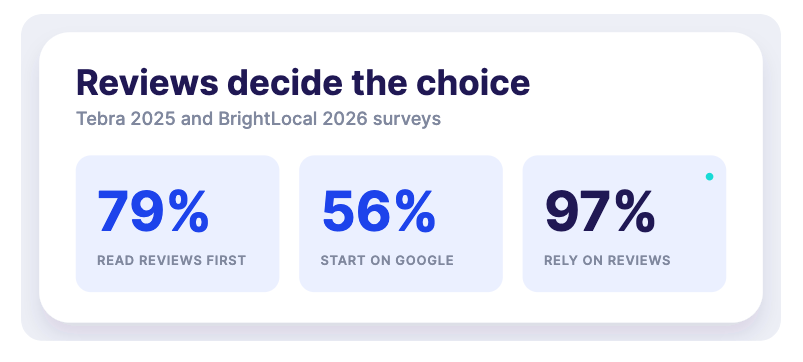
Zoom out to local businesses in general and BrightLocal’s 2026 review survey puts the share of consumers who lean on reviews at 97 percent (nearly everyone who picks a local business). Reviews used to be one signal among many. Now they’re the whole call.
So patients are already judging your reviews. The real question is what they saw when they did, and whether anyone at your practice was looking at the same screen they were.
What a slipping star rating costs you
Patients aren’t generous with a low number. Tebra’s 2025 report found 53 percent of patients won’t consider a provider rated under 4 stars. BrightLocal’s 2026 survey points the same way.
Nearly a third of consumers (31 percent) now use only businesses rated 4.5 stars or higher, almost double the year before. Drop under 4 stars and most of those patients filter you out before they read a word.
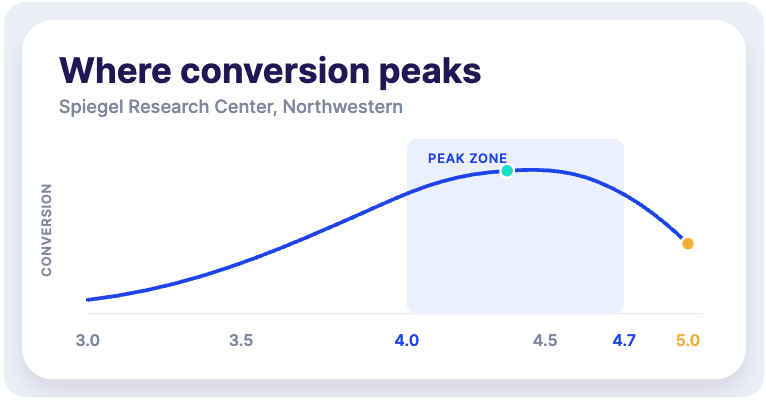
Chase a spotless 5.0 and you can convert worse than the practice sitting honestly at 4.6. The Spiegel Research Center’s 2017 study at Northwestern found buying likelihood climbs 270 percent once a product carries its first five reviews.
Then it gets stranger. Conversion peaks somewhere around 4.0 to 4.7 stars and starts to fall as the rating nears a perfect 5.0. Turns out people read flawless as fake.
 I’ve watched practices burn months trying to bury a handful of one-stars. The rating was never the problem. The real fix was answering them, in public, like a human.
The damage runs past reputation, because reviews also decide whether a patient sees you at all.
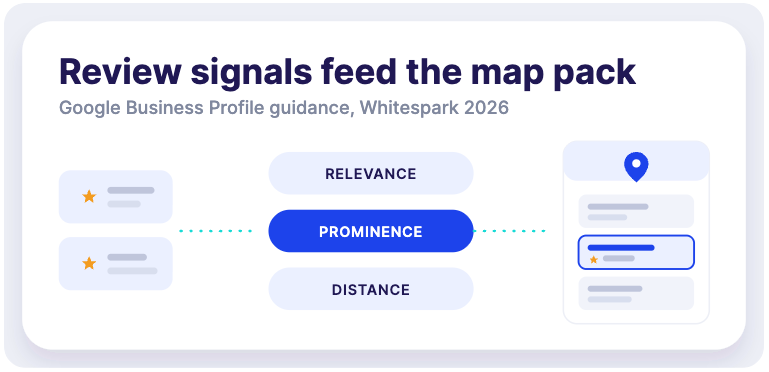
Google says so itself. Its Business Profile ranking guidance ties local results to three things, relevance, distance, and prominence. More reviews and stronger ratings push that prominence score up.
Whitespark’s 2026 ranking factors report backs it up. Its panel of dozens of local SEO specialists (surveyed every couple of years) ranks review signals and recency among the heaviest factors moving the map pack. Let your reviews go stale, and you drop out of the three results most patients see.
 Good practices fall into this constantly. You can write a strong service page, build a fast site, and still sit on page two because your reviews dried up eight months ago. We see it the moment a practice comes to us ranking for nothing local.
The pages are fine, so why page two? The review flow died, and the map pack moved on without you. Getting reviews moving again is part of how we approach healthcare SEO, because the ranking and the reputation are the same work.
Most practices treat review responses as a chore for a slow afternoon. The patients reading them don’t.
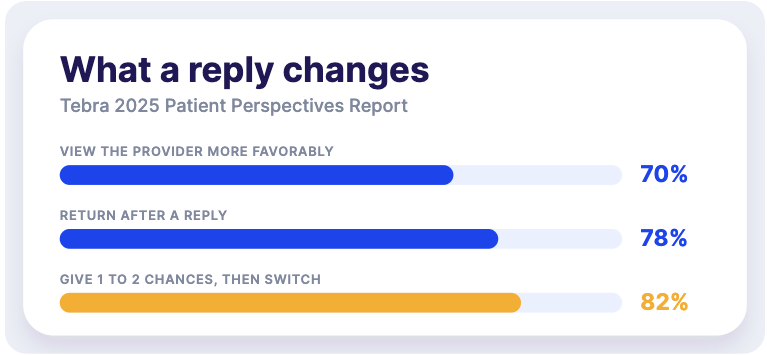
Tebra’s 2025 report found 70 percent of patients viewed a provider more favorably after seeing a reply to a negative review, and another 78 percent said they’d come back if the practice addressed their concern. The catch is, patients aren’t patient.
A full 82 percent give a provider one or two chances before they switch. So is one careful reply to a bad review worth it? For a wavering patient, it can do more than 10 five-stars sitting above it with no answer.
The judgment call gets risky fast. A medical practice can’t reply the way a restaurant does. Confirm an appointment or name a condition in a public reply, and you’ve just exposed protected health information.
A safe reply looks boring on purpose. It thanks the person, offers to take things private, and gives no hint they were a patient. Get it wrong, and a warm gesture turns into a public HIPAA complaint.
So review response is judgment work. It’s not something you hand to whoever’s got a free minute at the front desk.
Patients don’t check every review site. They check a few, and the few that count aren’t the ones a plumber or a restaurant worries about.
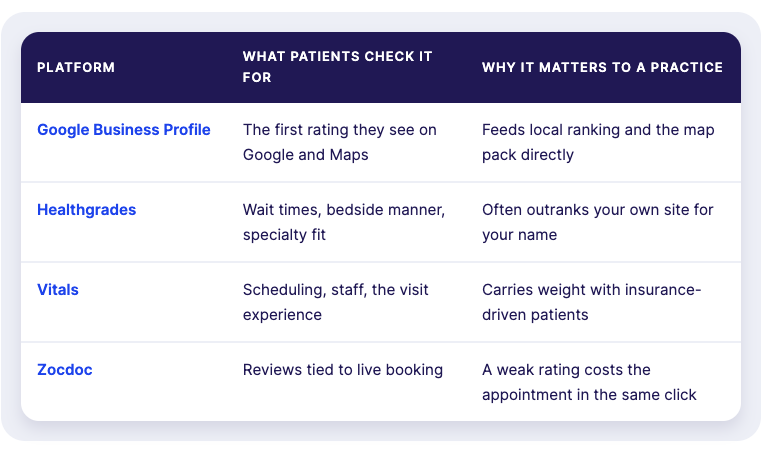 A practice can hold a 4.8 on Google and a forgotten 3.2 on Healthgrades (the site that often outranks your own for the doctor’s name). Which one do you think some patients see first The 3.2 star review.
They book elsewhere, and you never find out a second page beat you.