Healthcare provider directories and doctor review sites have lost a substantial amount of organic traffic over the years. According to our recent study on where patients are finding our clients, directory sites lost about 15% of the lead share in 2026 vs. 2025.
That being said, they are still absolutely an important factor to your practice growth on many fronts.
Doctor review sites help drive more first appointments than any other type of website. In rater8’s 2025 survey of 1,000-plus patients, 84% said they read reviews before choosing a new provider.
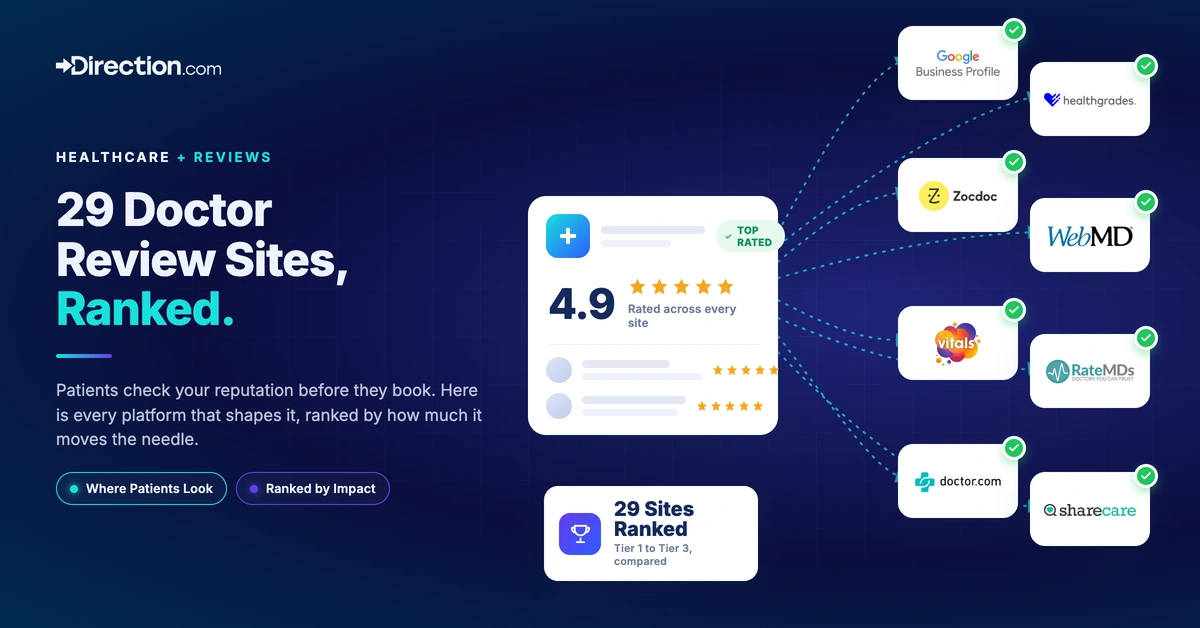
Below, we’ll go over the top 29 directories for doctors into three tiers. If there are any I’m missing that you find great success with in driving new patient inquiries, please reach out to me directly and let me know. I keep this list updated quarterly.
How Doctor Review Sites Influence Patient Decision-Making
A patient reading another patient’s review trusts it more than anything your website says about you. This is a must-leverage trust advantage which shows up four ways:
- Transparency. Peer reviews read as unfiltered. One stranger’s account of a Tuesday morning appointment counts for more than a page of marketing copy.
- Social proof at scale. A practice with 200 reviews averaging 4.8 beats the competitor with 20 reviews at 4.5, even when the doctors are equally good. And a referral doesn’t skip this step. Patients another physician sent still read your reviews before they call.
- Non-clinical detail. Wait times, front desk attitude, billing surprises, parking. Patients read the polished copy on your site, then find out what the visit feels like from someone who sat in your waiting room.
- Competitive separation. Three practices in the same zip code offer the same procedures. The one with the stronger review profile usually gets the call.
How Directory Review Ratings Impact Medical Practice Search Visibility
Ratings on medical review sites help your overall online search visibility in four primary ways.
1. Local Search Rankings & Google Maps
According to a 2026 Whitespark report, are about 20% of total ranking factors, up from 16% three years ago. Review recency also jumped from #93 to #11.
Google wants to see new reviews coming in every month, or you’ll see your rankings begin to slide.
Star ratings change click behavior too. Wordstream put out a good article outlining how having better online reviews has a direct correlation with higher CTRs, traffic, and sales
2. Healthcare Directories
Healthgrades, Zocdoc, and Vitals are search engines in their own right. Each ranks doctors internally, and complete profiles with recent reviews rank higher. Healthgrades says half of Americans who see a doctor each year use its site, and plenty of those patients never open Google at all.
3. Branded Search
Google your practice name and look at what comes up. On almost every new practice we audit, review profiles are part of the month one deliverables. And sometimes, depending on how much the need is, we’ll even optimize them before the practice’s own website.
It really all depends on what’s going to drive the highest patient acquisition the fastest. Patients sometimes see those profiles before the practice site, so a strong one closes new bookings and drive website visits; whereas drives them away.
4. AI Search
Patients now ask ChatGPT to recommend a doctor, and it answers with real names.
rater8 runs big patient surveys on how people pick providers, and their numbers are growing. Its June 2025 survey found 31% of patients used AI to research providers. That share reached 47% in its April 2026 survey.
The same survey asked patients who’d selected or searched for a provider in the past year. It asked what shaped their search. AI tools came in at 36%, ahead of Google search at 34% and a referral from another doctor at 32%. AI Overviews appeared for 89% of BrightEdge’s tracked healthcare keywords in December 2025, per BrightEdge’s healthcare search tracking.
Where do the models get their answers? Mostly from the same doctor review sites and healthcare directories ranked below.
Seer Interactive pulled 800,000 real AI answers and checked which brands kept getting named. The ones with strong review profiles got cited more, and that held on every platform in the test.
Every profile you complete teaches these tools who you are.
A Note On HIPAA Compliance With Doctor Review Sites
Healthcare providers have a special compliance rule no other industry deals with. You can’t confirm or deny that a reviewer was a patient, and you can’t reference clinical details in a public reply.
The rule applies to every website and directory where your replies are public, from Google to Yelp to Healthgrades. Even a well-meant correction (“we have no record of this patient”) can violate HIPAA by disclosing patient status. An expensive way to win an argument.
Play it safe by acknowledging the feedback, stating your commitment to patient care, and inviting the reviewer to continue the conversation offline. Keep clinical specifics out.
The 29 Most Important Doctor Review Sites
Doctor directories earn attention in proportion to the patients they send you. Some need weekly work. The three tiers below separate those from the ones you claim once and check quarterly.
Tier 1 Directories Every Practice Needs to Actively Manage
These five directories are by far the most reputable for driving new patients, as well as helping with overall search visibility. Every practice needs complete, actively managed profiles here.
| Platform | Reach | Online booking | Cost to claim | Strongest fit |
|---|---|---|---|---|
| Google Business Profile | Largest local search surface (Search + Maps) | Links out to your scheduler | Free | Every practice |
| Healthgrades | Half of Americans who see a doctor each year (company reported) | Yes, on eligible profiles | Free profile, paid upgrades | Specialists, branded search |
| Zocdoc | High-intent patients ready to book | Yes, core feature | Paid (per-booking or subscription) | Competitive metro markets |
| Vitals | One of the largest provider databases | No | Free | Research-heavy patients |
| Yelp | Strong in dental, urgent care, cosmetic; feeds Apple Maps | No | Free | Consumer-style specialties |
1. Google Business Profile
The highest-impact review signal for local search ranking, and the first thing patients see when they research your practice. Weekly monitoring and a steady flow of new reviews required.
2. Healthgrades
The leading dedicated healthcare review platform in the U.S. The company says half of all Americans who see a doctor in a given year use the site. Healthgrades profiles rank high in branded and specialty searches, and patients hunting for quality ratings land there first.
Our research on Healthgrades

Healthgrades traded sideways on traffic (up 3.6%) while its top-3 rankings jumped 26.9%, which is what the AI Overviews squeeze looks like: more rankings, fewer clicks per ranking. The patients who do click arrive closer to booking, so a complete profile with fresh reviews still pays here. Treat it as the non-negotiable it’s always been.
| Healthgrades.com | Jul–Dec 2025 (avg/mo) | Jan–Jun 2026 (avg/mo) | Change |
|---|---|---|---|
| Organic traffic | 3,638,582 | 3,769,028 | +3.6% |
| Top 3 keywords | 237,499 | 301,411 | +26.9% |
| Top 4–10 keywords | 672,440 | 715,525 | +6.4% |
| Top 10 total | 909,939 | 1,016,935 | +11.8% |
3. Zocdoc
Reviews plus direct appointment booking, so the traffic arrives ready to schedule. Zocdoc charges providers (per-booking fees or subscription, depending on market), and it earns that cost in metros where new patient scheduling is competitive.
Setup your listing on Zocdoc for Providers.
Our Read on Zocdoc's Momentum

Zocdoc’s organic traffic is up 29.8% period over period (913K to 1.19M monthly average) with top-10 keywords up 27.9% to match, so this directory is growing consistently. It’s the fastest riser of the four, and the traffic arrives ready to schedule. Update your profile here more often than the others, and if you’ve been on the fence about the booking fees in a competitive metro, this data leans yes.
| Zocdoc.com | Jul–Dec 2025 (avg/mo) | Jan–Jun 2026 (avg/mo) | Change |
|---|---|---|---|
| Organic traffic | 913,471 | 1,185,352 | +29.8% |
| Top 3 keywords | 46,863 | 65,411 | +39.6% |
| Top 4–10 keywords | 96,653 | 118,139 | +22.2% |
| Top 10 total | 143,516 | 183,550 | +27.9% |
4. Vitals
One of the largest provider review databases, with listings for specialty-plus-location, as well as branded searches. Keep the profile accurate.
Claim your physician profile on Vitals.
My take on the SEO value of Vitals.com

Vitals lost more than half its organic traffic in a year (143K down to 64K monthly average), and keeps going down. Keep your profile claimed and accurate since patients still go there, but I wouldn’t put as much budget there as before, shift it over to Zocdoc. But continue to check it quarterly and watch whether the decay continues.
| Vitals.com | Jul–Dec 2025 (avg/mo) | Jan–Jun 2026 (avg/mo) | Change |
|---|---|---|---|
| Organic traffic | 142,710 | 64,365 | −54.9% |
| Top 3 keywords | 1,754 | 2,741 | +56.3% |
| Top 4–10 keywords | 68,842 | 46,794 | −32.0% |
| Top 10 total | 70,596 | 49,535 | −29.8% |
5. Yelp
Unfortunately, despite being proven in court to be the biggest bully to small business owners, it somehow still is one of the strongest directories for dental, urgent care, and cosmetic practices, and its profiles feed Apple Maps results. Yelp’s filter is famously suspicious of asked-for reviews, so claim and complete your Yelp listing and let reviews pile up on their own.
The verdict on your Yelp profile

Yelp’s traffic dipped 4.2% on a base of roughly 105 million monthly visits, while its top-10 rankings grew 4.9%, and May and June were its two biggest months of the year. A wobble at that scale doesn’t change much for practices. Keep the listing complete, and respond to every review. Especially in dental, urgent care, and cosmetic.
| Yelp.com | Jul–Dec 2025 (avg/mo) | Jan–Jun 2026 (avg/mo) | Change |
|---|---|---|---|
| Organic traffic | 109,116,836 | 104,503,538 | −4.2% |
| Top 3 keywords | 4,670,142 | 4,944,844 | +5.9% |
| Top 4–10 keywords | 7,980,588 | 8,321,309 | +4.3% |
| Top 10 total | 12,650,729 | 13,266,153 | +11.8% |
Tier 2 Directories (Check These Quarterly)
| Platform | Reach | Online booking | Cost to claim | Strongest fit |
|---|---|---|---|---|
| WebMD Physician Directory | Roughly 30M monthly site visits (Similarweb) | No | Free basic listing | Name and specialty searches |
| RateMDs | 500K+ providers, 2.7M+ reviews (company reported) | No | Free profile, paid promoted listings | Comparison-shopping patients |
| Recommendations surface in social search and local groups | Book Now button links out | Free | Community-based practices | |
| US News Health Doctor Finder | 750K+ physician profiles, powered by Doximity | No | Free, claimed through Doximity | Deep-research specialist patients |
| Doctor.com | Partner network reaches 100M users a year (company reported) | Through partner sites | Paid subscription | One profile syndicated to 50+ partners |
| Sharecare | 500K+ providers, search powered by Healthgrades | No | Free | Consumer wellness audiences |
| Apple Business Connect | Apple Maps ships as the default on 58% of U.S. phones (StatCounter) | Action links to your scheduler | Free | Every practice with iPhone patients |
| Bing Places for Business | About 14 to 17% of U.S. desktop searches, feeds Yelp and Apple Maps | No | Free | Set-and-check NAP consistency |
6. WebMD Physician Directory
WebMD’s brand trust carries over to its provider profiles, which appear in name and specialty searches. A well-maintained profile signals clinical credibility.
7. RateMDs
This directory has 500,000+ providers and 2.7M+ reviews. That said, nearly 90% of its traffic comes from Canada (Ahrefs, June 2026), so U.S. practices should claim it once and spend the review effort elsewhere.
8. Facebook
Recommendations on your business page show up in social search and matter most for community-based practices.
9. US News Health Doctor Finder
The US News brand pulls in patients who research thoroughly before choosing a specialist.
10. Doctor.com
A provider directory that syndicates profile data to partner directories, so one accurate profile travels further.
11. ShareCare
A consumer health platform with a find-a-doctor directory powered by Healthgrades data. Its search reach has thinned over the past year. I’d claim it, confirm the details, and move on.
12. Apple Business Connect
Direct control of your Apple Maps listing. iPhones hold the majority of U.S. mobile share, and Apple Maps is their default, so an unmanaged listing costs real bookings.
13. Bing Places for Business
Bing powers search for a slice of Windows and Edge users and syndicates data to Yelp and Apple Maps. Claim it, keep the NAP data accurate, and move on.
Tier 3 Specialty and Supplemental Platforms
Claim these, keep them accurate, and check them two to three times per year. Some matter a great deal in one specialty and barely at all in the next.
| Platform | Reach | Online booking | Cost to claim | Strongest fit |
|---|---|---|---|---|
| RealSelf | 10M monthly visitors, 2M+ reviews (company reported) | Consultation requests | Free profile, paid upgrades | Plastic surgery, derm, aesthetics |
| Psychology Today Therapist Finder | 160K+ therapists listed, dominates therapy searches | No | Paid monthly listing | Mental health practices |
| Solv | Same-day care booking across major metros | Yes, core feature | Paid for providers | Urgent care, same-day slots |
| Opencare | Dental patients comparing and booking online | Yes, booking requests | Fees per booking request | Dental practices |
| 1-800-Dentist | Phone and online referrals from patients ready to book | Phone referrals | Paid membership | Dental practices building call volume |
| MD.com | Provider profiles with reviews and credentials | No | Free basic profile | Supplemental visibility |
| Doximity | 80%+ of U.S. physicians are members (company reported) | No | Free for clinicians | Specialist and referral visibility |
| AMA DoctorFinder | Verified profiles of licensed U.S. physicians | No | Free, AMA-maintained | Credential-checking patients |
| Medicare.gov Care Compare | Official directory for 65M+ Medicare enrollees | No | Free via PECOS enrollment | Practices accepting Medicare |
| eHealthScores | Credentials shown next to reviews | No | Auto-listed from public data | Credential-driven selection |
| FindATopDoc | Detailed profiles for deep specialty research | No | Free basic profile | Research-heavy patients |
| ProPublica Surgeon Scorecard | Ranks high in surgeon searches, built from Medicare records | No | Not claimable (journalism database) | Surgeons, monitor what yours says |
| Wellness.com | Holistic and integrative health audience | No | Free basic listing | Complementary medicine |
| Angi | General consumer review audience | No | Free listing, paid ads | Markets where Angi runs deep |
| NPI Registry | Federal registry covering every HIPAA-covered provider | No | Free (NPPES) | Licensure verification |
| Chamber + local directories | ChamberOfCommerce.com, Local.com, SuperPages citation network | No | Chamber dues, some free | Local SEO citations |
14. RealSelf
The standard for cosmetic procedure reviews and before/after photos. For plastic surgeons, dermatologists, and aesthetic practices, RealSelf works as a primary source of new patients.
See our SEO services for dermatologists to learn how we help your practice with search.
15. Psychology Today Therapist Finder
Patients looking for therapists, psychologists, and counselors start here, often before Google. Non-negotiable for mental health practices.
16. Solv
Booking and ratings for urgent care and same-day appointments. Relevant for urgent care clinics and any practice holding same-day slots.
17. Opencare
Dental and alternative medicine focus, pairing local provider matching with a booking interface.
18. MD.com
Provider profiles covering specialties, certifications, and patient reviews.
19. Doximity
A physician professional network that doubles as a patient-facing directory. Strong for specialist visibility, particularly with patients referred by physicians who use the platform themselves.
20. AMA DoctorFinder
Verified profiles of licensed physicians, maintained by the American Medical Association. A high-trust signal for patients who verify credentials before booking.
21. Medicare.gov Care Compare
The official government directory for Medicare-enrolled providers (it replaced Physician Compare when CMS merged its eight compare tools). Medicare patients use it to check that you take their coverage, so practices that accept Medicare need an accurate entry.
22. eHealthScores
Puts provider credentials next to reviews. Useful where credentials drive patient selection.
23. FindATopDoc
Detailed profiles for patients doing deep specialty research.
24. ProPublica Surgeon Scorecard
Surgeon performance data built from Medicare procedure records. The scorecard ranks high in searches for surgical providers, so surgeons should know what theirs says.
25. Wellness.com
Holistic and integrative health focus, relevant for practices offering complementary services alongside traditional medicine.
26. Angi (formerly Angie's List)
A general consumer review platform that includes healthcare providers. A low priority. Claim it if it’s popular in your specific market.
27. NPI Registry
The federal registry for provider credentials. Patients and referring physicians use it to verify licensure, so keep your NPI record current even though it hosts no reviews.
28. Chamber of Commerce and local directories
Chamber membership, ChamberOfCommerce.com, Local.com, and SuperPages add citation value for local SEO. Direct patient impact runs modest, and the NAP consistency value makes them worth keeping synchronized.
29. 1-800 Dentist
A dental referral service that matches patients to member dentists by phone and online. Practices pay for membership, and the calls arrive already asking for an appointment.
How To Leverage Each Doctor Review Site For Success
The medical practices that consistently outperform competitors in patient acquisition have review profiles that reflect their clinical quality accurately. Getting there requires building review generation into operations, responding consistently using HIPAA-compliant frameworks, and managing platform presence proactively rather than reactively.
Review management is one component of a complete healthcare local search strategy. The practices with the strongest patient pipelines combine strong review profiles with optimized Google Business Profiles, consistent citation management, and healthcare-specific SEO that drives organic visibility alongside their reputation presence.
Build Your Doctor Review Site Strategy
Every doctor who joins Direction gets the full directory treatment as part of onboarding. Our team claims and completes your profiles across all 29 platforms, fixes whatever’s wrong today, and checks each one on a consistent schedule so nothing drifts. You focus on patients, and the directory work happens without you touching it.
Reach out if you’d like us to give you a completely free report on how well your profiles are optimized, and to see everywhere you’re listed (or not listed but should be.)