Healthcare trends only matter to a practice owner when they change something concrete: patient volume, trust, access, cost pressure, or how care gets delivered.
Most 2026 healthcare trends lists are not written for that reader. They are written for hospital boards, payer teams, benefit leaders, investors, and software vendors. Useful, maybe. Less helpful when you run a medical practice and need to know whether next quarter's phone calls, reviews, consults, and booked visits are at risk.
I would not keep the old 2025 page as-is. Old copy aimed at healthcare marketing trends, carried numbers that need new sources, and missed the broader 2026 search intent Cyrus found in Ahrefs. Google moved the query, and Direction needs to move with it.
Here is the cleaner test.
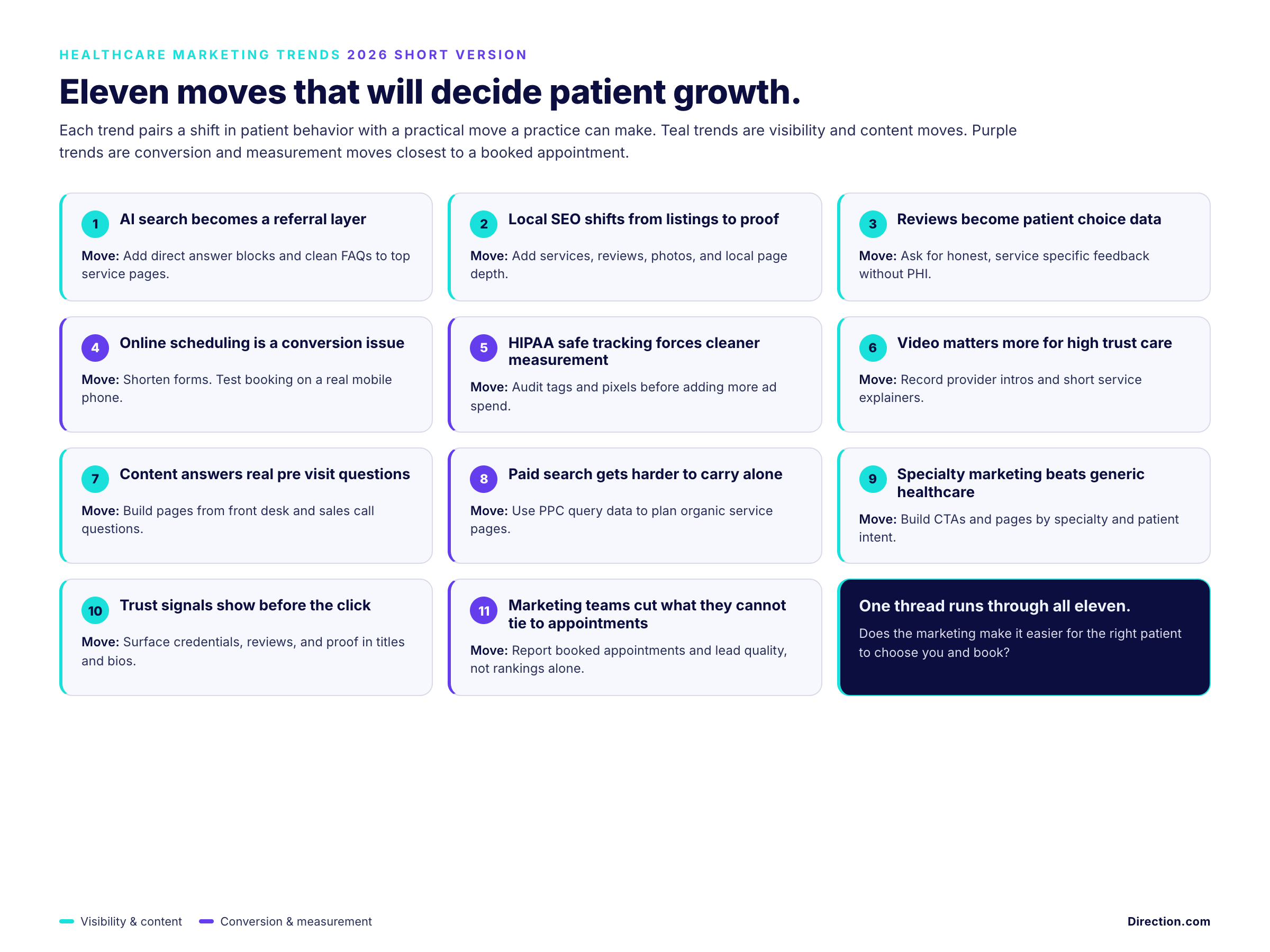
If a trend changes how patients choose care, how they judge a provider, how fast they can book, what they can afford, or how care gets delivered, it belongs here. If it only gives vendors another slide for a webinar, cut it.
The real healthcare trend test for 2026
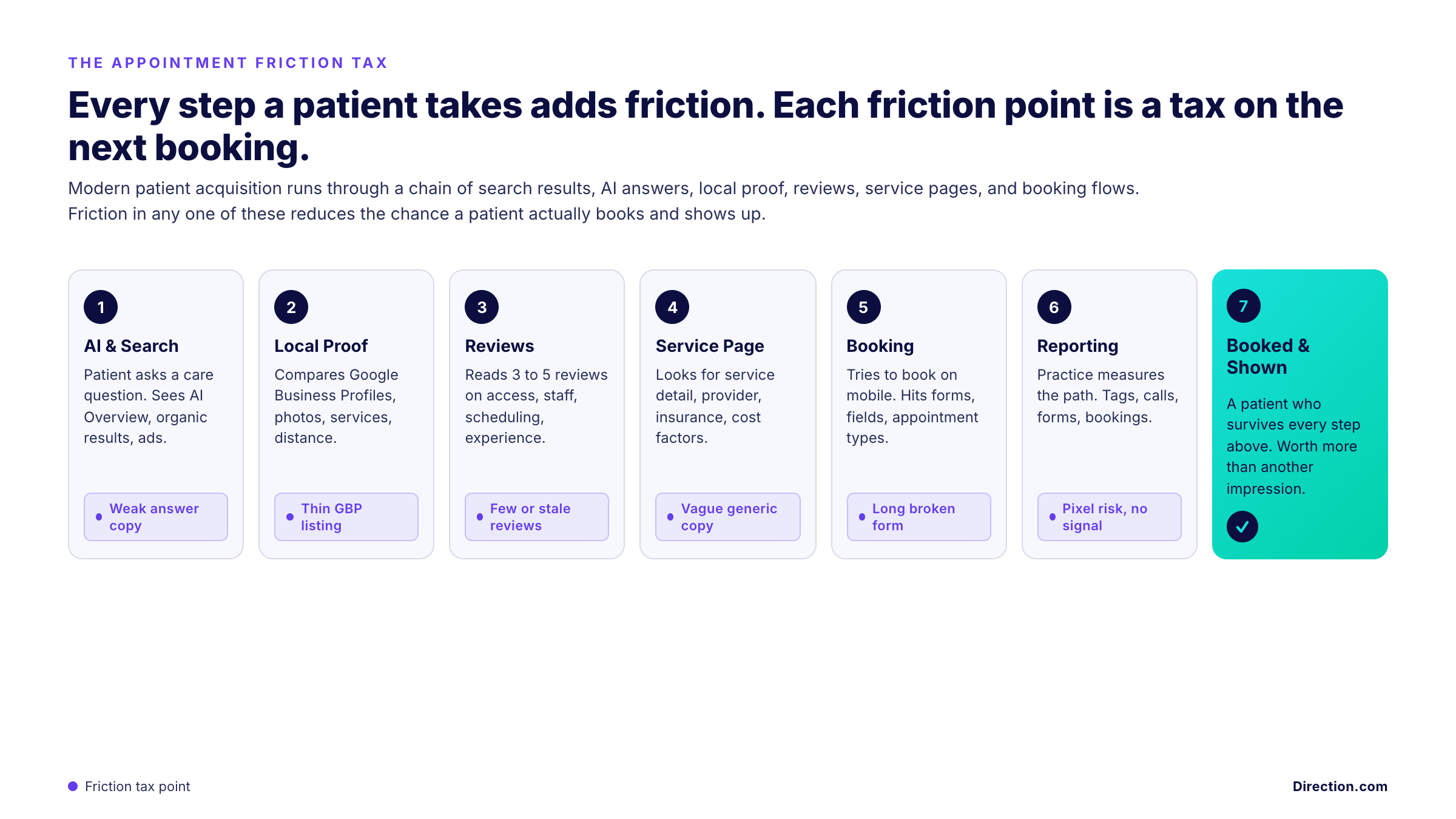
Healthcare trends for 2026 should be filtered through practice impact instead of industry noise. A private practice does not need a museum tour of every macro shift in U.S. health care. Practice owners need to know which forces can change booked visits, capacity, and patient confidence.
Our working filter is simple enough to use in a staff meeting, which is good because nobody needs another 40-slide trend deck. Ask whether the trend changes one of five practice-level outcomes. Patient volume covers whether more people are searching, comparing, or asking for a service. Trust comes into the picture when patients need outside proof before they book. Scheduling, phones, wait time, and online booking all test access. With cost pressure, the question is how patients compare value across providers. Care delivery is on the list when service lines, clinical workflows, or patient education need to shift.
One caveat before we get into the list: AI and GLP-1 adoption will hit each specialty differently. A med spa, cardiology group, pediatric clinic, and orthopedic practice will feel different versions of the same pressure. Geography and payer mix can change the math again.
That is why this piece ranks trends by what a practice can act on, with less punditry and a working checklist at the end.
Trend 1. Cost pressure changes what patients compare
Patients are comparing care with a harder cost filter in 2026. According to the American Medical Association, U.S. health spending reached $4.9 trillion in 2023, or $14,570 per person.
By the AMA's count, spending also grew 7.5% and reached 17.6% of GDP that year, which is a lot of pressure before a patient ever reaches a practice website.
Those are national numbers, which can feel abstract from the front desk. A patient does not call and say, “I am reacting to GDP share.” They ask whether insurance is accepted, whether financing exists, whether the consult fee applies to treatment, and whether a cheaper option will work.
Cost pressure turns comparison shopping into normal patient behavior. Practices that hide fees, skip financing language, or make coverage details hard to find will lose some patients before the first call.
Cost is where the problem gets practical for the website. Many medical websites still treat it as a sales conversation that happens late, after the patient has already narrowed the list. Patients are often doing that math before they choose which practice gets a form fill.
Act on this by adding cost-adjacent content where it reduces fear without creating legal or compliance risk. Explain what affects price, clarify insurance basics when you can, and show which questions the patient should ask during a consult. If exact fees vary, say why they vary.
A useful page can be honest without becoming a price sheet.
Trend 2. AI adoption moves faster than trust
AI in health care is moving into daily work faster than patient trust can catch up. AMA survey data says 66% of physicians reported using health AI in 2024, up 78% from 2023.
Health systems are racing in the same direction. HFMA reported that 88% of health systems were using AI internally, while only 18% had a mature governance structure.
Private practices should read that split carefully. AI can save staff time in intake, notes, scheduling, call review, and content planning, so I would test those uses quickly. Carefully, though. Medical AI slop on a public website is a real trust risk, especially when nobody has reviewed it for accuracy.
Practices that win on AI in 2026 will use it behind the scenes to reduce admin drag and speed up patient help. The practices that lose will publish thin medical pages, vague symptom content, and chatbot answers nobody reviewed.
Patient-facing AI needs guardrails, especially around clinical claims. Name who reviews medical content, cite sources, and make a human own the final copy.
A small self-correction belongs here. AI itself is not the trend that matters most. Adoption without governance is the trend. A practice that saves ten hours a week through staff workflows and keeps human review tight will outperform a practice filling its blog with generic medical advice.
Trend 3. AI search becomes a second front for patient acquisition
AI search is now part of patient acquisition because Google is already answering healthcare trends queries in the SERP. Cyrus found an AI Overview present for this cluster. That changes the copy job.
Old SEO pages could win with a long article, basic headings, and enough authority. A few still can, usually when the domain already has authority. For healthcare marketing trends in 2026, the page also has to answer questions in a format an AI system can quote without guessing.
Medical practices need content that says the answer early, cites named sources, and makes entities clear. A page about migraine treatment should identify the provider, specialty, conditions treated, location, credentials, and when a patient should get care. Same idea for service pages, FAQs, and comparison pages.
Direction has a deeper page on AI search optimization for healthcare and another on healthcare content for LLM visibility. Short version: answer blocks, citations, schema, internal links, and entity clarity now work together.
Practices also need a stronger bridge from content to conversion. If a patient finds a practice through AI search, they may arrive with less context than a Google visitor who clicked through several pages. That means the landing page has to explain who the practice serves, what to do next, and why the provider is credible without forcing a scavenger hunt.
For clinics that need the full commercial layer, Direction's healthcare SEO services connect this work to search, content, and lead flow.
Trend 4. Reviews become proof assets
Reviews have moved beyond a nice reputation layer. They are proof assets for patients, local search, and AI summaries.
A patient comparing two providers often reads reviews before credentials. Maybe that should not be true. In practice, it is often how the decision starts. Patients want to know whether staff answer the phone, whether wait times are tolerable, whether the doctor listens, and whether billing creates problems.
Google's local ranking guidance has long discussed relevance, distance, and prominence. Reviews sit inside that prominence picture. For medical practices, review content also gives patients language they trust more than polished website copy.
Recency matters here, but not by itself. A steady review profile with specific comments about care, communication, and outcomes will usually beat a stale profile with generic praise. Reply quality matters too, especially when a public response could drift into private health details. Healthcare replies must be useful without revealing protected health details.
Practices should build review intake into the patient journey, then audit what those reviews actually say. If every negative review mentions phone delays, marketing cannot fix that alone. Marketing can only send more patients into the same bad handoff.
Direction's guide to doctor review sites is the natural next read for this section. Use it to decide where reviews matter beyond Google Business Profile.
Trend 5. Access beats awareness
Awareness fails when access breaks. A patient can find the practice, like the provider, and still leave because scheduling feels hard.
That is the quiet risk inside many healthcare marketing trends. More traffic does not help if calls go unanswered, forms sit untouched, online booking is missing, or the page never says when appointments are available.
BLS projects about 1.9 million openings each year in healthcare occupations from 2024 to 2034, based on replacement needs and growth. Staffing pressure is not theoretical for practice owners. They see it in phone coverage, rooming speed, provider availability, and follow-up.
Access content should answer the questions patients ask before they call.
- How soon can I get in?
- Can I book online?
- Which locations offer this service?
- Do I need a referral?
- What happens after I submit the form?
A lead is only useful when the practice can handle it. Direction's guide to healthcare lead generation is relevant because it connects marketing source data to actual patient inquiries.
One warning belongs in the plan: avoid marketing a service line harder than the practice can serve it. That creates frustrated patients, worse reviews, and staff burnout. Pretty expensive way to win a keyword.
Trend 6. Staffing pressure changes the marketing promise
Staffing pressure turns marketing claims into operational promises. If the page says same-week appointments, the schedule needs to support that claim. If the ad says compassionate follow-up, someone has to follow up.
Healthcare industry trends often talk about workforce strain as a broad labor issue. For a private practice, workforce strain changes what should be promoted.
A practice with limited provider capacity may need to narrow its marketing around high-fit patients and high-priority service lines. A practice with strong admin coverage can lean harder into fast scheduling, consult volume, and patient education. The market may look identical from the outside; the promise the practice can keep is what changes.
Marketing should match capacity in three places.
- Service pages should reflect what the practice can provide now.
- CTAs should set a clear next step with realistic timing.
- Reporting needs to show which channels create booked visits rather than inquiries alone.
I would rather see a practice grow slower with clean intake than buy traffic it cannot absorb. That take will never win a conference panel, but it usually protects reviews and staff morale.
Staffing changes content planning too, especially when providers have limited time. If providers do not have time for new video, capture short answers during normal clinical downtime. If front desk staff cannot manage long lead forms, reduce the form fields and route calls better. Marketing does not get to pretend operations are someone else's problem.
Trend 7. Video turns expertise into trust before the consult
Video gives patients a faster read on the provider before they book. In high-anxiety specialties, that matters.
Patients want to know how the physician explains things. They want to see whether the practice feels calm or rushed. They want basic questions answered without digging through a 2,000-word page on their phone at 11 p.m.
Healthcare video marketing works best when it removes fear. Short clips can explain what happens at the first visit, who is a good fit for a treatment, what recovery looks like, and which red flags require medical care. Unsupported conversion stats would weaken the section. Patient behavior makes the case better than any stat: people trust what they can understand.
A good video plan does not require a studio day for every topic. Start with the questions the front desk hears every week. Record clean, short answers. Add the transcript to the page. Link the video from the matching service page instead of a random media library nobody visits.
Direction has a full guide on healthcare video marketing for practices that need formats and placement ideas.
One caution belongs here: medical video still needs review. A confident provider saying an imprecise thing on camera can create more risk than a dull paragraph ever will.
Trend 8. Privacy rules make cleaner measurement a competitive edge
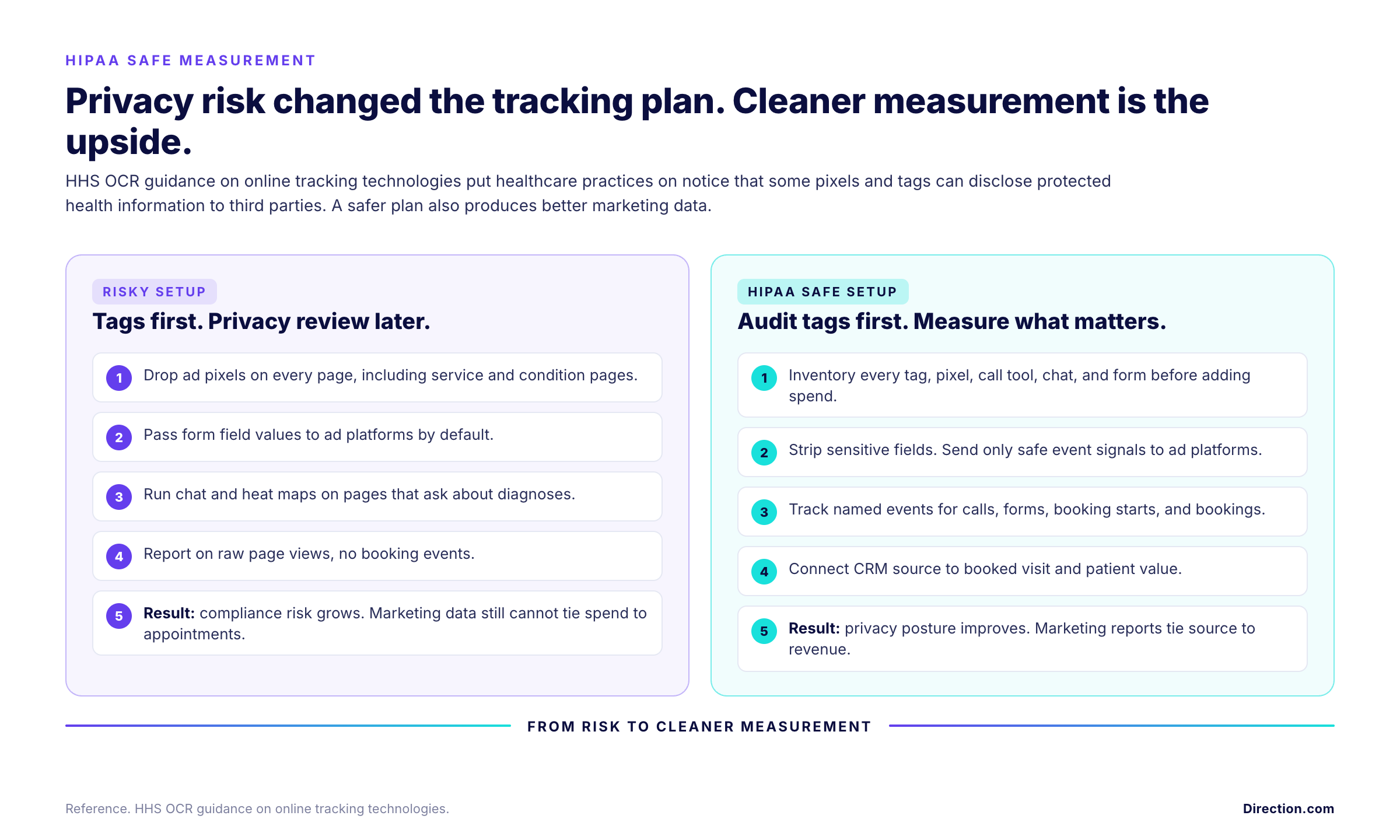
Healthcare tracking is under more scrutiny, and standard marketing pixels can create risk when protected health information is involved. HHS Office for Civil Rights guidance on online tracking technologies sets out which uses of pixels, analytics tags, and similar tools may implicate HIPAA when a regulated entity is involved.
The practice-level issue is clear. Healthcare marketers need cleaner measurement, with fewer lazy assumptions about what can be tracked.
Many practices want the same reporting they see in retail or home services: every click, every visitor path, every retargeting pool. Healthcare does not work that freely. Sensitive service pages, patient portals, appointment tools, and condition content can change the risk profile.
A better measurement plan starts with consent-aware analytics, call tracking configured for healthcare, source-level reporting, and clear form routing. Review the basics in Direction's HIPAA marketing guidelines before adding another script to the site.
Here is the damaging admission for agencies too. Perfect attribution is not always the right goal in healthcare. Defensible reporting will usually serve a practice better than aggressive tracking that puts it at legal risk.
Practices that get this right can still make good marketing decisions. Track channels, calls, booked visits, and close rates by service line. Keep the reporting useful enough to guide budget, without pretending every patient action should be followed around the web.
Trend 9. GLP-1 demand reshapes patient behavior across specialties
GLP-1 use is changing what patients ask about, which providers they compare, and which content they search before booking. KFF reported that 1 in 8 adults said they were currently taking a GLP-1 drug for weight loss, diabetes, or another condition. KFF also found that about half of GLP-1 users said it was difficult to afford these drugs.
GLP-1 patient behavior reaches beyond weight loss clinics. Primary care, endocrinology, cardiology, bariatric groups, med spas, nutrition programs, and even some surgical specialties are seeing new patient questions.
Patients want to know who qualifies, how side effects work, what happens when they stop, whether insurance helps, and how medication fits with procedures or long-term care. Those are content opportunities, but they need medical review. GLP-1 content is a bad place to wing it.
Specialty differences matter because patient intent changes by context. A cardiology group should not write the same GLP-1 content as a med spa. Primary care may need a broader education hub, while bariatric practices may need comparison content around medication, surgery, and long-term support.
Cost pressure shows up here too. A patient interested in GLP-1s may be clinically eligible and still unable to afford the drug. Content should address that friction honestly, then explain what the practice can and cannot help with.
What medical practices should do in the next 30 days
Start with a trend audit before a content calendar. Healthcare trends 2026 content only pays off when it changes what the practice does next. Use this 30-day checklist as the starting point.
- Pick the three trends most likely to affect your specialty, since cost pressure, AI search, access, reviews, privacy, and GLP-1s will weigh differently by practice.
- Audit your top five service pages for fit, location, next step, and provider proof. A patient should know who the service is for and why the practice is credible.
- Check proof assets across reviews, provider bios, video, citations, and clinical review notes. Thin proof weakens every other marketing claim.
- Test access friction by calling the practice, submitting the form, and trying to book online. A clumsy handoff feels worse to a patient who is already worried.
- Clean up measurement by removing scripts the practice cannot defend. Track calls, forms, booked visits, and source quality with a healthcare-aware setup.
- Build one answer-ready content asset around a high-intent patient question. Give the direct answer, cite sources, add expert review, and link it to the right service page.
- Compare capacity against marketing before adding new campaigns. Push service lines the practice can serve and pull back where bottlenecks will hurt reviews.
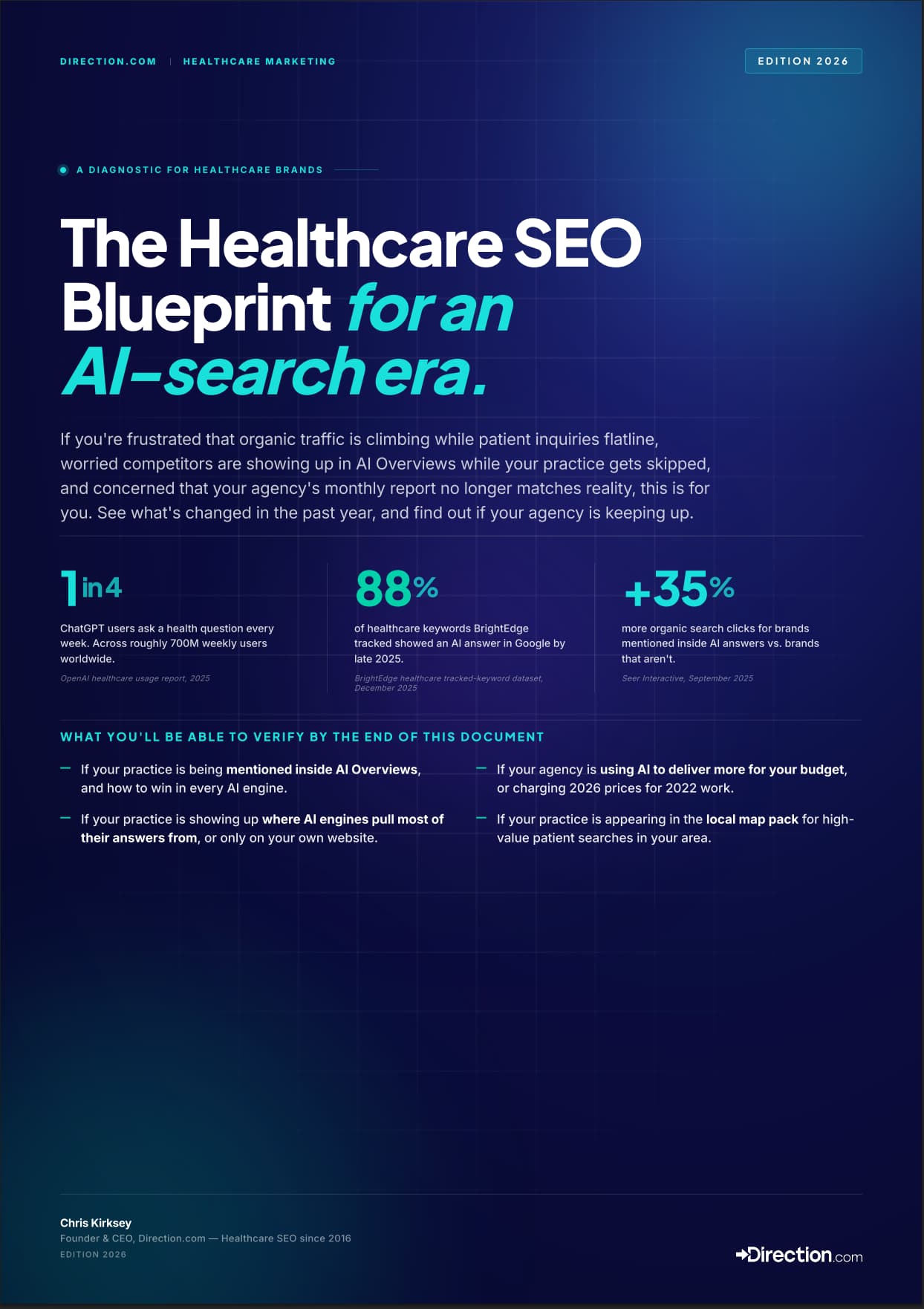
For SEO-specific planning, read Direction's guide to healthcare SEO trends. If your practice needs the working plan, download the 2026 Healthcare SEO Blueprint.
Need to know which trend is already costing you patient volume? Ask for a free SEO review. We will look at your search visibility, content, reviews, and conversion paths, then show you where the leak is most likely happening.
FAQ
What are the biggest healthcare trends for 2026?
Cost pressure, AI adoption, AI search, reviews, access, staffing pressure, video, privacy-safe measurement, and GLP-1 demand are the biggest healthcare trends for practices. Each one can change how patients compare providers or book care.
Which healthcare trends matter most for private practices?
Private practices should prioritize trends that affect patient volume, trust, scheduling, or affordability. A broad payer trend matters less unless it changes how patients choose or how the practice serves them.
How is AI changing healthcare marketing?
AI is changing healthcare marketing in two ways. Search results now include AI answers, and practices can use AI for internal marketing work. Public medical content still needs human review, named sources, and clear clinical guardrails.
How should medical practices respond to rising healthcare costs?
Begin with the questions patients ask before they book. Explain what affects price, how insurance may factor in, what financing options exist, and what patients should ask before care. Avoid fixed claims unless the practice can support them.
Why do reviews matter more in healthcare search now?
Reviews shape patient trust before the consult and can support local search visibility. Fresh, specific reviews also give patients language they believe because it comes from other patients rather than the practice's own marketing copy.