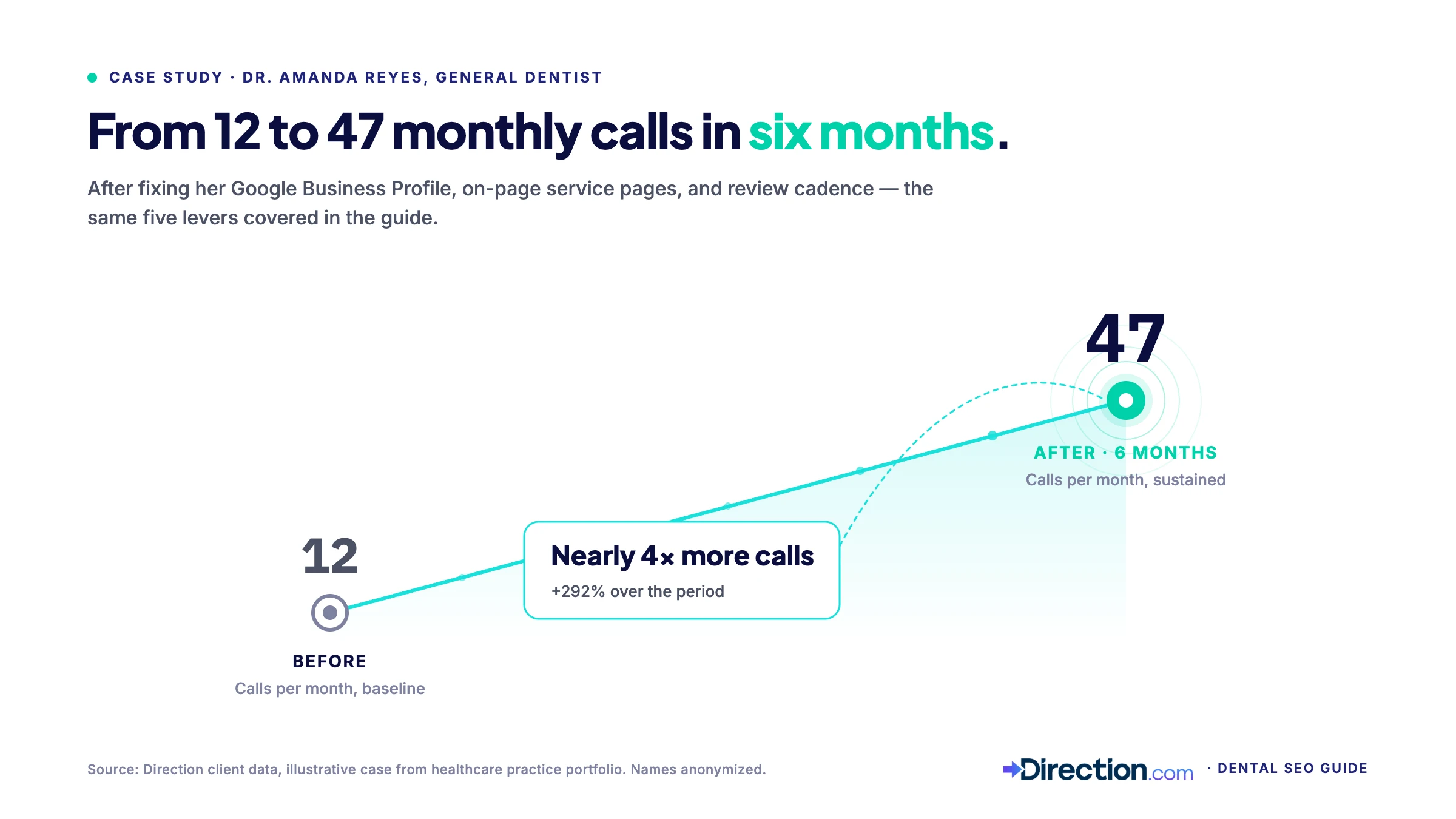
Dr. Amanda Reyes ran a general dentistry practice in Phoenix for seven years. Her schedule sat at 60% capacity. She was paying $800 a month to Zocdoc for leads she didn’t own.
February 2024, she killed the Zocdoc subscription and put that money into dentist SEO. By August, her practice ranked in the local 3-pack for “dentist Phoenix” and “dentist near me” across three zip codes. New patient calls went from 12 a month to 47.
That’s what happens when a practice stops renting visibility and starts owning it.
You already know SEO matters. What most dentists miss is which levers actually move rankings, in what order, and why half the stuff agencies push doesn’t apply to local search at all. That’s what this covers.
Direction has helped 100+ healthcare practices grow through organic search. Here’s what we found.
What Is Dentist SEO?
Your competitors show up on Google when patients search for a dentist. You don’t. Dentist SEO fixes that.
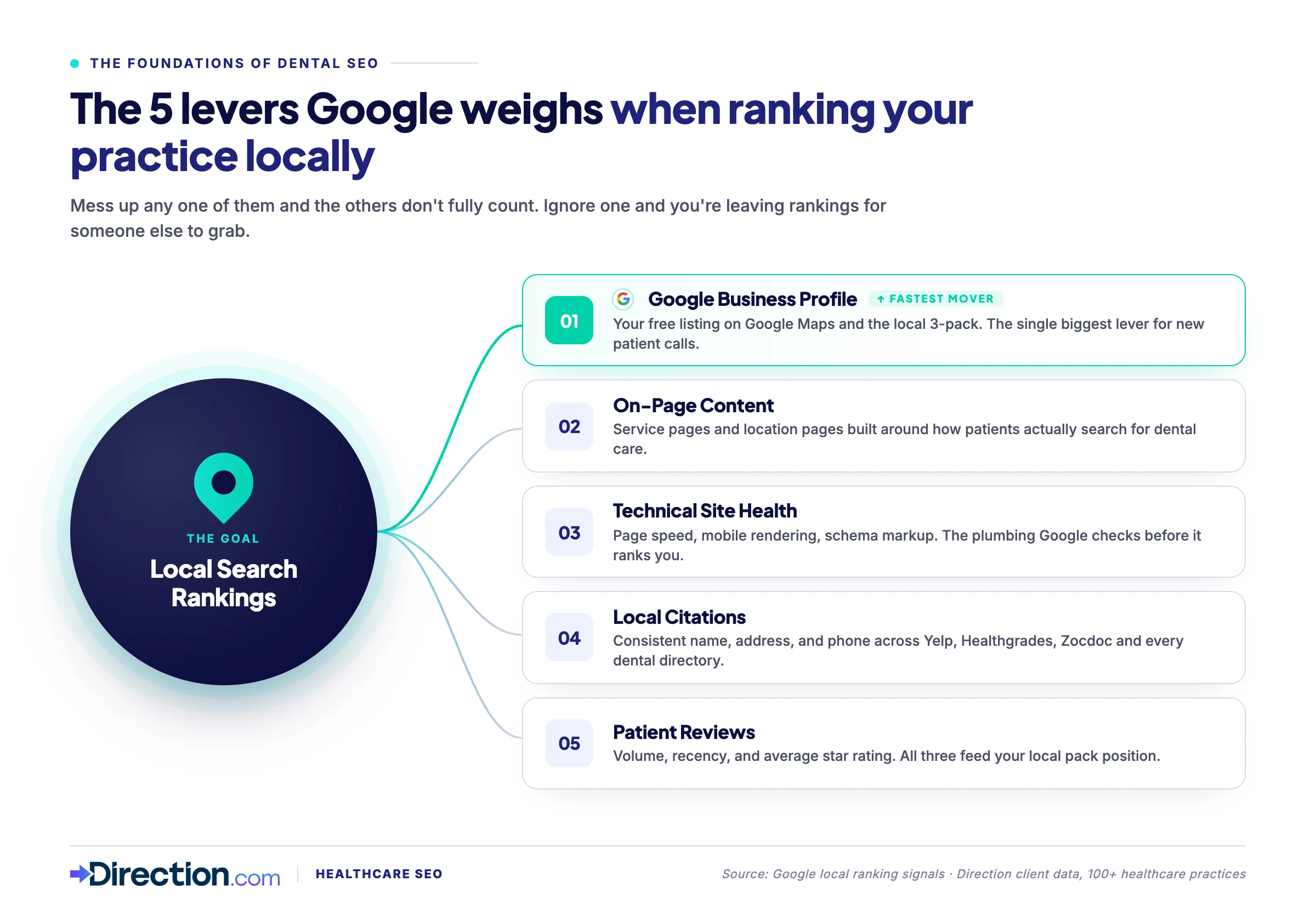
Your Google Business Profile, on-page content, technical site health, local citations, and reviews. Google looks at all five. Mess up any one of them and the others don’t fully count. Ignore one and you’re leaving rankings for someone else to grab.
What separates dental SEO from general SEO is local intent. Nobody searches for the best dentist in America. They search for the best dentist within 10 miles. That makes the Google local pack (the map results showing three practices) the most valuable piece of real estate in dental search.
Why Your Dental Website Is Probably Losing Patients Right Now
77% of patients use a search engine before booking with a healthcare provider for the first time. BrightLocal data. For dental specifically, that number skews higher because dental care is mostly non-urgent and completely location-dependent.
Most patients find a new dentist through Google, a directory like Zocdoc or Healthgrades, or a personal referral. Two of those three you can actually control.
If your practice doesn’t rank on page one for “dentist [your city]” or “teeth cleaning near me,” you’re invisible to roughly 90% of the people searching right now. They’re booking with whoever shows up first. The practices above you aren’t better dentists. They just have better dentist SEO.
That’s fixable.
The Google Business Profile: Your Most Important Local SEO Asset
If you have time for exactly one thing, do your Google Business Profile. Nothing produces faster results for local search visibility in dental SEO.
Getting the Dental GBP Basics Right
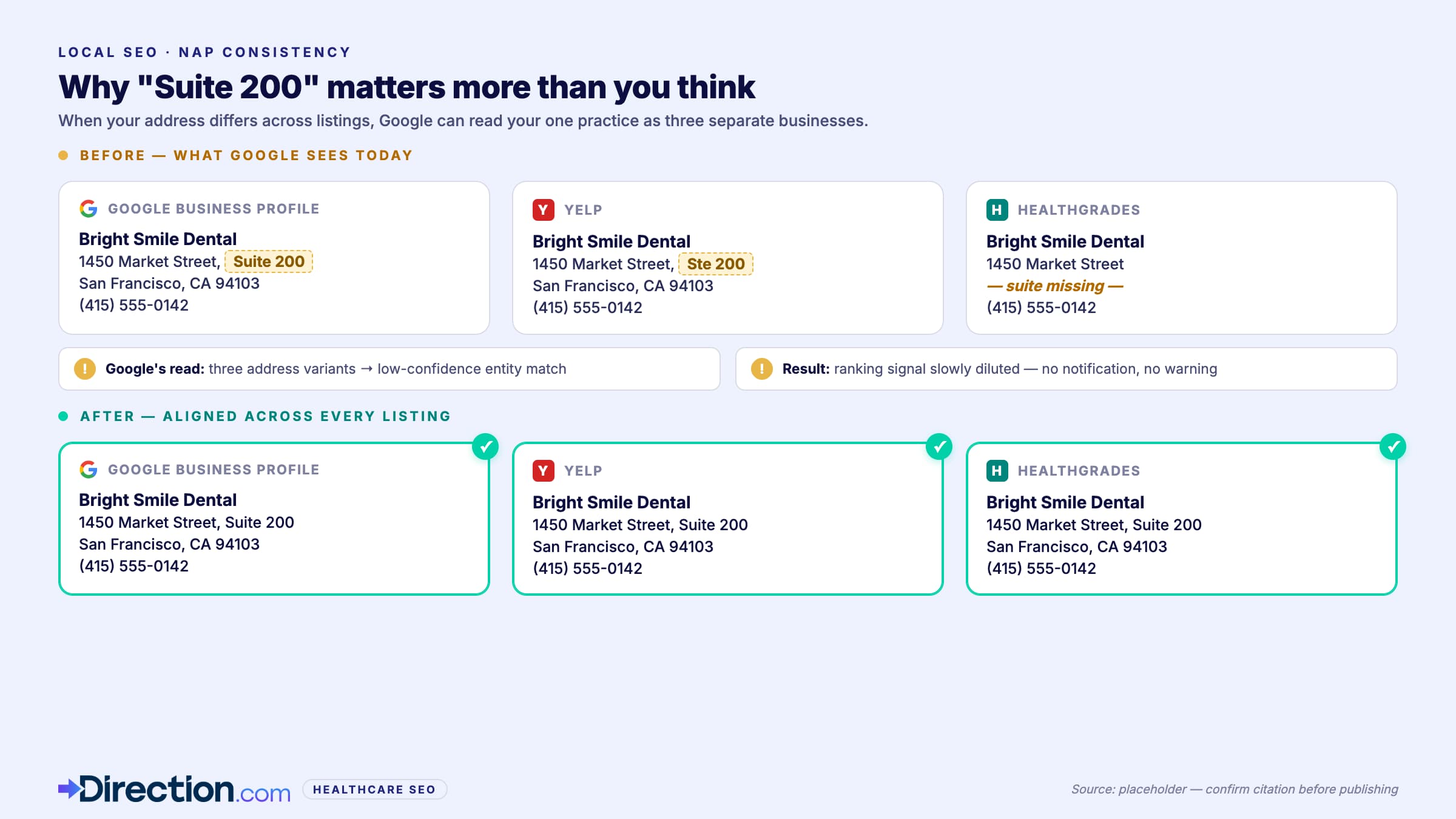
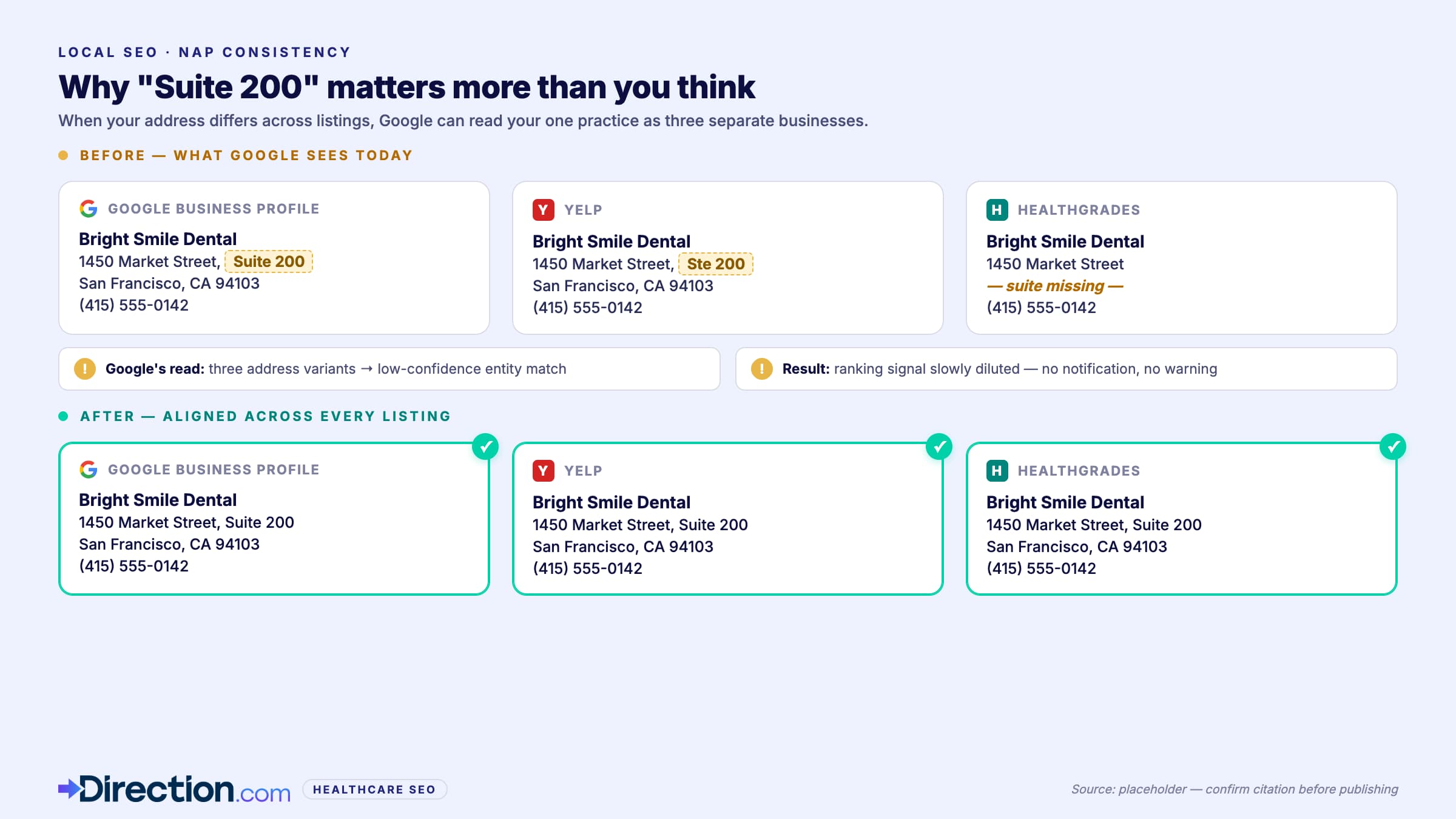
Your GBP name has to match your legal business name. Exactly. Your address and phone number have to match everywhere. Website, GBP, every directory listing. Same format, same spelling. If Yelp has “Suite 200” and your website doesn’t, Google sees two different businesses. That’s not a ranking penalty you’ll ever get a notification about. It just slowly works against you.
Pick the right primary category. Most general dentists use “Dentist.” Add secondary categories where they apply. “Cosmetic dentist.” “Pediatric dentist.” “Emergency dental service.” Each one expands the searches you’re eligible to appear for.
You Don't Need Better Ads. You Need Better Photos.
GBP profiles with strong photo libraries get significantly more calls. That’s straight from Google’s own data. The average dental practice has eight stock photos from their last website redesign, sitting there untouched since 2021.
Upload your team, your front desk, your operatories, your waiting room. Add before-and-after photos with patient consent. Put up new photos every month. Google rewards active profiles with better visibility.
Patients Read Your Reviews. So Does Google.
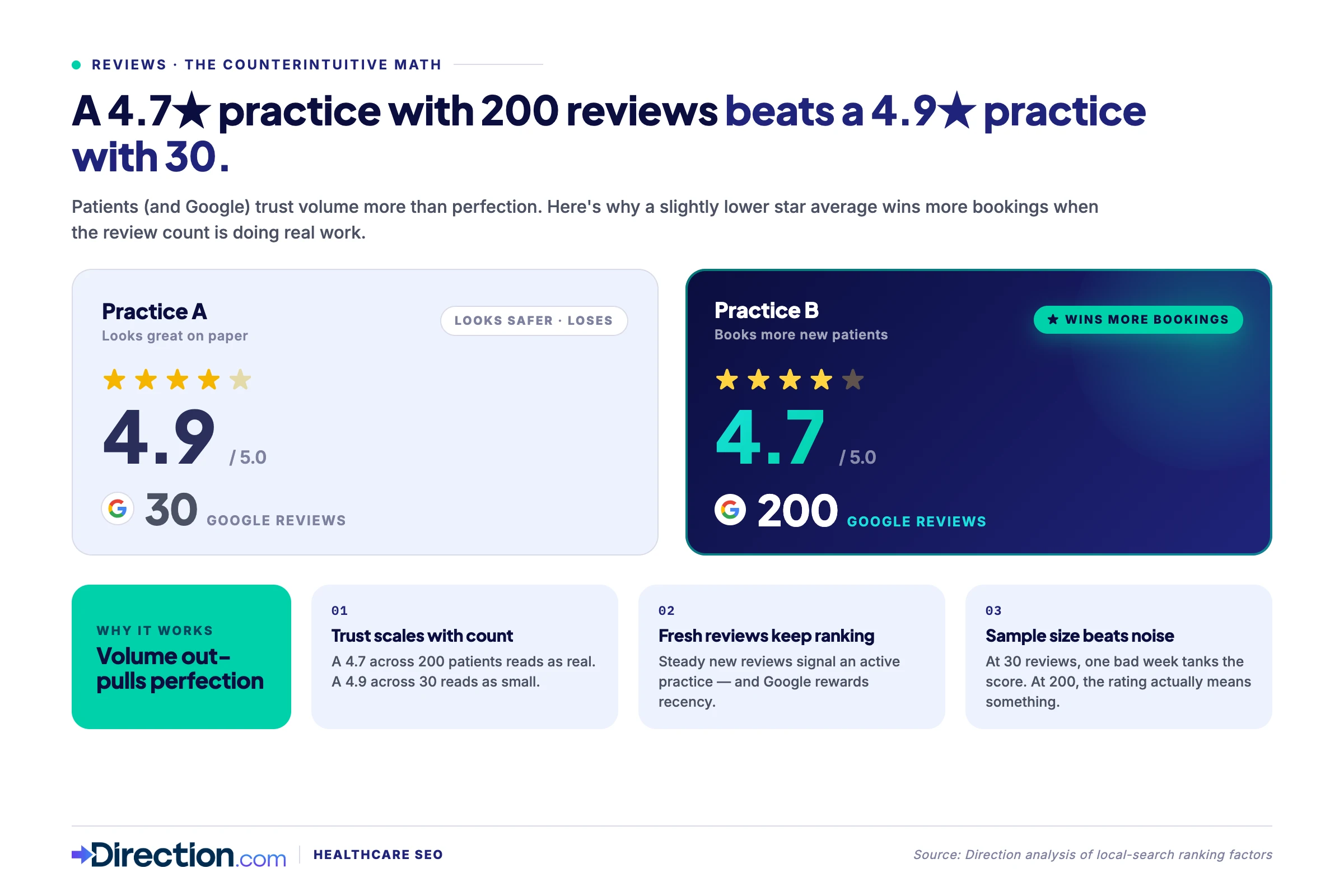
Review count, recency, and average star rating all influence your local pack position. A practice with 200 reviews at 4.7 stars will consistently outrank a competitor with 30 reviews at 4.9. Volume signals credibility to both Google and patients. Pretty cool right? Nerd.
Build a review request system. Ask at checkout, send a follow-up text with a direct Google review link, train your front desk. The practices winning in local search treat review generation as a process, not a happy accident.
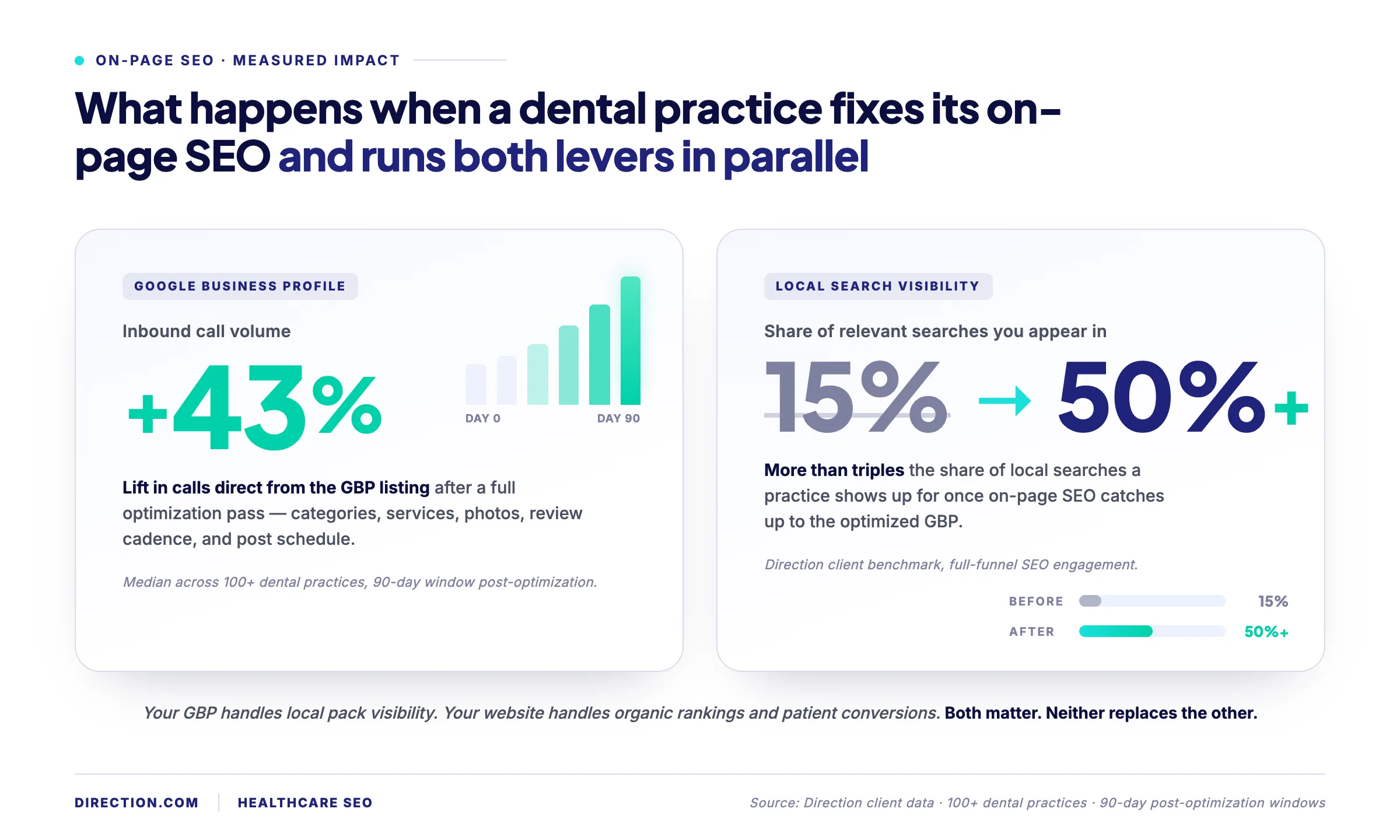
Dr. Marcus Webb runs a general practice in Denver. March 2024, his office manager Sarah spent two hours on their GBP. 60 new photos. Business description rewritten with location-specific keywords like “family dentist Denver” and “same-day emergency appointments.” GBP booking feature turned on. Review requests sent to every patient from the prior 60 days.
That’s without any website changes. Just GBP work done consistently.
On-Page SEO for Your Dental Website
Your GBP handles local pack visibility. Your website handles organic rankings and patient conversions. Both matter. Neither replaces the other.
If Your Service Pages Are Weak, Nothing Else You Do Will Matter
Most dental websites have one “Services” page with a bulleted list. That’s a missed ranking opportunity for every procedure you offer.
Every core service needs its own dedicated page. General dentistry. Cosmetic dentistry. Orthodontics if you offer it. Pediatric dentistry if applicable. Emergency dental care. Your top 3 to 5 procedures by production.
Each page targets a specific keyword. “Teeth whitening [city].” “Invisalign [city].” “Emergency dentist [city].” These pages give Google a clear signal about what you offer and give procedure-specific searchers a page that matches exactly what they typed.
Rankings Get You Seen. Title Tags and Meta Descriptions Get You Chosen.
Every page needs a unique title tag with your primary keyword and location. The format that works is [Service] [City] | [Practice Name].
For a dentist in Austin, the homepage might read: Dentist Austin TX | Family and Cosmetic Dentistry | Dr. [Name]. Service pages follow the same pattern: Teeth Whitening Austin TX | [Practice Name].
Your meta description should include the keyword and a clear patient benefit in 150 to 160 characters. It shows up directly in search results and affects how often people actually click through.
Local Signals in Your Copy
Mention your city and surrounding neighborhoods naturally in your copy. “We serve patients throughout Phoenix, Scottsdale, and Tempe” sends location signals to Google. Don’t force it. Write for people first. The signals follow naturally.
Does Your Website Loads in 6 Seconds? Your Patient Left in 3.
Google’s Core Web Vitals score your site on load speed, interactivity, and visual stability. A slow dental website loses rankings and patients who bounce before your homepage finishes loading. Check your score in Google PageSpeed Insights. Below 70 on mobile? Fix that before you spend another dollar on content or links.
The Right Keywords. The Right Pages. The Right Patients.
Not all dental keywords are worth chasing. Some have massive search volume and brutal competition. Others convert at higher rates because they match stronger patient intent. Knowing the difference is the whole game.
The Keyword Groups That Matter
High-Intent Local Keywords — Hardest to rank, highest value
- "dentist near me"
- "dentist [city name]"
- "emergency dentist [city]"
- "family dentist [neighborhood]"
Procedure-Specific Keywords — Moderate competition, strong conversion intent
- "teeth whitening [city]"
- "dental implants [city]"
- "Invisalign [city]"
- "dental crowns [city]"
Informational Keywords — Lower competition, strong for building authority
- "how much does Invisalign cost"
- "what to do if you break a tooth"
- "how to find a dentist that takes [insurance]"
For volume and difficulty data by keyword, see our full guide to SEO keywords for dentists.
Strategy for New vs. Established Websites
Newer site with limited content? Start with informational keywords. They rank faster and build the topical authority that eventually supports rankings for the competitive local terms.
Established site with existing traffic? Go after local procedure keywords first. “Dental implants Phoenix” is achievable. “Dental implants” nationally is not. Pick your battles.
Content Marketing for Dental Practices
“My patients don’t read blogs.” Maybe that’s true of existing patients.
Prospective patients searching “how much do dental implants cost” or “is Invisalign worth it for adults” absolutely do. They’re in research mode. They’ll book with whoever answers their questions clearly before they ever pick up the phone.
What Content Actually Works for Dental SEO
FAQ pages and posts. “Does teeth whitening hurt?” “How long do dental implants last?” “What exactly is a crown?” Real patient questions with real monthly search volume. Answer them directly and completely.
Procedure explanation pages. Not just a services list. Detailed pages explaining the process, what to expect during treatment, recovery time, and typical cost ranges. Informed patients book with more confidence and cancel less often. Worth noting.
Local resource content. Articles like “What to expect at your first dental visit in [city]” or “How to find a dentist that takes [insurance] in [neighborhood]” build local relevance and earn links from community websites and parenting blogs. Two birds.
Patient FAQ content. What does your front desk hear every single week? If patients keep asking about wisdom tooth removal, dental emergencies, or what happens if they skip their cleaning for two years (no judgment), write the authoritative answer and rank for those searches.
Link Building for Dental Practices
Links from other sites to yours are still one of Google’s strongest ranking signals. For dental practices, the goal isn’t thousands of backlinks. It’s quality local links from sources Google actually trusts.
Start with Local Citations
Citations are directory listings of your practice name, address, and phone number. Yelp, Healthgrades, Zocdoc, ADA Find a Dentist. They all contribute to local authority.
NAP has to be consistent across every listing. A different phone number on Yelp than your website, or a slightly different business name on Healthgrades, confuses Google’s local algorithm. It quietly hurts your rankings every single day.
Get Listed in Dental-Specific Directories
ADA member directory. Your state dental association. Local dental society listings. WebMD, Healthgrades, Vitals, Zocdoc. Insurance provider dentist finders. Patients search all of these. Don’t skip them.
Local Links Outweigh Niche Links for Local SEO
A link from the Phoenix Chamber of Commerce matters more for a Phoenix practice than a link from a dental blog in another state. Local signals win local search. Always.
Sponsor local events. Join the local business association. Participate in community press when you can. These generate exactly the local signals Google values for local pack rankings.
Dr. Lisa Thornton runs a pediatric dental practice in Sacramento. She spent months on traditional link outreach with minimal results. April 2024, she sponsored the local youth soccer league for $500.
The league site linked to her practice. The city parks department newsletter mentioned her. Three local parent blogs covered it. A newspaper ran a community spotlight. Eight inbound links total, improved authority signals, and 12 new patients who found her through the league.
The best link building for a local dental practice doesn’t look like link building at all. It looks like showing up in your community.
For more local SEO tactics specific to dental, see our complete guide to local SEO for dentists.
Common Dentist SEO Mistakes (and How to Fix Them)
Most dental websites make the same handful of errors. Fix these before you invest further in anything else.
One Page for Multiple Locations
Multiple locations need separate pages. Each one needs a unique URL, unique content, a location-specific title tag, and its own verified Google Business Profile. One "Locations" page listing two addresses does almost nothing for local search visibility.
Duplicate or Missing Title Tags
A lot of dental websites were built by web designers, not SEO people. Default titles like "About | Your Dental Practice" or identical titles across multiple pages quietly hurt rankings. Audit every page. Each needs a unique, keyword-specific title.
Ignoring Negative Reviews
A 3.2-star average hurts two ways. It signals lower quality to Google's local ranking algorithm, and prospective patients read reviews before booking. Respond to every review, including the 1-stars. A calm, professional response often converts fence-sitters better than any ad copy you write. Bro.
Not Tracking What's Working
Google Analytics 4 and Google Search Console are free. They show you which keywords bring traffic, which pages get visits, and where patients drop off. If you're not checking these monthly, you're guessing instead of knowing.
Expecting 30-Day Results
Meaningful ranking improvements show up in 3 to 6 months. Compounding results come at 6 to 12 months. Anyone promising faster is either talking about paid ads or not being straight with you. The practices with the strongest organic patient volume today started 12 to 18 months ago. Start now.
Get Found. Get Clicks. Get Patients. That's the Dental SEO Strategy.
A complete dentist SEO strategy consists of a layered order of operations:
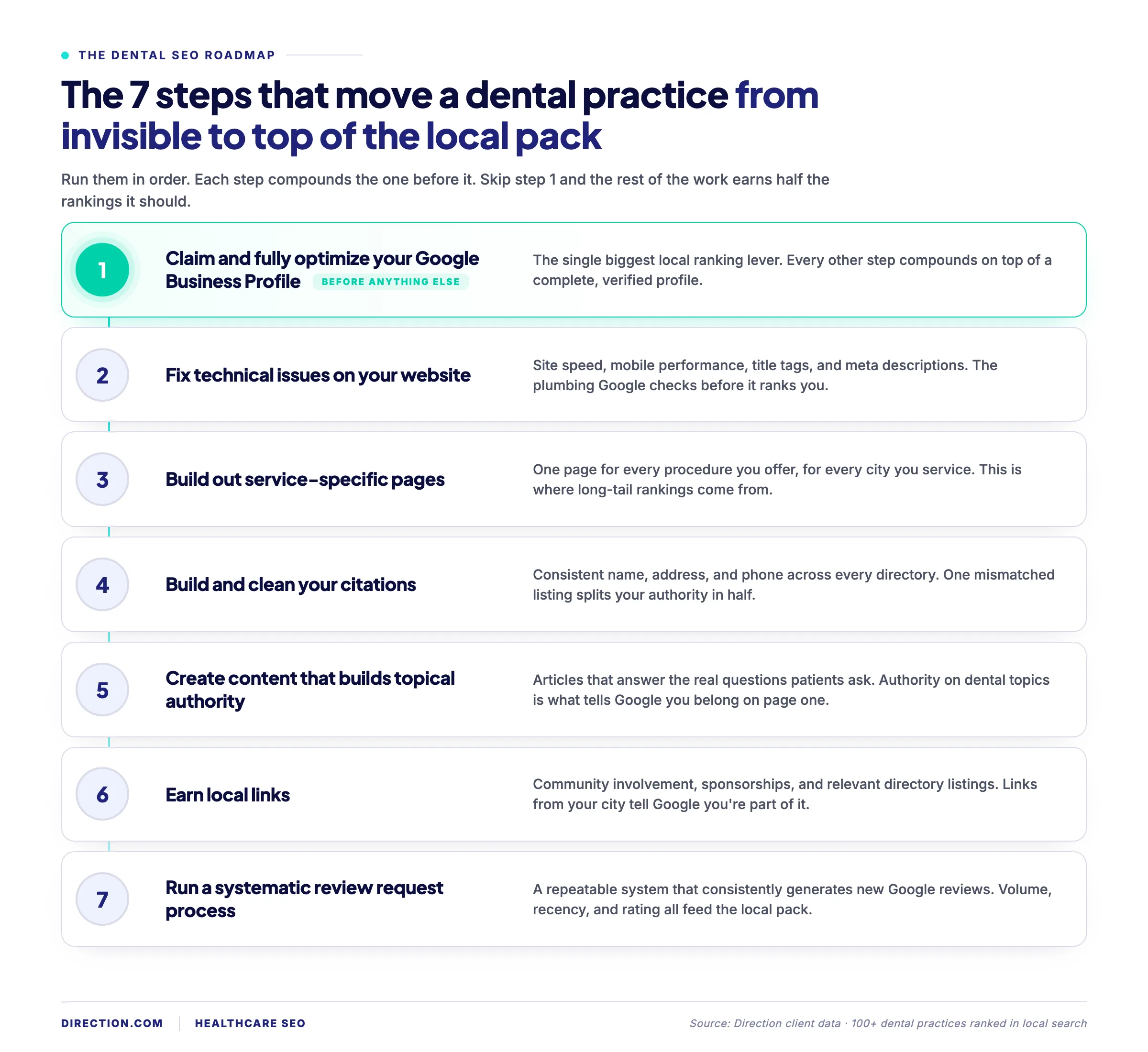
GBP earns your spot in the map pack. Service pages earn your spot in organic results. Content earns authority that compounds month after month. Links earn the trust that holds it all together. Stack those layers. Six months for real movement. Twelve months for a powerful patient pipeline you can count on.
Own Your Patient Acquisition, Stop Renting It
Most dental practices are either invisible on Google or paying directories to rent the visibility they could own outright. Both situations cost more long-term than building an organic foundation that compounds over time.
The practices winning in local search did the work. They optimized their GBP. Built service-specific pages. Earned reviews consistently. Created useful content. Built local links through real community involvement. No massive marketing budget required. Just a clear plan and consistent execution.
Here’s where to start:
- Audit your Google Business Profile and make sure it's complete, accurate, and actively managed with fresh photos and review requests
- Create dedicated service pages for each procedure you offer, optimized with local keywords
- Build a review system that runs without your attention every week
- Start creating content that answers what your prospective patients are already searching
Direction works exclusively with dental and medical practices. We’ve helped 100+ practices build patient acquisition channels they own, not rent. Want to see what we’d recommend for your market?
If you’d rather have a team run this for you, our dental marketing agency handles SEO, Google Ads, and website design for practices.
SEO is one channel; our guide to dental marketing strategies covers the other eleven and how they fit together.