Whether you’re planning to create new infographics or your design team already has graphics ready to publish, there’s a big difference between putting an infographic on your website, and getting other websites to link to it.
Whatever the case may be, you only have so much time and money to spend on your marketing. So, how do you leverage infographics as a marketing asset? And more importantly, is it worth the time and money?
The SEO industry always has an answer: it depends.
I also have an answer. It depends.

Does your infographic provide something genuinely useful, interesting, or difficult to find elsewhere that someone would want to share with their own audience?
If the answer is no, you’re probably better off spending your time and money elsewhere. A pretty graphic with information anyone can find in five seconds isn’t much of a reason for another website to link to yours.
But if the answer is yes, you’ve got something worth working with.
Now, the question becomes how to get that infographic in front of the right people, give them a reason to reference it, and turn those references into backlinks that actually benefit your SEO.
That’s exactly what we’re going to cover.
What is Infographic Link Building?
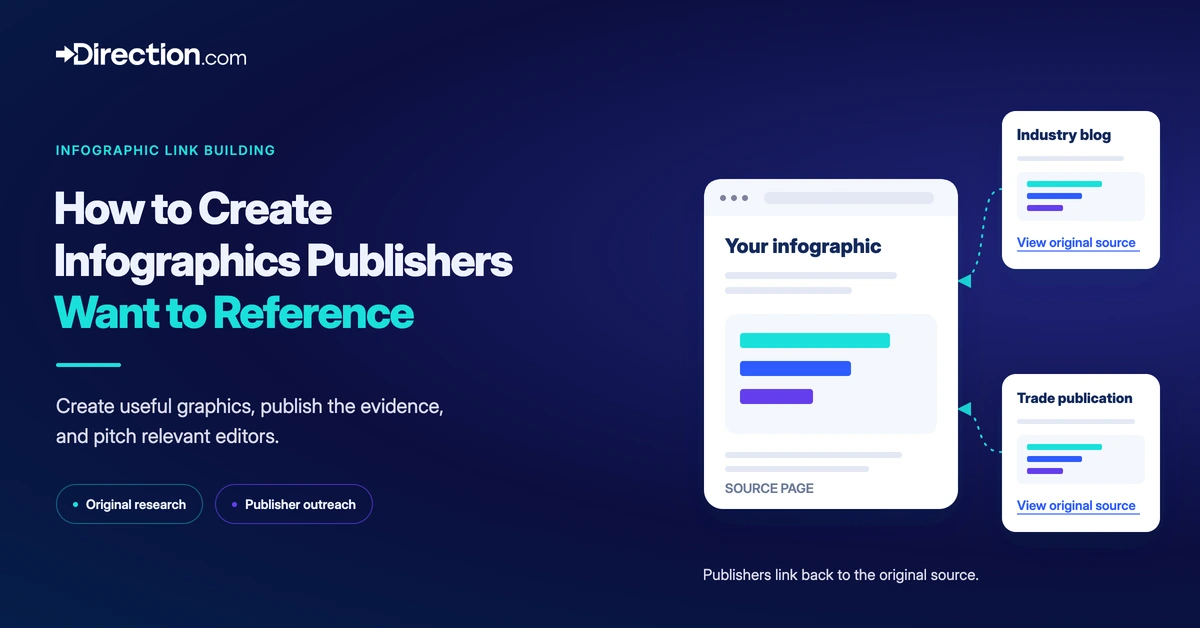
Infographic link building is the process of getting other websites to link to your website by creating and promoting useful visual content.
The idea’s relatively simple, in theory.
You create an infographic that explains something, presents interesting and/or unique data, or helps people understand a topic. Other websites find it useful enough to reference in their own content, and some of those websites link back to yours as the source.
Those links can help improve your website’s authority and organic search visibility.
But there’s an important distinction here.
Publishing an infographic isn’t link building. Getting other websites to reference and link to it is.
And even then, not every link is worth pursuing.
A backlink from a relevant, reputable website that uses your infographic to support its content is generally much more valuable than a link from some random directory that accepts every infographic submitted to it.
The goal isn’t to get your graphic published on as many websites as possible. It’s to get it referenced by websites whose audiences would actually find it useful.
Why Would Someone Link to an Infographic?
The answer: it depends.
Ok just kidding, maybe. Not really.
But, someone would probably link to an infographic because that website had something their readers would benefit from seeing. Maybe it was an original study, a helpful explanation, or a statistic they wanted to reference.
Infographics work the same way.
People don’t link to graphics simply because they look nice. They link because those graphics help them communicate something to their audience.
Personally, I love getting infographic links. Why? Well, typically people slap your infographic onto their site, hyperlinked back to yours. That’s way more authoritative for your brand than simple anchor text. Now people are seeing your brand and associating it with so much more than just a few words.
Anyway, here are the typical reasons people link to or embed an infographic:
- It contains original data. A publisher wants to reference findings they can’t get anywhere else.
- It makes complicated information easier to understand. A visual explanation saves the reader time.
- It provides a useful comparison. Someone can quickly understand the differences between products, processes, or options.
- It illustrates a process. A writer can show readers how something works without explaining every detail in a long paragraph.
- It answers a question better than the existing resources. The infographic fills a gap in what’s already available.
Notice what’s missing from that list?
Design quality.
Don’t get me wrong. Design matters. If your infographic looks like it was made in Microsoft Paint in 1998, I think it might be cool, but, not everyone would. Thing is, design in and of itself isn’t enough.
The information is what makes your infographic worth referencing. The design just makes that information easier to comprehend.
Keep note of that throughout this process.
Step 1. Find an Infographic Topic People Care About Right Now
When I’m making an infographic, this is where I spend the most time.
Before creating anything, figure out who’s likely to link to it and why. Kudos if it’s a trending and/or emerging topic you have a unique perspective or data on.
Start With Websites You Want Links From
Let’s say you run a dental practice and want to create an infographic about oral health.
You could make a graphic titled “10 Tips for Healthy Teeth.”
There’s nothing inherently wrong with that topic, but think about how many websites have already published similar information.
Why would someone link to yours?
Now, what about an infographic showing how dental insurance coverage varies right now in 2026 across common procedures, using verified policy information and clearly stated limitations.
That might be useful to patient education websites, benefits publications, and writers explaining dental costs.
The second idea has a more specific audience and a clearer reason to reference it.
Here’s how I’d research potential topics:
- Identify websites that publish content relevant to your industry.
- Look for articles that already contain charts, graphics, statistics, or links to research.
- Pay attention to the questions those articles are trying to answer.
- Find information that could be presented more clearly or supported with better evidence.
- Build your infographic around that opportunity.
It goes without saying, but, don’t copy their content. What you’re doing here is figuring out what information publishers already consider valuable enough to reference.
Step 2. Give Your Infographic Something Worth Linking To
Once you’ve chosen a topic, you need the actual information.
Don’t go and take facts from existing articles, add some icons and colors, and present everything as though it’s new.
Use Original Research Whenever Possible
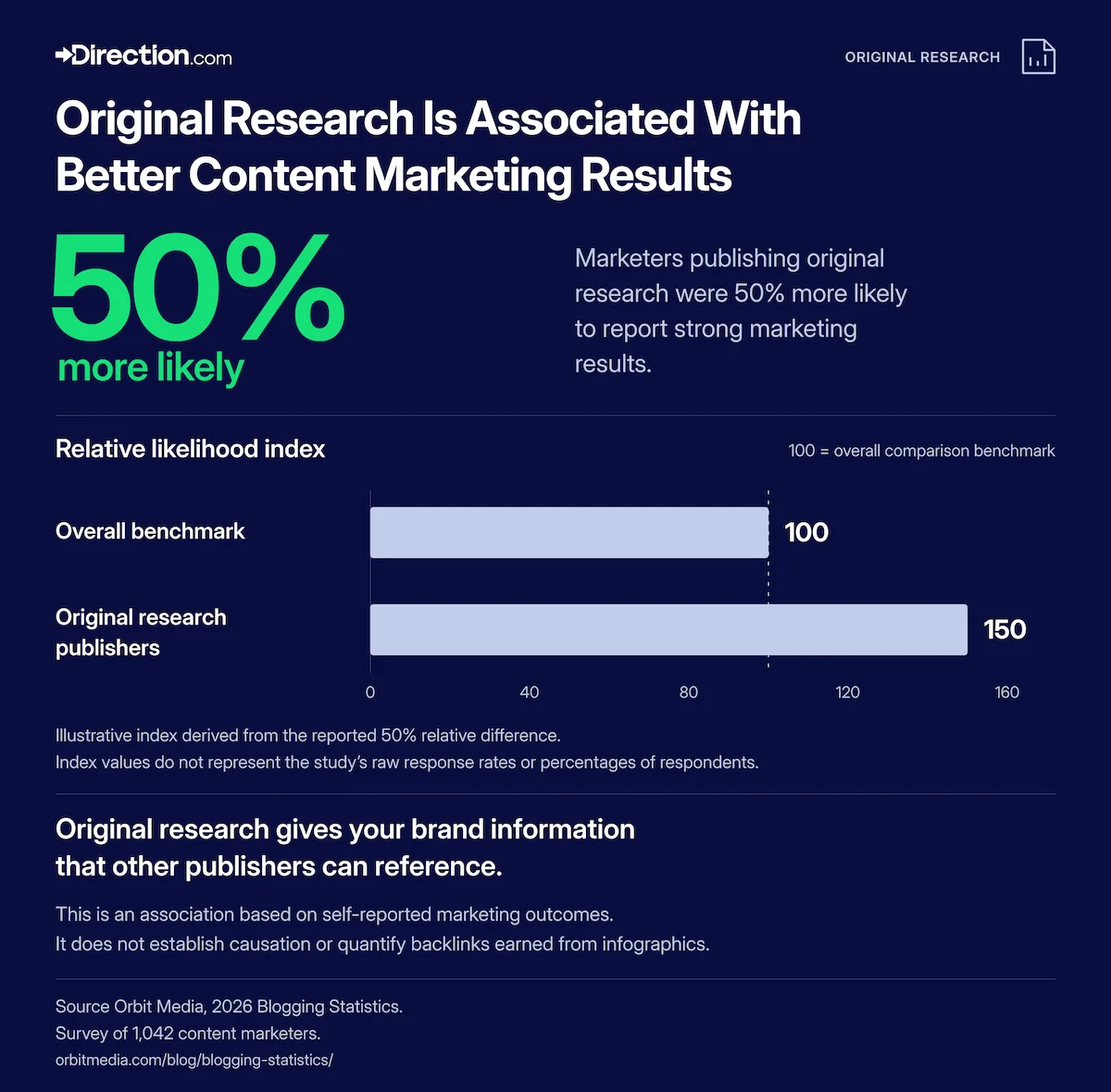
Original research is one of my favorite approaches because it gives people a reason to cite your website specifically.
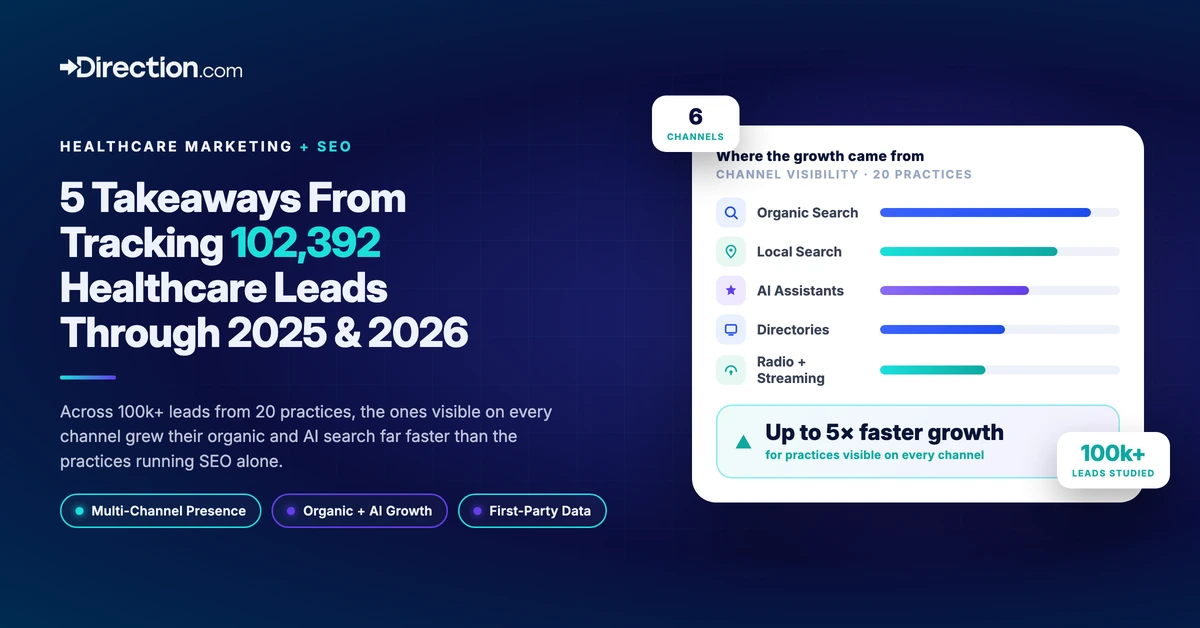
For example, at Direction, we analyzed 102,392 non-paid leads across 20 healthcare practices to understand how different marketing channels contributed to patient acquisition.
Our research found that, during the first half of 2026, those leads came from sources including:
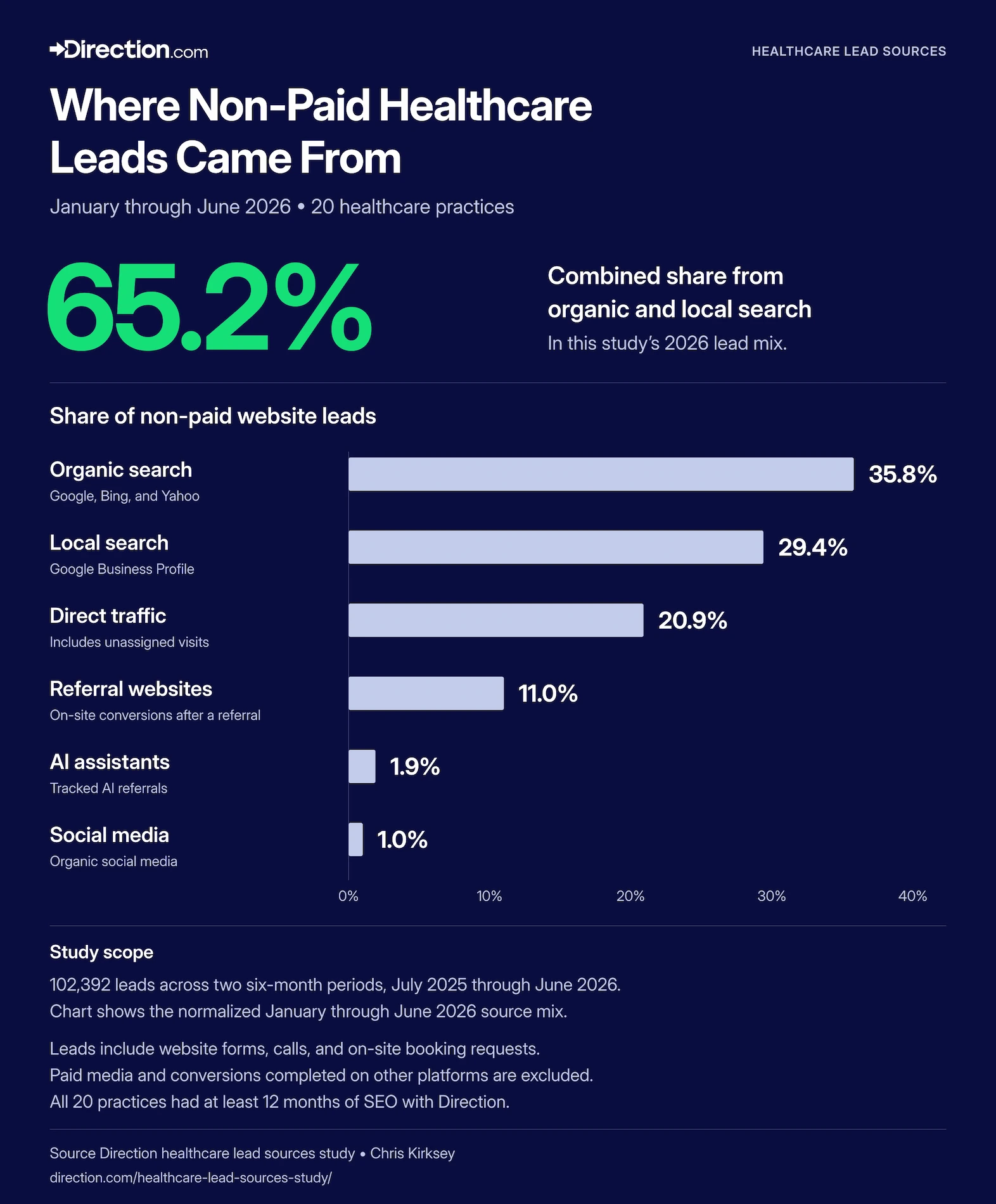
The above graphic showing the findings could help healthcare marketers, practice owners, and industry publications understand how patient acquisition channels compare within the sample.
And if someone references our findings, they have a clear reason to link to the original study.
That’s a much stronger position than publishing another generic infographic about why SEO matters.
Use Timely, Credible Third-Party Research
Not every business has original data to publish.
That’s fine.
You can still make a great infographic using research that’s already out there. Look at government reports, academic studies, and trusted industry publications to see what information you can bring together.
Just don’t go copying other people’s data claiming it’s yours. Always give credit where credit is due.
Now, let’s say you’re reading some blog posts and find two infographics about the same topic. If one has data from 2018, and another has data from 2026, which one would you trust more?
It depends on the topic, of course. Older research can still be valuable.
A great example is Backlinko’s study with BuzzSumo in 2019 on how powerful infographics are as a content marketing asset. Some data is timeless.
Old data can be a problem, especially in healthcare where things change all the time. Before using any data, check how recent it is. Personally, anything over a decade is generally a no-go for me.
Step 3. Choose the Right Infographic Format
Not every topic needs the same type of infographic.
The format should make the information easier to understand, not just more visually interesting.
Here are five formats I’d consider:
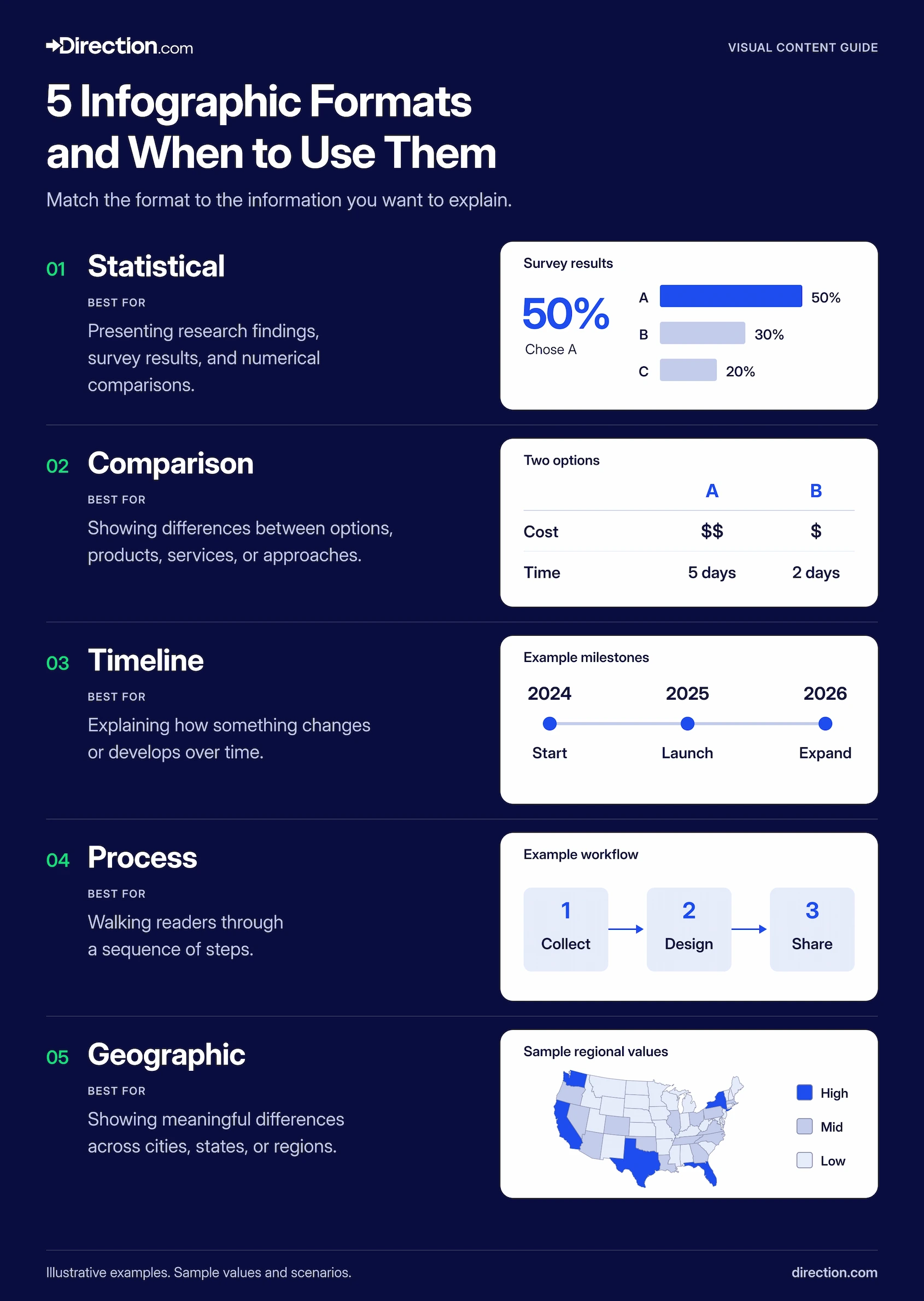
Timeline infographics work well for explaining changes to industry regulations, whereas comparison infographics help readers evaluate treatment options
Statistical infographics make more sense for presenting findings from large datasets. Remember, don’t try to force every piece of information into a single, enormous vertical graphic. Sometimes, a few smaller charts are more useful than one huge infographic.
In fact, when it comes to infographic backlinks, smaller graphics are the winner, as publishers can use a specific chart that supports their article without having to embed a massive infographic.
Step 4. Design the Infographic for People Who Would Publish It
Your infographic needs to work for two audiences.
- The people visiting your website
- The people who might want to include it in their own content
A long infographic might look great on your landing page but be nearly impossible to read when a publisher places it inside an 800-pixel-wide article.
Here are a few things I’d prioritize.
Make It Easy to Understand Without Reading the Article
Someone should be able to look at the graphic and understand it as quickly as you can say “Ah-ha!”
Always include a clear title, descriptive labels, units of measurement, and enough context to understand the information correctly.
Include Attribution Without Making It Obnoxious
Subtly place your company name and/or website somewhere on the graphic.
You want readers to know where the information came from, but you don’t want your infographic to look like a giant ad.
Always give credit where credit is due for statistics and research findings.
Step 5. Publish the Infographic on a Page Worth Linking To
Once you’ve got your infographic, publish it on a page or post that provides meaningful supporting information. Basically, give publishers a useful destination to reference.
Include the Information Behind the Graphic
If you’re publishing original research, explain how you collected and analyzed the data.
If you’re combining third-party sources, identify them and explain the comparisons.
Add information that couldn’t reasonably fit inside the infographic itself.
For example, a graphic might show that organic search accounted for 35.8% of non-paid leads in our healthcare study.
The accompanying article can explain the sample, reporting period, channel definitions, and limitations.
Make the Graphic Easy to Access
Don’t hide your infographic behind a form or require someone to create an account to view it. Provide a downloadable version and a simple way to copy the image URL. An optional embed code can also be helpful.
Just avoid forcing keyword-rich anchor text into the embed code. Google’s spam policies specifically address manipulative link practices, including certain links distributed through widgets.
Address SEO Best-practices for Images
Titles, image size, and alt text all play a part in helping search engines find, understand, and display your content.
So, don’t, for example upload an image called final-infographic-v7.png. Use a file name that accurately describes it, such as: healthcare-lead-sources-2026-infographic.png
Write descriptive alt text, compress the image appropriately using squoosh.app, and make sure it displays well on mobile devices.
Step 6. Find Websites That Might Actually Link to Your Infographic
This is where infographic creation turns into infographic link building.
And it’s also where people waste a tremendous amount of time.
You could send your infographic to 500 websites that have nothing to do with your topic.
Or you could find 30 websites that publish content directly related to the information you’ve created.
I’d choose the second approach.
Find Articles That Already Discuss Your Topic
Start with Google.
Let’s say your infographic compares patient acquisition channels for healthcare practices.
You might search for:
healthcare marketing statisticspatient acquisition channelshealthcare SEO researchmedical practice marketing trendshealthcare marketing benchmarks
Look for articles that discuss the same subject but could benefit from additional data or a visual explanation.
You’re trying to answer one question.
Would this infographic make their existing article more useful?
If the answer is yes, you’ve found a potential outreach opportunity.
If the answer is no, move on.
Find Websites Linking to Similar Research
Use Ahrefs or Semrush to find sites linking to articles or studies related to your infographic.
Then look for opportunities in those pages.
If your infographic offers newer findings, original data, or a genuinely useful visual comparison, you have something of value to offer the site.
Evaluate Relevance Before SEO Metrics
Domain Rating and Authority Score can be useful when researching websites.
But neither metric tells you whether a backlink will generate meaningful value.
So, I’d look at relevance first.
Does the website publish content about your topic?
Would a link to your resource make sense in the context of the page?
I’d rather earn a relevant editorial link from a respected industry publication than chase an impressive-looking third-party authority score on an unrelated website.
Build a Simple Prospect List
Build a spreadsheet with the following information: the domain, relevant article URL, appropriate contact, and why your infographic would add value. Track when you reached out, the current status, and the published backlink URL if you earn one.
If you can’t explain why your infographic would improve the article, don’t send the email.
Step 7. Reach Out Without Sounding Like a Spammy Link Builder
If you’ve ever published content on a reasonably established website, you’ve probably received emails that look something like this.
“Hello dear webmaster, I came across your excellent article and found it very informative. We have created a high-quality infographic that would be a valuable addition.”
Ugh. Gross.
It’s generic, it’s obvious, and it doesn’t demonstrate that the sender has actually read the article.
Keep your outreach short, specific, and focused on what the recipient’s readers would find useful.
Here’s an Outreach Email I’d Actually Send
Subject: A chart that verifies your information
Hi [Name],
I just finished reading your article on X, and after reading your section on Y, I was like, no way, I just made something about this!
I literally just last week analyzed X and created a graphic showing how everything you said checked out.
I attached it here, feel free to add it to your article if you want, it’d probably be pretty useful to show another source verifying your findings.
[URL]
Either way, enjoyed the article.
[Name]
That’s it.
No lengthy introduction about your company.
No paragraph explaining the importance of backlinks.
And no request to “kindly insert a dofollow link.”
You’re showing someone a relevant resource and letting them decide whether it’s useful.
Follow Up Without Becoming a Nuisance
A brief follow-up can be reasonable if you haven’t received a response.
But sending the same person five increasingly desperate emails isn’t a strategy I’d recommend.
If someone doesn’t respond after a reasonable follow-up, move on. There are plenty of fish in the sea.
Step 8. Understand What Counts as a Successful Placement
A website can use your infographic without linking to your website. As long as your logo/and or website is on the graphic, I’m just happy it’s being shared. Search engines can see your brand name and url anyway. Link or no link. Though, link is always more helpful.
Just remember that the publisher ultimately decides how to reference your content. Don’t annoy people for links.
Step 9. Measure Whether Infographic Link Building Is Worth the Money
Is infographic link building actually worth the time and money? Well, you won’t know unless you measure the results.
Measure:
- The number of backlinks
- The relevancy of the backlinks
- Referral traffic
- Conversions
Calculate Your Cost Per Referring Domain
Let’s say you spend $600 on research and content creation, then another $600 on the graphic itself, then $600 on prospect research and outreach. Well, you’re at nearly $2k in on a single infographic.
But what if that one infographic earns eight relevant referring domains.
Your cost per referring domain would be:
$1,800 ÷ 8 = $225
If the links are highly relevant, I’d say that’s a pretty sweet deal.
I’d also continue to monitor and see if the infographic continues attracting links after the outreach campaign ends.
That’s where a genuinely useful infographic can become a very strategic longer-term asset.
Can Infographics Help With AI Search Visibility?
Potentially, yes. But I wouldn’t create infographics solely because someone promised they’ll make your brand appear in ChatGPT or Google’s AI-generated answers.
AI search systems can draw on information published across the web, and clear, well-supported content can make your research easier to discover and reference.
An infographic supported by a detailed article is where the real power’s at.
If other websites reference your research, your brand and findings are likely to also appear in more places across the web.
That said, there’s no guarantee that earning infographic backlinks will equal ChatGPT referencing it.
I’d focus on publishing information that deserves to be referenced rather than trying to reverse-engineer a guaranteed citation.
Frequently Asked Questions About Infographic Link Building
Do infographics still work for link building in 2026?
Yes, I’ve ran campaigns with infographics that continue to earn backlinks every year due to their helpfulness. Just make sure it’s a unique infographic and you do spend some quality time on reaching out to other websites.
Can I use someone else’s statistics in my infographic?
Yes. You can report factual findings with proper attribution, but you should verify the original sources, preserve context, and avoid copying protected creative elements. You can simply ask the publisher of the data, and review permissions or licensing requirements when reusing charts, images, or substantial portions of someone else’s work.
What’s the best way to get backlinks from infographics?
Find websites that already publish content about your topic. Create an infographic that contributes useful information to those articles, publish it alongside supporting content, and contact relevant writers or editors with a specific explanation of why their article, and readers would benefit.
My Take on Whether Infographic Link Building Is Worth It
If you’ve already invested in an infographic that contains genuinely useful information, I think it’s worth exploring whether relevant publishers would want to reference it.
You’ve already paid for the asset. Spending some additional time researching potential placements and conducting thoughtful outreach might help you get more value from that investment.
But if you’re starting from scratch, I wouldn’t commission an infographic just because you heard they’re good for backlinks.
I’d first identify a topic publishers care about, determine what useful information you can contribute, and decide whether a visual format actually makes that information better.
Sometimes an infographic is the right answer.
Sometimes a research report, interactive tool, comparison table, or detailed article is a better use of your budget.
And sometimes the best decision is to improve content you already have.
The point is to create something people have a reason to reference, then make sure the right people know it exists.
That’s how I approach infographic link building.
And if you’re looking for help turning research, content, and other marketing assets into backlinks that support your organic growth, get in touch with our team. We can help you figure out which opportunities are worth pursuing.