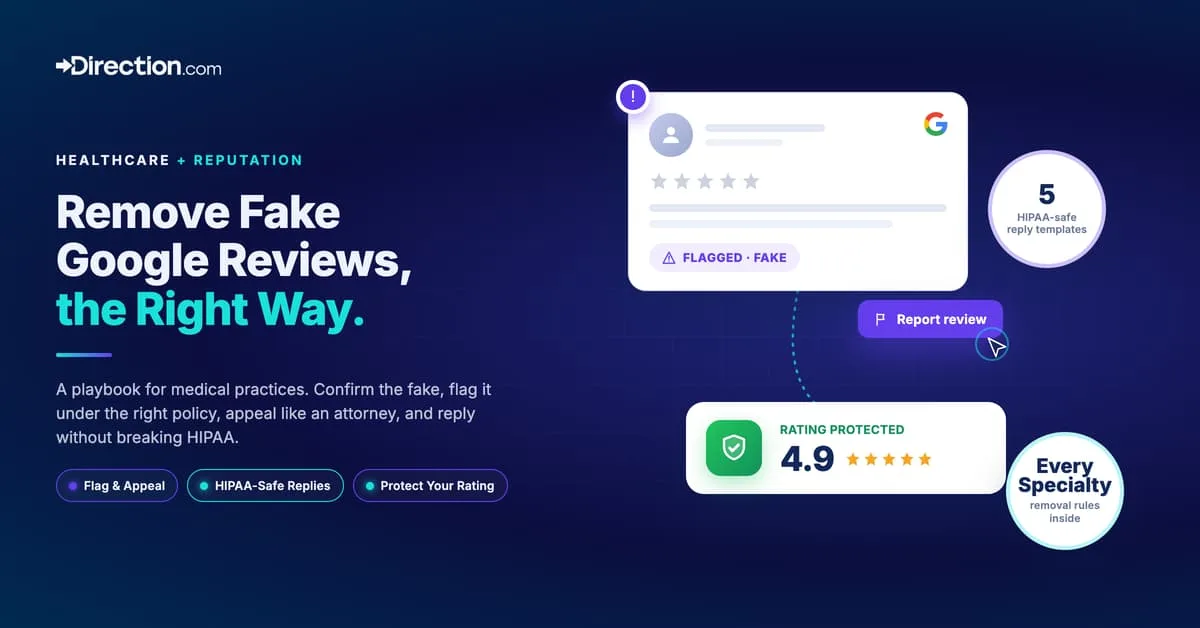
If a fake review is posted on your business profile, despite Google’s filter catching 292 million fake policy-breaking reviews in 2025 (per the 2025 Trust & Safety Report), there are some scary risks to posting a rebuttal – so hold off on doing that until you read this. You risk losing a lot more than you’ll ever gain from the fake review response.
My team at Direction handles all aspects of healthcare SEO for doctor offices, including removing fake reviews from local listings.
So, I’ll go over with you how to properly report and get fake reviews removed, as well as the HIPPA rules that limit the types of responses you can even make. Plus, some free response templates that work wonders so that you don’t have to hire an attorney.
Fake reviews pose more risks than reward for healthcare providers
Ok, so you got a fake review claiming a botched crown procedure that never actually occurred. You’ve never seen or treated the person that’s claiming that negative feedback. If you were a restaurant owner, totally different case here as you’d be able to quickly respond however you’d like. Unfortunately, in the healthcare space, you can’t.
As defined by HIPAA regulations, identifying or confirming whether someone has received services from you constitutes a “disclosure.” Any details regarding treatment, billing or scheduling also fall under the same regulations. Even if it was in self-defense (per the law).
Don’t end up like New Vision Dental. In 2022, the U.S. Department of health and human services’ office for civil rights fined California dental office new vision dental $23,000 in connection with the practice’s public responses to online reviews that included patient names, treatment details, and insurance information. Additionally, the dental practice agreed to accept federal monitoring for two years over those responses. To respond to online reviews.
Common types of attacks against your Google reviews
I’ve found that fake review attacks against a medical office’s Google profile typically originate from disgruntled employees, billing issues that became personal, competing businesses within crowded markets and paid review campaigns.
Types of reviews that Google removes easiest
Reviews that clearly violate Google Maps user content policy are easiest to get removed. However, it’s real hard to get anything else to go away, regardless of how unjustified the review appears. Repeatedly flagging a review multiple times won’t produce results either.
So what kind of reviews does Google easily take down?
- Reviews from obviously suspect-looking profiles is the big one.
- Conflicts of interest occur when a competitor or former employee with a grudge creates a profile.
- Off-topic reviews containing excessive ranting, harassing comments and/or doxxing are also easily removable.
A one-star review from a real patient who waited 40 minutes? Real. Don’t go reporting a review simply because it is a one-star review. Falsely flagging reviews can negatively affect your ability to submit future reports against reviews that do break policy. Avoid being labeled as the boy crying wolf.
Also, Google prohibits review-gating (filtering patients based on whether they left positive or negative reviews), and paying for reviews. The FTC’s Consumer Reviews and Testimonials Rule took effect on October 21, 2024. Courts can impose civil penalties when someone knowingly breaks the rule.
| Removal stage | Where it happens | Typical timeline | What decides it |
|---|---|---|---|
| First flag | Review’s three-dot menu or the Review Management Tool | About 3 business days | Software screening. Expect a first no. |
| Status check | Review Management Tool | Anytime after flagging | Shows pending, rejected, or escalated. |
| Appeal | Review Management Tool, up to 10 reviews | Under 24 hours to 2 weeks | One appeal only. Evidence quality decides it. |
| Support case | Google Business Profile support | Days to weeks | A specialist reads the case. Privacy framing helps practices. |
| Legal removal | Google’s legal removal request form, with your attorney | Weeks or longer | Reserved for defamation. Strongest tool, slowest path. |
Google protects profiles on its own since April 2026
In April 2026, Google announced several features protecting profiles that you should be aware of before filing an issue. When Google identifies an unusual increase in spam reviews for a particular profile, the fake reviews will go bye-bye, and all new reviews could be suspended until further notice.
You’ll know this happens to you because you’ll get an alert via email. Google also identified and targeted review extortion schemes. Basically, schemes involve posting numerous one-star reviews and demanding money from the owner of the profile to delete them. Google now monitors for this behavior before allowing reviews to be posted. Never pay the scammer, always report the threat.
Step-by-step process to determine whether a review is fake prior to reporting
Check that a complaint is fake before flagging it. Check your schedule, call log, and patient records. No match anywhere Strong signal. The reviewer’s profile tells you the rest, starting with account age and review history.
Always spend time to determine whether a review is fake prior to submitting it. Is the reviewer a scheduled, contacted or documented patient in your records? Ask your team if any of them know someone by the name of the reviewer, before explaining to them that they left a negative review.
If not, strong indication it’s fake. The remaining clues are in the reviewer’s profile itself. The age of the account and previous reviews help establish credibility.
An account created last month with only one review is suspicious. Accounts reviewing businesses in different cities (i.e., Austin texas and Tampa florida) during the same week are also suspicious. Take screenshots with the date visible.
Typically, legitimate reviews contain some level of detail regarding services rendered, providers involved, procedures performed and billing information. Fake reviews tend to lack this specificity (“terrible experience”, “horrible staff”) as the author lacks tangible details to reference.
Lastly, another type of pattern exists in both dentistry and aesthetic medicine markets: review clusters.
What are review clusters?
Review clusters are basically a bunch of one-star reviews appearing within a short period of time. For example, 4 negative reviews in 2 days. Usually they also have similar language and lack sufficient specificity.
Both factors influence how Google support responds to your request, especially given google’s propensity to automatically pause profiles exhibiting clusters due to paid campaigns.
Whatever your check finds stays internal, and your team logs it. Document the date, the investigator and what returned blank.
The moment any identifiable details appear in a public response, you’re exchanging a fake review for a federal complaint. Your internal documentation will show the fact-check occurred without disclosing any patient-specific data.
Removing reviews from Google (using their system)
Here’s the process:
1. Screenshot first
Capture dated screenshots of the original review and the reviewer’s profile documenting account creation date(s), previous reviews written, geographic areas referenced. Identify specifically which section of the user content policy was violated prior to reporting.
Google’s screeners will never view your patient records; therefore, your argument must solely be based on public evidence only.
2. Categorize correctly under three-dot menu
Flag the offending review from the Three-dot menu or use Google’s review management tool. Once flagged, you’ll be able to monitor the status of your report and follow-through with additional action items as requested by Google’s support team. This is only a feature you can use if you have a verified GBP.
Selecting correct categories here in step two is critical. During testing, I’ve successfully filed identical complaints using two separate categories and experienced significantly better success rates utilizing category 1: conflict-of-interest vs category 2: spam. Spam seems like an easy option; however, avoid using it unless it perfectly applies to your situation.
3. Expect the first no, then check your status
Upon initial processing, many complaints are rejected by Google. After rejection, you can file an appeal. Monitor status updates in the review management tool.
4. Write the appeal the way an attorney would
A rejected report gets one appeal. You can only appeal ten reviews at a time. And once filed, you can’t refile subsequent complaints.
Appealing requires describing exactly which provision of Google’s user content policy was violated and attaching relevant supporting documentation from the reviewer’s profile indicating no corresponding scheduled visits existed matching those referenced in the complaint. Clearly stating that there are no records available detailing any patient receiving service(s) associated with referenced description minimizes potential breaches of patient confidentiality.
Clean appeals come back fast. I’ve had removals land in under 24 hours and watched sloppy cases sit for two weeks and lose. A typical case closes in about 11 business days start to finish.
5. Escalate when the appeal fails
When your appeals of negative fake reviews are unsuccessful, create a new support ticket via Google Business Profile support, and center it around patient confidentiality. I’d also have multiple employees from your organization report the same policy-violation from their accounts. Evidence supporting your appeal from step #1 serves as primary source material throughout this process.
Is the review making statements that are obviously false and affecting your ability to attract patients? Google permits defamatory-based removal petitions via its legal removal form, although courts have consistently ruled against anonymous reviewers in similar scenarios. So, no guarantees there.
Legal removal of fake reviews can take weeks. Responding quickly helps reduce reputational damage until the review is removed.
The HIPAA-safe way to respond while waiting for the fake review removal
Saying nothing reads as guilt to the next patient scrolling your profile, so the review needs a public answer, and the answer needs tact. Acknowledge the feedback and invite offline contact. Nothing about care, billing, or patient status.
And do not write “we have no record of this patient.” Do that, and you’re now exposed to HIPPA rules around confirming and denying patient status, the exact disclosure the OCR settlements punished. All response templates presented below pass this HIPAA compliance litmus test.
Template 1. General suspicious review
“Thank you for the feedback. We take each review seriously, and we’re committed to safe, attentive care for the people we treat. Privacy rules keep us from discussing specifics publicly, and we’d welcome a direct conversation at [phone].”
Template 2. The review describes a visit that never happened
“We appreciate feedback and look into every concern that reaches us. We aren’t able to respond to specifics here. Please contact us directly at [phone or email] and we’ll give this our full attention.”
Template 3. Coordinated or competitor review
“We’re committed to the patient experience at [Practice Name]. We haven’t been able to verify this review as a genuine patient experience, and we’ve submitted it through Google’s policy process. We welcome any legitimate concern at [phone].”
Template 4. The review makes a false clinical claim
“Patient safety guides everything we do. We can’t discuss clinical claims in a public forum, out of respect for the privacy of anyone who receives care here. If this reflects a real experience, please call [phone].”
Template 5. Likely former employee or known bad actor
“We take how patients experience our practice seriously. We’ve reviewed this submission carefully and reported it to Google through the policy process. For any genuine concern, our office is at [phone].”
Stay inside the template wording, since improvising is where violations start.
After a removal is successful, check the AI-generated summary at the top of your profile. Nobody knows Google’s refresh schedule, and the deleted review’s wording can hang around for who knows how long, unfortunately.
The Fake Google Review Removal Rules by Specialty
Dental Practices
Star ratings drive routine-care decisions, so dental profiles absorb the most attacks, usually rooted in billing disputes or crowded urban markets. Multi-location groups should run monitoring from one seat, because an attack on one location is sometimes the first visible piece of a wider campaign.
- Proactively request genuine reviews from satisfied patients after appointments. Real volume of authentic reviews is the best defense against isolated fake ones.
- Monitor your GBP weekly; don’t let fake reviews age without a response. The faster you report a review, the higher likelihood it will be removed.
- For multi-location dental groups, centralize review monitoring. Fake attacks on one location are sometimes a signal of a broader campaign.
Plastic Surgery and Aesthetic Medicine
Your patients research for months before a high-dollar procedure, which makes these profiles valuable targets. Outcome disputes need extra care, since answering any result claim publicly is HIPAA exposure.
A consent form with a review-and-media clause, signed before you document cases, gives you room you won’t have otherwise. Spreading your review volume across review directories such as RealSelf, Healthgrades, and Google blunts a single-platform attack.
- Before/after result disputes require special care, as responding to any clinical outcome claim publicly is a HIPAA exposure.
- Have a patient consent form that includes a social media and review clause for documented outcomes. This gives you more flexibility if a review dispute involves a patient you can identify.
- Invest in review generation across multiple platforms, essentially diluting the impact of a single platform attack
Mental Health Clinics and Therapy Practices
The privacy bar sits highest here. Your reply can’t hint at treatment status even obliquely, so one trained staff member should own every response you post. Telehealth groups running profiles in multiple states should expect attacks to cross state lines with them.
- The HIPAA response constraint is especially important here. Never hint at a patient’s mental health history or treatment status.
- Group practices should designate a single staff member for review response to ensure consistency and compliance.
- Telehealth providers operating across state lines may face fake reviews targeting multiple geographic profiles simultaneously.
Primary Care and Specialty Medicine
Fake reviews here usually describe front-office experiences (billing, wait times, phone conduct), which makes them easier to disprove against your appointment records. Track reviews by provider name if you run a multi-physician group, since attacks sometimes target one doctor for personal reasons. Hospital-affiliated practices can pull compliance into formal removal requests
- Multi-physician practices should track reviews by provider name, as fake reviews are sometimes targeted at a specific physician for personal reasons.
- Hospital-affiliated practices may have additional resources through their compliance or legal department for formal review removal requests.
What One Fake Review Star Does to 15 Reviews Vs 200
One fake one-star review barely dents a 4.8-star profile with 200 recent reviews. On a profile with 15, the drop is obvious. And recency matters more than volume: hundreds of outdated reviews offer less protection than a steady stream of fresh ones.
Building a steady flow of reviews starts with your patient experience. Send a quick follow-up text within 24 hours of a positive visit, have your front desk ask happy patients at checkout, and include a review link in your patient portal and email signature.
The FTC rule bans rewards for reviews when the reward depends on a positive or negative view. Google’s spam systems watch a sudden five-star burst the same way they watch a one-star cluster.
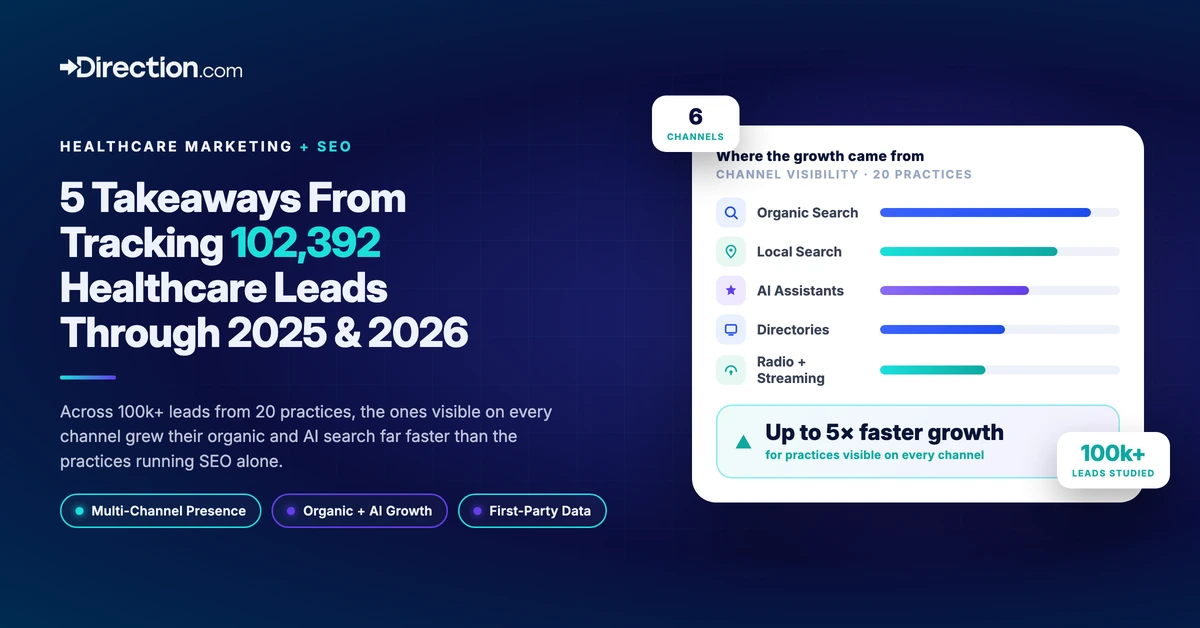
Review signals also feed the local pack rankings, the map results that decide which three practices a nearby patient sees first. Reputation sits inside the healthcare SEO program Direction runs. My team analyzed 102,392 leads for the 2026 healthcare lead-sources study, and profile strength kept showing up in which channels booked patients.
Answers to Common Questions About Fake Google Review Removal
Can a medical practice respond to a Google review without violating HIPAA?
Yes, but only with strict guidelines. Your reply can’t confirm or deny that the reviewer was a patient, and it can’t reference diagnoses, procedures, visits, or billing. Acknowledge, invite offline contact, and stop, since the five templates above already hold that line for you.
How long does it take Google to remove a fake review?
Three business days for a first decision, in my experience, and most first decisions are rejections. Appeals resolve anywhere from under 24 hours to two weeks. Defamation cases through Google’s legal process run weeks or longer, so post a HIPAA-safe public response while you wait.
Can I sue someone for leaving a fake Google review on my medical practice?
Sometimes, when the review states provably false facts and you can show real harm, since opinions don’t qualify. Courts have ordered platforms to unmask anonymous reviewers in coordinated-attack cases. Your evidence file from the removal process becomes the core of that suit, one more reason to keep it.
What should a medical practice do when fake reviews appear to be from a competitor?
Records first, meaning timestamped screenshots, the reviewer profiles, and the pattern across dates. Flag under conflict of interest, then bring your full file to Google support. A cease-and-desist from your attorney, paired with those records, has moved stubborn cases faster than any flag I’ve filed.
Can you just delete a bad Google review yourself?
No. Only the reviewer or Google can take one down, and reviews can’t be switched off for your profile. Anyone selling you guaranteed deletions is selling something Google doesn’t offer.
For a review on Yelp, follow the Yelp review removal steps.
The Practices That Win This Fight Never Fight It Alone
A fake review caught on day one, with the evidence file started before your anger fades, comes down in days. Caught a month later, after a defensive reply went public, it can cost a five-figure settlement plus federal monitoring. The difference is a person on the profile every week.
Someone who knows the policy lines, writes appeals that survive a specialist’s read, and notices the cluster before Google’s banner does.
That’s the work Direction runs for medical practices. We’ve been healthcare-focused since 2016, so the team knows an operatory from an exam room, and you’ll see your full plan before you sign anything. We measure the engagement in booked appointments.
If your profile is under attack, or you want it defended before one lands, book a discovery call with Direction.