You’ve got the credentials. Board certifications, fifteen years in practice, hospital privileges, the whole wall of framed paper.
So why does some content mill’s listicle outrank you for the procedure you perform every Tuesday? A plastic surgeon asked me that in March. He wasn’t going to enjoy my answer.
The short version is that his site proved he was qualified, and somehow never showed that he’d done the work himself.
The Extra E in Double-E-A-T
Experience is the E most healthcare sites don’t properly implement, and it just means you’ve done the thing you’re writing about. Google added it to E-A-T in December 2022 and weighs it heaviest on medical pages.
Your MD shows expertise. It says nothing about whether you’ve treated the condition the page covers.
Google added more E-E-A-T context later in 2025 to their rater guidelines.
"Does content also demonstrate that it was produced with some degree of experience, such as with actual use of a product, having actually visited a place or communicating what a person experienced? There are some situations where really what you value most is content produced by someone who has first-hand, life experience on the topic at hand."
- Google Search Central Blog
Content written start to finish by a generative AI tools, with no human review and no original value get scored Lowest Quality.
(see Google’s full search rater guidelines here)
Sure, any AI model can explain a procedure. But it can’t sit with a nervous patient and catch the fear on their face before they speak.
After enough years, you read a patient on instinct. Google’s raters eat that realness up.
So pull it out of your provider’s head and onto the page.
- Have the provider record themselves discussing the procedure in first person, then transcribe it.
- Hire a photographer to get high-quality shots of the operatory or exam room. A stock photo of a smiling stranger in a generic clinic kills trust in an instant, don’t do it.
- Write down the chair-side detail (the pre-op conversation, the diabetic-patient question you always ask) that only someone who’s been there would know to talk about.
I’ve watched this over and over again over the past decade. The pages created with content based on how the provider actually talks, the messy first-person stuff, beat the pretty ghostwritten ones every time. It’s real, and in this AI age, people crave real.
Focus on the medical concept first, procedure second.
Entity clarity means Google knows which specific medical concept your site covers, down to the procedure. Generic terms like “medical SEO” or “best doctor near me” put you in a pool with ten thousand other clinics. Get more specific and you’re up against less competition for the top spots.
A longevity clinic that writes about Longevity Medicine, C-suite health panels, and full-body MRI screening is telling Google exactly what it treats. Then there’s the entity side. Author entities, Person schema, and a presence in Google’s Knowledge Graph all count a lot in health searches in 2026. They mattered far less even a year ago.
Your keyword research should map these specialized concepts, then build a page around each one.
The trap, and I’ve watched good practices walk straight into it, is treating this as a word-stuffing chore. It isn’t.
So what’s the real work here? You’re teaching a search engine what kind of medicine you practice.
How AI Overviews Pick Their Medical Sources
Google’s raters started evaluating AI Overviews in the September 2025 guidelines, using examples similar to how they rate featured snippets and knowledge panels.
According to SEMRUSH, ChatGPT, along with Google AI Overviews and AI Mode use a query fan-out. They break one search into many sub-queries, run in parallel across the live web and the Knowledge Graph.
Your page can get mentioned just for answering one small question better than anyone else, even if it never ranks first for the big term. So start every section with a clear answer to what a patient would type, in about forty words. Then add more below it.
When the model needs to answer a small question, it pulls that clean block of information. It also cross-checks the claim against other sources, so a number that matches the wider record survives and a lonely, unsupported one gets dropped.
Original data gives the model something to corroborate. When SE Ranking analyzed the March 2026 Core Update, they found sites publishing original data picked up more visibility, and sites that were just rehashing other stories dropped hard.
So, if you choose to rewrite the Mayo Clinic on your blog, guess what happens? You give the model your competitor’s authority. AI loves to pull from and mention sites with original data. So if you have patient outcome data, anonymized numbers, intake records, and similar, you’re sitting on an AI-discovery goldmine.
Build The Author Box A YMYL Page Needs
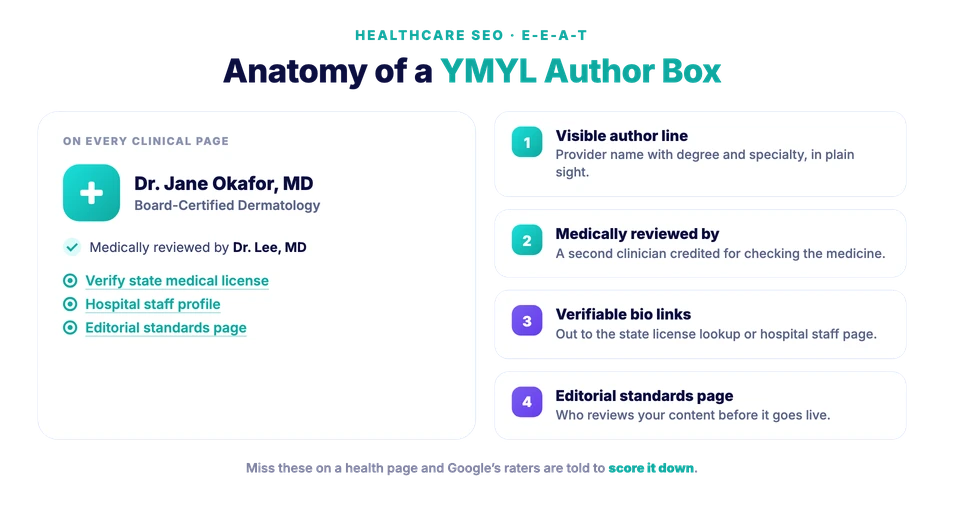
On any medical page, Google’s raters look for a legitimate, credentialed author and a way to confirm those credentials are real. Give every clinical page four things.
- A visible author line with the provider’s degree and specialty.
- A “medically reviewed by” credit naming a second clinician who checked the medicine.
- An author bio that links out to the state license lookup or the provider’s hospital staff page (the part patients and raters both verify).
- An editorial standards page explaining who reviews your content before it goes live.
A page that could affect someone’s health, with no identifiable expert behind it, is exactly the profile Google’s guidelines tell raters to score as low.
Show Google You're Real By Linking to Your Other Medical Profiles and Directory Pages
Third-party proof tells Google your practice is real beyond its own website. When you show up on Castle Connolly, the AMA directory, your specialty board, and the hospital systems that credential you, that all confirms your practice exists in the wider medical record. The sameAs schema property ties your site to those profiles, so the Knowledge Graph can link them up.
That said, schema in and of itself doesn’t create authority. Google has said for years that it’s a non-ranking signal.
It clarifies which entity you are, so the Knowledge Graph can properly reflect you. The authority itself still has to exist in other places online.
Most healthcare sites I audit already have profiles with verifiably real, up-to-date credentials. There’s just a lack of connecting everything with schema.
You're Trusted Based on Your Off-Site Reputation
Trust is the T, and it’s the pillar you control least. Google’s search quality evaluator guidelines tell evaluators to research what independent sources say about a practice and its providers. For a health site, that means reviews, news coverage, your standing with the state medical board, and any public record of complaints or sanctions.
Now back to query fan-out, when the model assembles an answer, it pulls corroboration from review platforms, forums, and earned media. A wall of five-star copy on your own domain counts for little when third-party sites says something else.
So most of the work is for other websites other than your own. Keep your Google Business Profile and Healthgrades reviews current and answered. Then correct whatever factual errors are sitting on your hospital and board profiles right now.
Treat earning mentions from authoritative medical sites as a trust project, because raters and models both read what other sites say about you.
Tell Patients Who The Procedure Isn't For
A “who this isn’t for” section is one of the strongest trust signals you can publish on a health page. Explain that a treatment carries real risk for a patient who smokes or has uncontrolled diabetes.
A quality rater reads it as a practice that puts the patient ahead of the booking.
One caution, because this matters. A contraindication is itself a clinical claim. A credentialed provider has to review it before it goes live.
A wrong limit published as fact is a trust negative and a real-world risk.
By SE Ranking’s measure, the March 2026 Core Update moved 79.5 percent of top-three positions, the most volatile reshuffle they’ve recorded. Google confirmed the update itself. The trust weighting held through the May update.
Promotional pages that read like a glossy brochure dropped, and pages naming contraindications and honest limits held position.
Across our current book of healthcare campaigns at Direction, the practices showing up in AI Overviews are the ones willing to publish this kind of honest, candid content.
Turns out telling people the truth ranks well. Who knew.
Start Fixing Your Site
Start with the page for your highest-margin procedure, because that’s where a single ranking move pays for the whole project. Then work down this list.
| E-E-A-T signal | What it looks like on the page | The fix |
|---|---|---|
| Experience | First-person clinical detail and real photos of your space | Record the provider for fifteen minutes, transcribe the detail, swap the stock photo for your exam room |
| Expertise | Named, credentialed author with a second clinical reviewer | Byline every clinical page to the provider, add a "medically reviewed by" credit, and link the bio to a license lookup |
| Authority | Third-party profiles wired to your site, plus real off-site mentions | Add Person schema with a sameAs array to Castle Connolly, the AMA, and board profiles, then earn citations from medical publishers |
| Trust | Honest candidacy content and a clean third-party record | Write the provider-reviewed "who this isn't for" paragraph and keep reviews current and answered |
| AI citation | A clean forty-word answer the model can corroborate | Front-load the patient's question, expand below it, and back claims with original data |
Check out our dental case study to see how this worked for a real practice.
Let's Jump on a Google Meet to do a real-time audit
Don’t have the calendar for all this? We’ve got you covered. Having successfully run healthcare-focused SEO campaigns since 2016, we know how to help you execute on all these and more.
Book a discovery call and we’ll see if we’re a good fit for each other or not.
All Your Healthcare E-E-A-T Questions, Answered:
What is E-E-A-T in healthcare SEO?
E-E-A-T stands for Experience, Expertise, Authoritativeness, and Trust. On health topics, Google’s quality raters hold pages to the highest standard under what it calls YMYL, short for Your Money or Your Life. The framework decides whether a page reads as something a qualified, experienced provider stands behind. Health professionals may gain credibility if they continually publish high-quality, evidence-based content that proves they know their stuff and answers what patients actually want to know.
Is E-E-A-T a direct Google ranking factor?
Despite what you may hear on Reddit, nope. E-E-A-T isn’t one dial Google turns up or down. Around 16,000+ human raters score pages against it, and their judgments train the algorithms that do the actual ranking.
How does healthcare provider show Experience without a marketing team?
Fifteen minutes and a phone recorder can go a long way. Talk through a common procedure the way you’d explain it to someone you just met at Chipotle. Then transcribe it into the page copy. One real photo of your exam room and one first-person paragraph beat a month of polished, generic content.
How do AI Overviews choose which sites to cite?
Google has confirmed that AI Overviews and AI Mode use a query fan-out, splitting one search into several sub-queries run at once. The system retrieves and corroborates sources across those sub-queries. A page can get cited for answering one narrow piece well, even when it doesn’t rank first overall.
Which schema matters most for healthcare E-E-A-T?
Use Person schema for the doctor, and link it with sameAs to their profiles on other medical sites. Add Article schema that names who wrote the page. This code just tells Google who you are. It doesn’t make you an authority, and Google has said schema isn’t a ranking factor. You have to earn that reputation off your site first, then the code helps Google connect the dots.