A periodontist in Austin showed me a keyword list her last agency built. Forty keywords, every one some version of “periodontal disease treatment.”
The search volume looked strong, but, only one of those keywords ever drove new business. Ouch.
People with bleeding gums usually don’t search for clinical terms such as “periodontal disease treatment”.
They type “why do my gums bleed when I floss” and “gum specialist near me that takes Cigna.”
Her list targeted clinically common keywords while her patients were typing out how their mouths felt.
Practices think in medical terms. Patients search by symptoms, questions, location, insurance, cost, and what they’re worried about.
Great healthcare keyword research consists of finding those patient-language searches first, then turns them into pages that can bring in appointments.
What Is Healthcare SEO Keyword Research?
Healthcare SEO keyword research is the process of finding the words and questions patients type into Google when looking for medical care.
It shows you what patients search for, how often they search for it, and which searches your practice should target with its website.
| Keyword type | What a patient types | What they want |
|---|---|---|
| Symptom | "why do my gums bleed when I floss" | Answers and reassurance |
| Condition | "periodontal disease" | To understand what they have |
| Procedure | "root canal cost without insurance" | To compare options |
| Provider, local | "gum specialist near me" | A practice to call |
| Insurance | "dentist that takes Cigna" | To confirm coverage |
| Booking | "emergency root canal near me" | To book today |
Healthcare keyword research differs from the regular kind in two ways. Patients search by how they feel. They type “stomach burning after eating” long before they type “GERD.”
And healthcare is in a category Google calls YMYL (Your Money or Your Life). Google’s helpful-content documentation say experience, expertise, and trust matter even more for topics that can affect someone’s health.
The keyword you want to rank for most may not bring you the most patients.
Patients often book after searching something specific, such as a symptom, a location, an insurance plan, or a question they need answered now.
Finding those searches is where the real value of keyword research begins.
Start With the Keywords Patients Use
Spend an hour listening to how patients explain what they need when they call your front desk.
Write down the exact words they use. Those phrases often tell you more about what leads to appointments than a keyword tool can.
Patients describe feelings. A dizzy patient searches “the room spins when I stand up” months before the word “vertigo”. A worried parent types “my kid’s ear keeps getting infected.”
Those keyword phrases become your seed list. From there a tool shows how many people search each one and the related phrasing they use.
The keywords a fearful parent types almost always has less competition and a searcher who’s ready to book.
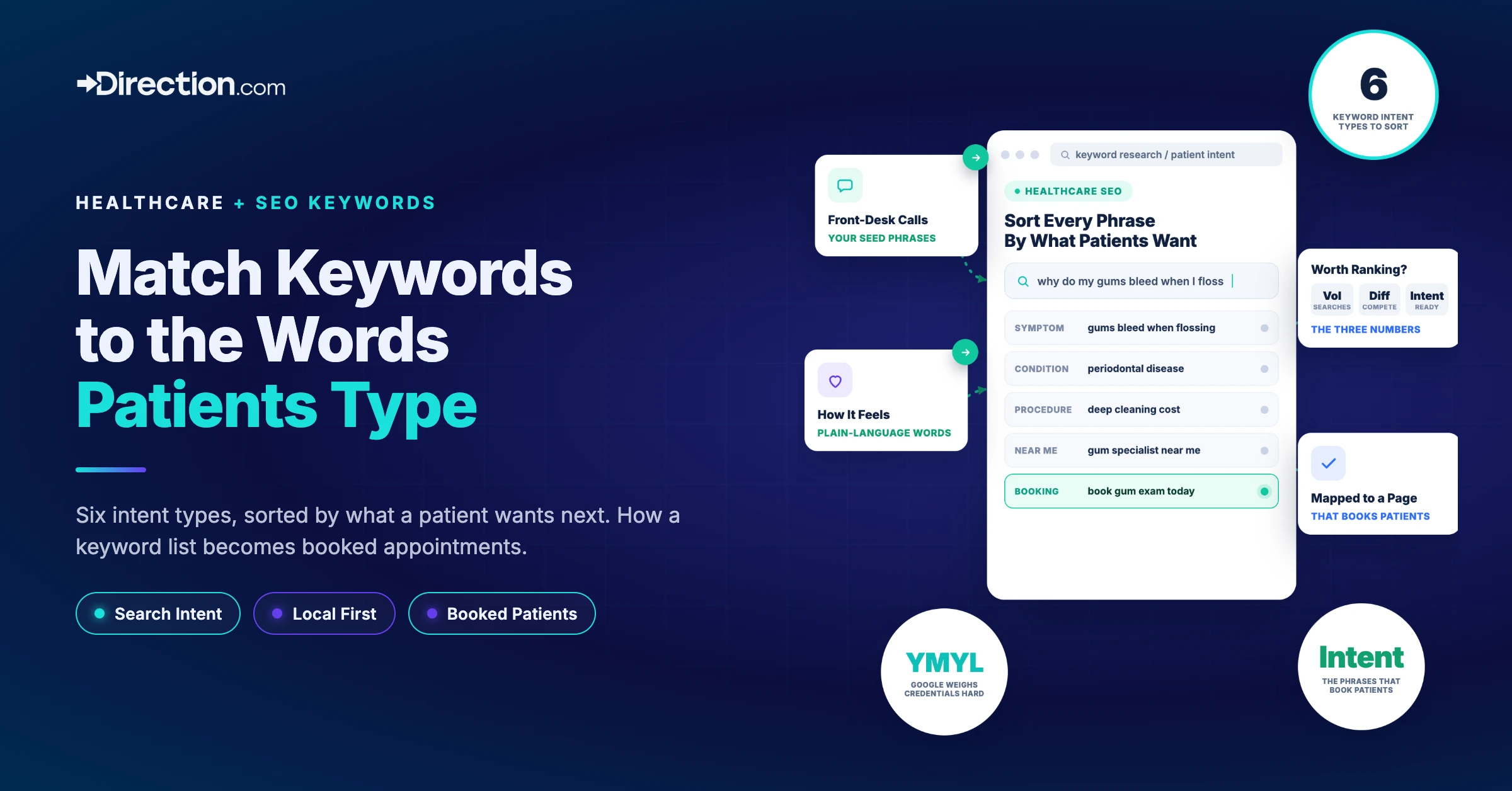
Sort Every Keyword by Patient Intent
A raw list of keywords is noise until you sort it by intent. Intent is the question behind the search, and healthcare searches fall into a few clear groups.
Someone searching “is a root canal painful” wants information, weeks out and maybe anxious. “Root canal cost without insurance” is a person comparing options. “Emergency root canal near me”? They book today.
Three searches about the same procedure, three different people.
Booking searches fill your schedule fast, and most practices under-serve them. They pour effort into the “is it painful” content, watch traffic climb, and wonder why the phone stays quiet.
Map the high-intent phrases to a booking page first. Then build the informational pages to catch patients earlier. That’s how you become the name they trust by the time they’re ready to book.
For a dental example of mapping intent to pages, see The Dental Team case study.
Find the Local Keywords Your Practice Can Rank For
If you’re trying to rank for a broad one-word search such as “Dermatologist,” you’re now up against national, well-established brands such as WebMD and Healthline.
A local practice has a much better shot at searches like “dermatologist in Austin” or “skin cancer screening in Lakeway.” Those searches also come from people who live close enough to become patients.
Start with your main SEO keywords, then add the places you serve. Use your city, nearby suburbs, and neighborhoods. Patients also search phrases like “dermatologist near me,” and Google uses their location to show nearby practices.
Insurance searches can be valuable too. A patient searching “dermatologist that takes Aetna” is usually much closer to booking than someone searching a broad term.
Your website and Google Business Profile work together in local search. The same keyword research can help you decide what pages to create, what services to list, and which local searches to focus on.
Want the full strategy covered? Our healthcare SEO campaigns include work on both the local map pack and your pages to reinforce each other.
3 Numbers to Check Before Targeting a Keyword
Once you’ve got your list of phrases, a tool like Ahrefs or Google Keyword Planner tells you how many people actually search each one, and the monthly trend. Three of them decide whether a keyword earns a page. Ahrefs scores difficulty 0 to 100 off the referring domains pointing at the pages already ranking.
| Number | What it tells you |
|---|---|
| Search volume | How many people search the phrase each month |
| Keyword difficulty | How hard it is to rank for, on a rough 0 to 100 scale |
| Traffic potential | The visits the top-ranking page earns across every term it ranks for |
Don’t let volume decide. A term with 1,000 searches and a difficulty of 60 sits on page four for a year, and that’s a long wait. One with 90 searches, a difficulty of 8, and real booking intent can fill a slot next month.
You’ll find the whole method, the seed list, the sort, and the local layer, in our 2026 Healthcare SEO Blueprint.
Analyze Competitors Keywords
Healthcare competitor keyword research is a bit different from your typical SEO report. You have three kinds of competitors:
- Direct practice competitors. The dermatology group across town, the one you already know by name. Pull up the service and condition pages they rank for.
- SERP competitors. WebMD, Healthline, and Cleveland Clinic own the research questions your patients read first. They shape who patients trust before a local name comes up at all.
- Directory competitors. Zocdoc, Healthgrades, Vitals. These outrank everyone on provider and procedure terms, which tells you where the commercial intent sits in your specialty.
Plug your top 10 to 15 phrases into Ahrefs and watch which domains keep showing up. The repeat offenders, the ones that appear for five or more of your terms, are your real competitive set.
Then pull the keywords they rank for and you don’t. Filter to difficulty under 40 with clear patient intent, and you’ve got a build list. Each phrase a competitor owns and you don’t is one more page worth writing.
Find the Topics Patients Ask ChatGPT and Google AI
More patients open ChatGPT, Perplexity, or Google’s AI Overview before they scroll a list of links. They ask a full question, “what’s the best treatment for a torn meniscus at 50,” and read the answer the model writes back. Your keyword research has to account for that.
Use the guide to earning AI citations to choose which patient questions to answer.
Two changes, in practice. Add the long, spoken-out questions to your research, the full sentences a person says out loud, because that’s what people type into AI.
And structure each page so a model can pull a clean answer. A direct response near the top, a real FAQ, a named provider on the page.
AI Overviews now turn up on a big share of local searches. Whitespark’s 2025 local-search study found them on 68 percent of local queries, with the local pack still showing on 39 percent.
Your Google Business Profile and local pages still pull the patients ready to drive to you. The AI answers show up more on the research questions patients read first.
The practices that started early are the ones the models name today, so we treat this as its own research track, AI search visibility. See how we approach SEO keywords for therapists.
FAQs Around Healthcare Keyword Research
What is healthcare SEO keyword research?
Finding the words patients type to look for care, then matching each phrase to a page that answers it. You sort phrases by intent, from symptom through booking, and build around the ones that bring patients ready to act.
What are the best keywords for a medical practice?
The ones that pair local intent with a clear next step. Think “[specialty] near me,” “[procedure] cost [city],” and “[specialty] that takes [insurance].” Each one reaches a searcher who’s already close to picking up the phone.
How long until keyword research shows results?
Low-difficulty local pages can rank in one to three months. Competitive terms take six months or more and usually need stronger site authority and link building. Start with the small, high-intent local phrases so you book patients while the harder pages build.
Get Your Healthcare Keyword List Mapped Perfectly The First Time
If your current keyword list is all condition names and your phone still isn’t ringing, that’s the first thing we untangle. We work with medical practices only. The team knows a symptom search from a booking search, and what production looks like across specialties, dental practices included.
Before any contract, we map the 6-month plan and show it to you. You’ll see the keywords worth owning and the pages that turn them into appointments.
We prioritize complete tracking of visits from the keywords we target to booked appointments. Talk to the Direction team and we’ll walk you through our process to see if we’re a good fit for each other.