Most dental marketing advice sounds like it was written by someone who’s never had to fill a schedule.
“Build a strong online presence.” “Engage with your community.” “Leverage social media.“
Thanks. Very helpful.
Here’s the reality: 77% of patients now start their dentist search on Google. They’re reading reviews, comparing websites, and making decisions before they ever pick up the phone. The practices winning new patients aren’t the ones with the best clinical skills. They’re the ones patients can actually find.
I’ve broken down 25 dental marketing strategies into what’s essential versus what’s optional, with actual data on what moves the needle. No “engage your audience.” Just what works.
The 3 pillars of dental marketing (and why order matters)
Every dental marketing strategy falls into one of three buckets: SEO, PPC, or website optimization. Understanding how they work together saves you from throwing money at the wrong things first.
Dental SEO: The slow burn that compounds
Search engine optimization gets your practice ranking in Google’s organic results. When someone searches “dental implants Austin” or “pediatric dentist downtown Seattle,” SEO determines whether you show up on page one or page nowhere.
Here’s what most people get wrong: they treat SEO as one thing. It’s actually three:
Local SEO is your Google Business Profile, directory listings, and reviews. This is what gets you into the Map Pack for “dentist near me” searches. For most dental practices, this matters more than anything else.
On-page SEO is your website content, page titles, and site structure. Each service page should target specific procedures patients actually search for.
Technical SEO is site speed, mobile responsiveness, and all the backend stuff Google uses to judge user experience.
The timeline for results varies wildly. Smaller cities? You might see ranking improvements in 3-4 months. Competitive metros like LA or NYC? Plan for 6-12 months of consistent work before significant movement.
SEO’s advantage is compounding returns. Once you rank for “teeth whitening [city],” that position generates patient inquiries month after month without additional ad spend. The disadvantage is patience. Most practices don’t have 6-12 months to wait.
Dental PPC: Immediate visibility, immediate cost
Pay-per-click advertising puts your practice at the top of search results today. You bid on keywords like “emergency dentist near me,” and your ad appears when patients search those terms.
Three ad types matter for dentists:
Search Ads show above organic results. Best for high-intent keywords where patients are ready to book.
Local Services Ads (LSAs) display at the very top with a “Google Guaranteed” badge. You pay per lead, not per click. For most dental practices, these outperform traditional search ads.
Display Ads show images across Google’s network. Better for brand awareness than direct patient acquisition. Most practices should skip these entirely until the basics are working.
What does PPC actually cost? The average cost-per-click for dental keywords runs $3-$12 depending on procedure and location. High-value procedures like implants often hit $15-$25 per click in competitive markets.
PPC’s advantage is speed. Launch Monday, receive calls Wednesday. The disadvantage is the meter never stops running.
Website optimization: Where leads go to die (or convert)
Here’s a stat that should terrify you: 97% of patients research dental practices online before making an appointment.
Drive all the traffic you want. If your website doesn’t convert visitors into appointment requests, you’re just paying to show people a bad website.
High-converting dental websites share common patterns:
- Phone numbers in the header. Not buried in the footer. In the header. On every page.
- Individual service pages. Not one “Services” page listing everything. Separate pages for implants, whitening, emergency care, etc.
- Trust signals everywhere. Reviews, credentials, before-and-after photos. Patients are anxious. Give them reasons to trust you.
- Mobile-first design. Over 60% of dental website traffic comes from phones. If your site looks bad on mobile, you’re losing patients to competitors.
- Online scheduling. Practices with online booking typically see 20-30% higher conversion rates than those requiring phone calls.
12 essential strategies every dental practice needs
I’ve labeled these “essential” because skipping them usually costs you more than doing them. Start here before anything else.
1. Fix your website first
Your website is the foundation everything else builds on. A professionally designed, fast, mobile-friendly site reflects the quality of care you provide. A slow, ugly one tells patients you’re behind the times before they ever call.
This isn’t about looking pretty. It’s about not losing patients you’re already paying to attract.
2. Claim and optimize your Google Business Profile
Your Google Business Profile is the cornerstone of local SEO. Practices with fully optimized profiles are 270% more likely to attract inquiries than those with incomplete listings.
Complete every field: business hours, services, office photos, and responses to reviews. Post updates weekly. Google rewards active profiles with better visibility.
3. Create content that answers patient questions
44% of patients read 3-5 pieces of content before booking. Blogging about “How to Prevent Cavities” or “What to Expect During a Root Canal” builds authority and captures search traffic.
But here’s what most dental blogs get wrong: they write for dentists, not patients. Use simple language. Answer the questions patients actually ask. Skip the clinical jargon.
4. Collect reviews from patients
Online reviews influence 70% of patient decisions. They also directly impact your local SEO rankings.
The key word is “systematically.” Don’t hope patients leave reviews. Build a process: send text or email requests within 24 hours of appointments. That’s when satisfaction is highest.
And respond to every review. Yes, the negative ones too. How you handle criticism tells potential patients more than how you accept praise.
5. Optimize for local search
“Near me” searches have increased 900% in recent years. Local SEO for dentists helps you capture the 60%+ of clicks that go to the top three Map Pack results.
Three things matter most: location-specific keywords on your site, NAP (Name, Address, Phone) consistency across all directories, and local backlinks from other businesses in your area.
6. Guest post on reputable sites (and local sites)
Writing articles for local news sites or dental publications earns backlinks that help your Google rankings. It also shows patients you know your stuff.
Quality matters more than quantity. One well-written piece on a respected site does more for you than ten posts on sites nobody visits.
Backlinks from other local websites tell Google you’re a trusted part of the community. They’re also hard for competitors to copy.
Work with local businesses. Sponsor community events. Get mentioned on neighborhood websites. Each good backlink helps you show up when someone searches “dentist near me.”
7. Build an email list (and use it)
Email marketing keeps your practice top-of-mind for existing patients. Appointment reminders, special offers, and educational content all drive repeat visits.
The mistake most practices make: sending the same email to everyone. Segment your list. New patients need different messages than patients you haven’t seen in two years.
8. Create educational videos
Video builds trust faster than text. Office tours, procedure explanations, and patient testimonials perform well on websites and social media.
Video also improves time-on-page metrics that Google tracks. More time on your site signals quality content, which helps rankings.
9. Get Zocdoc verified
Zocdoc makes booking easy. Modern patients expect convenience. The verification badge signals trustworthiness to patients comparing options.
Is there a cost? Yes. Is it worth testing? For most practices, yes.
10. Show up on social media (but don't overthink it)
Social media humanizes your practice. Team photos, patient success stories, and behind-the-scenes content build connection.
Here’s the thing: three quality posts per week beats daily low-effort content. Consistency matters more than volume. Pick one or two platforms and actually maintain them.
11. Launch a patient referral program
Personal recommendations remain the most trusted form of marketing. A referral program turns satisfied patients into a sales team.
Make the incentive meaningful (credit toward services, gift cards) and the process simple (digital referral links, not paper forms).
12. Get Your Dental Practice Recommended by ChatGPT and AI Assistants
You can apply all the rules above, but guess what? Ranking #1 on Google doesn’t guarantee all your ideal patients will find you anymore.
That sounds dramatic. It’s also true.
Google’s AI Overviews now answer patient questions directly in search results. ChatGPT has 300 million weekly users asking “who’s the best dentist near me?” Perplexity, Claude, and voice assistants like Siri are becoming default research tools for healthcare decisions.
The shift is already measurable. Based on internal data of our clients, AI tools now account for roughly 11% of dental practice website traffic, and that number doubles every few months. More importantly, visitors from AI citations convert 4.4x better than traditional organic traffic. By the time someone finds your practice through an AI recommendation, they’ve already decided you’re credible.
Traditional SEO gets you ranked. AI optimization gets you recommended. You need both.
What AI Systems Look for When Recommending Dentists
AI assistants don’t use the same ranking signals as Google. They’re looking for content they can confidently extract and cite as an authoritative answer.
Here’s what that means practically:
- Structured, extractable answers
- Clear entity signals
- Verification through reviews
- Technical accessibility
The practices showing up in AI-generated answers share three characteristics: fast-loading websites with clean HTML structure, content organized as clear questions and answers, and consistent business information across every platform.
5 Steps to Optimize Your Dental Practice for AI Search
1. Unblock AI Crawlers
Check your robots.txt file at yourdomain.com/robots.txt. Look for lines blocking “OAI-SearchBot,” “PerplexityBot,” or “ClaudeBot.” If you see “Disallow: /” for these user agents, AI systems can’t access your content.
Quick test: Search for your practice name on ChatGPT or Perplexity. If your website never appears as a source, you likely have an access issue.
2. Structure Content for Extraction
AI systems prefer content formatted as direct answers to specific questions. Write service pages with this pattern:
- Start each section with the question patients actually ask
- Answer in 2-3 sentences before adding detail
- Use bullet points for lists of 3+ items
- Include your practice name and location naturally (not just pronouns)
Example: Instead of “Our whitening treatments produce excellent results,” write “Teeth whitening at [Practice Name] in [City] typically lightens teeth 6-8 shades in a single 90-minute appointment.”
3. Build FAQ Pages That AI Can Cite
FAQ pages are citation magnets for AI systems. But not the generic kind. Write FAQs that answer the exact questions patients ask AI assistants:
- “How much do dental implants cost in [City]?”
- “Does [Practice Name] accept [Insurance Provider]?”
- “How long does Invisalign take for adults?”
- “What’s the best dentist for nervous patients near me?”
Each answer should start with a direct response (15-20 words), followed by supporting details. Add FAQ schema markup so AI systems can identify and extract these answers.
4. Strengthen Local Signals
AI systems cross-reference your website against Google Business Profile, Yelp, Healthgrades, and other directories to verify accuracy. Inconsistent information creates doubt.
Audit these elements across all platforms:
- Practice name (exact match everywhere)
- Address and phone number (NAP consistency)
- Hours of operation
- Services offered
- Insurance accepted
AI assistants handling “dentist near me” queries pull heavily from Google Business Profile data. A complete, accurate GBP with recent photos, updated services, and fresh reviews significantly increases your chances of being recommended.
5. Generate Review Velocity
AI systems use review recency, volume, and sentiment as trust signals. A practice with 50 reviews from 2022 looks less credible than one with 30 reviews from the past 6 months.
Focus on:
- Asking for reviews within 24 hours of appointments (response rates drop 80% after 48 hours)
- Encouraging specific details in reviews (“Dr. Smith explained the implant process clearly” beats “Great dentist!”)
- Responding to every review, positive or negative
Detailed reviews containing procedure names, staff names, and specific experiences give AI systems more data points to extract when generating recommendations.
Tracking AI Visibility
Traditional rank tracking doesn’t capture AI performance. You need different metrics:
- AI referral traffic: In Google Analytics, check Acquisition > Traffic Acquisition for referrals from chat.openai.com, perplexity.ai, and other AI platforms
- Brand mention monitoring: Periodically search your practice name and key services on ChatGPT and Perplexity to see if you’re being cited
- Zero-click query tracking: Monitor Search Console for impressions without clicks, which may indicate AI Overviews answering queries directly
AI search optimization isn’t replacing traditional dental SEO. It’s building on it. The practices winning AI recommendations already have strong organic rankings, accurate local listings, and consistent review activity.
13 optional dental marketing strategies worth testing
These can work well but aren’t essential. Test them once the basics are solid.
13. Offer a dental membership program
Membership programs appeal to uninsured patients who want predictable costs. They also create recurring revenue. Worth testing if you have a significant uninsured patient base.
14. Run a contest or giveaway
Free whitening contests drive social media engagement and email signups. Short-term tactic, not a long-term strategy.
15. Start a podcast
Podcasts build authority and attract a specific audience segment. High effort, slow payoff. Only pursue this if you genuinely enjoy it.
16. Support local charities
Community involvement builds goodwill and earns local press coverage. Choose causes you actually care about. Patients can spot performative charity.
17. Offer new patient discounts
Promotions lower barriers for first-time visits. Effective for patient acquisition, but be careful not to attract deal-seekers who won’t return.
18. Run Facebook ads
Facebook’s targeting lets you reach specific demographics and locations. Works best for cosmetic procedures where before-and-after images drive interest.
19. Set up Google Ads
Google Ads provide immediate visibility. Essential in competitive markets, optional in smaller ones where organic SEO can do the work.
Track cost per new patient, not cost per click. Plenty of practices pay for clicks that never convert.
20. Send press releases
New office openings, technology additions, or community involvement can earn local media coverage. Traditional but still effective for the right announcements.
21. Use direct mail (EDDM)
Yes, physical mail still works. Particularly effective in residential neighborhoods for reaching households that aren’t searching online.
22. Add QR codes to print materials
QR codes bridge physical and digital marketing. Include them on business cards, mailers, and in-office signage to drive traffic to your booking page.
23. List on healthcare directories
Healthgrades, Yelp, and Vitals provide additional visibility and review platforms. They also generate backlinks that support SEO.
24. Create location-specific landing pages
If you serve multiple neighborhoods or cities, dedicated pages for each location capture more local search traffic. Make each page unique, not just the same template with different city names swapped in.
25. Sponsor community events
School sports teams, charity runs, and local festivals offer visibility and goodwill. Choose events your actual patients attend.
How much should you actually spend on Marketing your dental practice?
The standard advice on how much to spend on marketing is 5-10% of revenue. That’s not wrong, but it’s not helpful either.
Here’s how to think about it more practically:
Startup practices need 7-10% of projected revenue because you’re building from zero. No existing patient base means marketing carries the entire acquisition load.
Growth-mode practices should budget 5-7%. This sustains current volume while funding expansion.
Stable practices focused on maintenance can often operate at 3-5%, primarily maintaining SEO rankings and reputation.
Where should the money go? Here’s a rough allocation that works for most practices:
| Category | % of Budget | Example ($60K/year) |
|---|---|---|
| SEO & Content | 30% | $18,000 |
| PPC Advertising | 40% | $24,000 |
| Website & Tech | 17% | $10,000 |
| Reputation Management | 13% | $8,000 |
5 mistakes that waste your budget
After working with dozens of dental practices, certain patterns keep appearing. Avoid these and you’re already ahead of most competitors.
Treating marketing as an expense instead of an investment
Practices that view marketing as a cost to minimize make poor decisions. They chase the cheapest provider, cut budget at the first slow month, and wonder why nothing works.
Marketing generates patients. Patients generate revenue. The question isn’t “how do I spend less?” but “how do I get better returns?”
Expecting instant SEO results
SEO is a 6-12 month investment in competitive markets. Practices that quit after 90 days because they “didn’t see results” waste their initial investment and never reach the payoff.
Track leading indicators (ranking improvements, organic traffic growth) before lagging indicators (new patients) appear. Progress happens before results.
Running PPC without conversion tracking
Spending on Google Ads without knowing which clicks become patients isn’t marketing. It’s gambling.
Install call tracking. Set up form submission tracking. Connect everything. Then optimize based on what actually brings patients through the door.
Ignoring reviews until they become a problem
A practice with 4.9 stars and 200 reviews will attract more patients than one with 4.2 stars and 30 reviews. Clinical quality doesn’t matter if patients never walk through the door.
Reputation management isn’t crisis response. It’s ongoing maintenance.
Hiring a generalist marketing agency
Agencies that also handle restaurants, law firms, and e-commerce stores don’t understand dental patient behavior, HIPAA compliance, or procedure-specific keyword targeting.
Work with specialists who know dental terminology and patient psychology. The learning curve with generalists costs you time and money.
Measuring what matters (hint: it's not clicks)
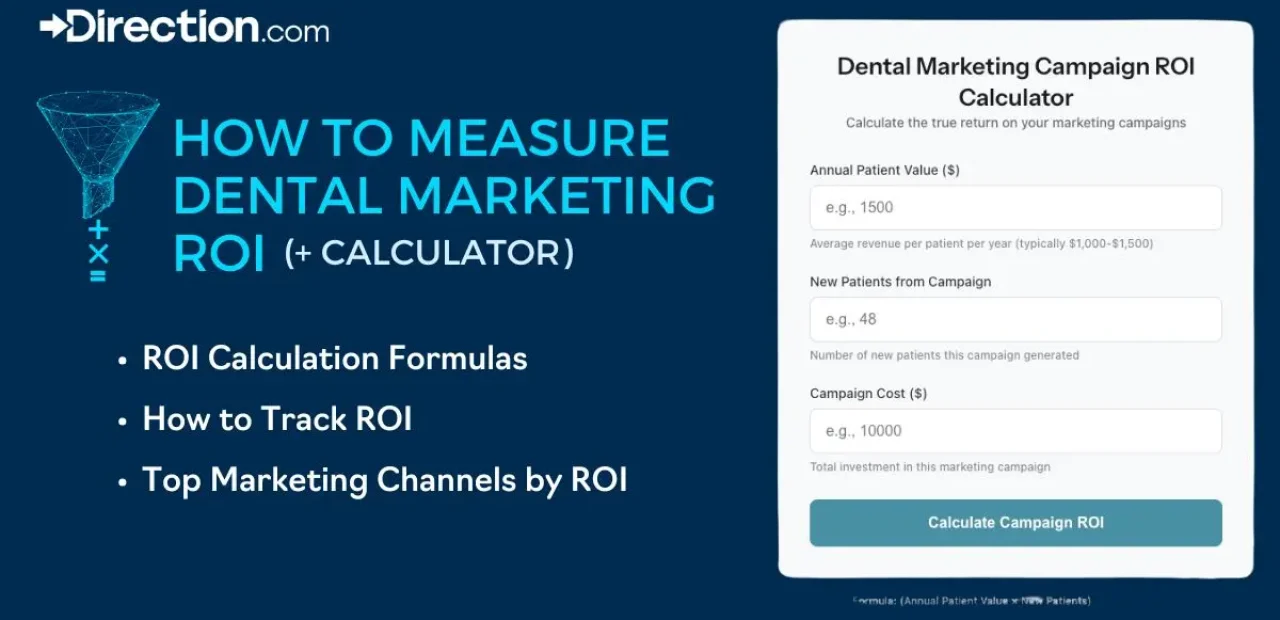
Dental marketing ROI isn’t measured in impressions, clicks, or rankings. It’s measured in cost per new patient and return on ad spend.
Cost per new patient = Total marketing spend ÷ Number of new patients acquired
If you spend $5,000 monthly on marketing and gain 25 new patients, your cost per patient is $200.
Whether $200 is “good” depends on patient lifetime value. A general dentistry patient might generate $1,500-$3,000 in lifetime revenue. An implant patient might generate $15,000-$30,000. Context matters more than absolute numbers.
What should you actually track?
- New patient calls and form submissions (total lead volume)
- Lead-to-appointment conversion rate (how many leads become patients)
- Cost per lead by channel (which sources deliver cheapest leads)
- Cost per new patient by channel (which sources deliver cheapest patients)
- Production attributed to new patients (actual revenue generated)
Dental Marketing FAQs
How much should a dental practice spend on marketing?
Dental practices should allocate 5-10% of gross revenue to marketing annually. A general dentistry practice generating $1 million in production would invest $50,000-$100,000 per year across channels like SEO, PPC advertising, and reputation management.
Budget allocation shifts based on practice maturity:
- Startup practices: 7-10% of projected revenue to build initial patient acquisition systems
- Growth-mode practices: 5-7% to sustain volume while funding expansion
- Established practices: 3-5% for maintenance of SEO rankings and review generation
Most practices we work with see the strongest ROI when 40% goes to PPC, 30% to SEO, and the remainder split between website optimization and reputation management. If you’re unsure where your budget should go first, starting with a marketing audit helps identify the gaps costing you the most patients.
How long does dental SEO take to work?
Dental SEO typically produces measurable ranking improvements within 3-6 months, with significant new patient acquisition beginning at 6-12 months in competitive metro markets. Less saturated markets like smaller cities and suburban areas often see faster movement in Google’s Local Pack.
The dental SEO timeline breaks into phases:
- Months 1-3: Technical fixes, Google Business Profile optimization, and on-page SEO implementation
- Months 3-6: Ranking improvements for secondary keywords and increased organic traffic
- Months 6-12: Primary keyword rankings stabilize and new patient calls increase
Practices that quit SEO after 90 days never reach the compounding phase where cost-per-patient drops significantly below PPC. Tracking leading indicators like keyword position changes and organic traffic growth helps confirm progress before new patients arrive.
Should I prioritize PPC or SEO?
Dental practices needing immediate patient flow should prioritize PPC advertising first, while practices building long-term acquisition systems should invest in SEO. Most successful dental marketing strategies combine both channels, using Google Ads for immediate leads while organic rankings develop.
The right priority depends on your situation:
- Choose PPC first: New practices, those recovering from slow periods, or launching high-value services like dental implants
- Choose SEO first: Established practices with stable cash flow seeking lower long-term cost-per-patient
- Use both simultaneously: Practices in competitive markets where organic rankings take 12+ months to achieve
PPC campaigns can generate patient calls within 48 hours of launch. Dental SEO requires 6-12 months before delivering comparable patient volume, but the cost-per-acquisition typically drops 40-60% below PPC once rankings stabilize. You shouldn’t have to choose blindly between channels when data can show which performs better in your specific market.
What's a good cost per new patient?
A good cost per new patient ranges from $150-$350 for general dentistry procedures and $250-$500 for high-value treatments like dental implants, full-mouth reconstruction, or Invisalign cases. Cost-per-patient benchmarks vary significantly based on geographic market, competition density, and procedure type.
Cost-per-patient context matters more than absolute numbers:
- General dentistry patient: $150-$350 acquisition cost, $1,500-$3,000 lifetime value (LTV)
- Cosmetic dentistry patient: $200-$400 acquisition cost, $3,000-$8,000 LTV
- Dental implant patient: $250-$500 acquisition cost, $15,000-$30,000 LTV
A $200 acquisition cost for a general dentistry patient generating $2,000 in lifetime production delivers 10:1 ROI. The same $200 cost for an implant patient generating $20,000 delivers 100:1 ROI. Tracking patient lifetime value alongside acquisition cost reveals which marketing channels actually drive profitability, not just lead volume.
Maximize Your Dental Practice's Patient Acquisition Potential
The practices that grow consistently aren’t doing anything magical. They’re doing the basics well: a website that converts, a Google Business Profile that’s complete, reviews that build trust, and content that answers patient questions.
Start with the essential strategies. Get them working. Then experiment with the optional tactics.
The biggest mistake isn’t picking the wrong strategy. It’s trying to do everything at once and doing nothing well.
Got questions? Talk to our team about your dental marketing strategy.