Healthcare digital marketing strategies are easy to come by – there’s plenty of ’em online. And the best part is that nobody can patent their marketing and advertising methods. So, once you see someone use one that you think is great, you can basically copy it (just not word-for-word, that’s stealing).
The goal of everything I’m going over here is ultimately to ensure you’re in-front of potential patients, right when they need you, wherever they may be looking.
I’ll discuss healthcare marketing services and strategies from online channels (search, maps, reviews, AI answers, email, and social), as well as offline channels that pair with your digital marketing strategies.
Everything here will be based on data-backed marketing strategies that have been proven to work for healthcare practices of different types – from dental to primary care and more.
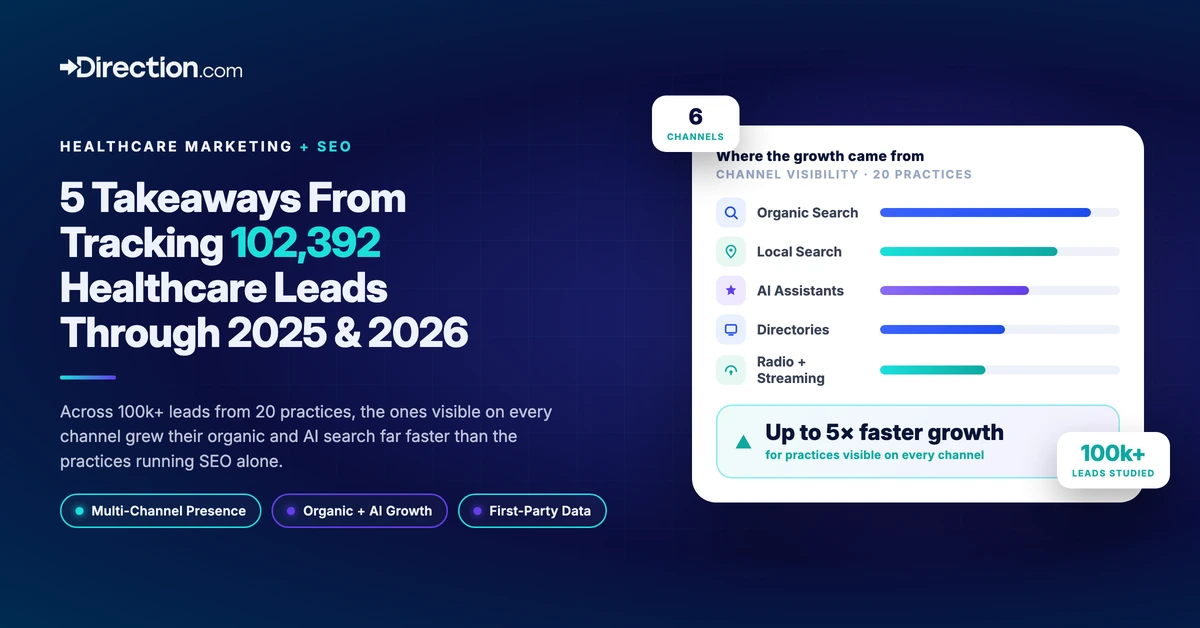
For reference, if I mention the Direction Lead Source study, it’s based on the data I pulled from our own internal research and data of 102,392 patient leads from 20 healthcare practices that we actively run marketing campaigns for, comparing late 2025 against the first half of 2026.
Where New Patients Can Be Found
| Lead source | 2025 share | 2026 share | Change |
|---|---|---|---|
| Organic search | 40.8% | 35.8% | ▼ 12.20% |
| Local search (Google Business Profile) | 27.5% | 29.4% | ▲ 6.95% |
| Direct | 16.9% | 20.9% | ▲ 23.51% |
| Referral directories | 12.8% | 11.0% | ▼ 14.39% |
| AI tools (ChatGPT, Perplexity, Gemini) | 1.2% | 1.9% | ▲ 55.10% |
| Organic social | 0.7% | 1.0% | ▲ 32.72% |
1. Run a Free Giveaway
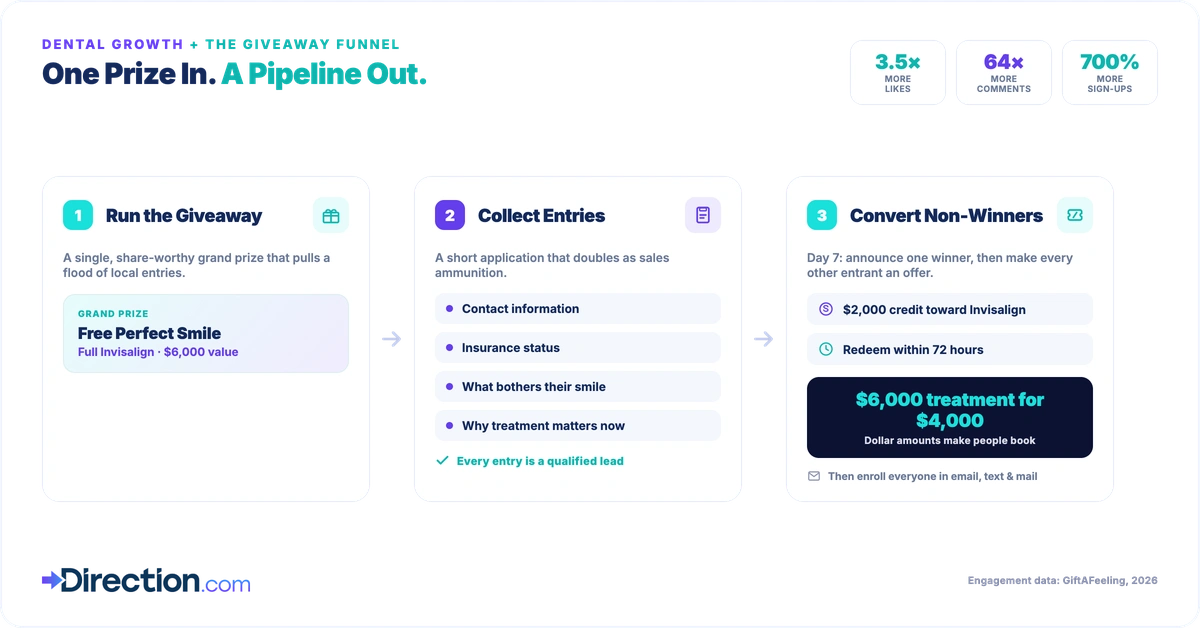
A giveaway advertises one grand prize, collects entries with contact information and qualifying questions, then converts every non-winner with a promotional offer. The data from GiftAFeeling is pretty clear on this one:
- Posts with giveaways get 3.5x more likes and 64x more comments than regular posts
- Brands that run them grow Instagram accounts 70% faster
- Landing pages tied to giveaways can see up to 700% more sign-ups compared to standard campaigns
A dental practice could run a “Free Perfect Smile Giveaway” with a full Invisalign treatment as the grand prize, a $6,000 retail value.
With Entry being a simple, short application: contact information, current insurance status, what bothers them about their smile, and why they want the treatment.
Great data for sales ammunition. After announcing the winner on day seven, contact every other entrant with other secondary/tertiary/etc prizes. For example; a $2,000 credit toward Invisalign, redeemable within 72 hours of booking a consultation.
These entrants told you exactly what they want the moment they signed up. Now let the credit do the talking, $6,000 of treatment for $4,000.
Percentages make people think. Dollar amounts make people book.
Keep the credit between 10-30% of your gross margin. If someone declines, have a lower-priced option as a backup, such as the same percentage off professional whitening.
Best of all, if you properly setup the prize rules with legal consent to market to them, you can now enroll everyone in email, text, and mailer campaigns.
Important caveat on free giveaways:
The healthcare industry has to address a web of HIPPA regulations, plus state and federal compliance requirements. Always have your attorney double-check everything. It’ll be worth the extra legal fees, as giveaways historically far outperform almost every other type of one-off marketing campaigns when run correctly.
Our HIPAA marketing rules guide covers what you can and cannot do with patient data in campaigns.
2. Let Patients Win Their Money Back
Sounds counter-intutive, I know. But stick with me for a minute here.
A win your money back offer asks patients to place a deposit on a program with a defined goal. Run one of these with a banner on your website, and on your social media channels and you’ll see lots more signups.
Hit the goal or complete the required actions, and the deposit comes back as cash or credit.
Example for Physical Therapy: The “Full Recovery Guarantee”
Patients tend to drop out of PT around visit six, even when their plan calls for twelve.
Incentivize patients to make every appointment by charging a $300 deposit on top of copays at the start of a plan of care.
Patients will earn it back, plus, say, a free additional visit by attending every scheduled visit, completing their home exercise program four days per week logged in the clinic’s app, and finishing their discharge evaluation.
The discharge eval is your sales appointment: present the monthly wellness membership, dry needling package, or gym-transition program there.
Apply the $300 as a discount spread across six months of the membership. The insurance already covers the visits, so the deposit costs the patient nothing if they simply do what their recovery requires.
3. Get Stocked on Promotional Products
Promotional products keep your practice on your patients minds. If someone books a visit online through your website, send them some swag.
According to research from PPAI, around 90% of consumers remember brands better after receiving a promotional item, and 80% of people said promotional products produced a positive brand impression for them.
A pediatric practice can build these into every touchpoint.
New patient families walk out with a welcome bag. A branded digital thermometer, a bandage dispenser for the diaper bag, and a growth chart with your brand. I know for my kids, they love the growth chart that hangs on their bedroom wall, and my wife knows our doctor by name, probably because of that.
The kids get a branded water bottle on the way out (please, stop with the candy). It shows up at every soccer practice after that.
Then back-to-school season rolls around, and the practice works the sports registrations and PTA nights handing out logo-printed first aid kits. Inside each one, a fridge magnet with the nurse line number. Scraped knee on a Saturday, and yours is the number already on the fridge.
Something as cheap and simple as a magnet will get your brand thousands of refrigerator impressions per household over its life, building strong brand recall.
The mom with a thermometer that’s got your logo on it answers the question of which practice to call when the time comes.
4. Treat Your Google Business Profile To Some Love
According to our research in the lead study, Google Business Profile, or, local SEO in general send nearly 1/3 of all non-paid leads. No other channel managed to perform this well, especially for how little time and money it takes.
The profiles that win the map pack get optimized weekly, and get reviews consistently. Always add new photos from your office, real ones. Sterling Sky’s 2025 test covered five website pages and Google Images. It didn’t test a Business Profile stock-photo filter. Make sure your service menus are filled out, you’re putting out different types of posts, and you’re on-top of review replies.
5. Build Service Pages for Money Searches
Organic search generated more leads to the practices we measured than any channel.
Pew Research tracked 900 US adults’ web use in March 2025. They clicked a standard result on 8% of visits with AI summaries and 15% of visits without them.
The dataset had 68,879 unique searches. AI summaries appeared for 12,593 of them.
Ahrefs separately studied desktop click-through rates using December 2025 data. Top-ranked pages for AI Overview keywords had rates 58% below the estimate for those same keywords without AI Overviews.
But guess what? Booking searches didn’t go away, at all. Someone typing “emergency dentist open Saturday” or “semaglutide clinic accepts Aetna” still sees regular results and a map, and still clicks.
Ahrefs’ trigger study of 146 million SERPs says the same thing. AI Overviews show up on 44.1% of medical-topic queries, 2.1% of transactional searches, and 7.9% of local searches.
So focus on creating service-pages for the various types of booking intent. One page per procedure, per physical location, answering cost, candidacy, recovery, and insurance before the patient has to call you and ask.
6. Get Found in AI Tools / LLM Chats
Would you take a surgeon recommendation from a chatbot? I wouldn’t, but, apparently your patients are starting to.
rater8’s 2026 patient survey asked patients about their choice of doctor. Of those who searched in the past year, 36% cited AI tools as an influence. Google search was 34%, and 32% cited doctor recommendations.
OpenAI shared its figures in January 2026. Over 230 million people worldwide ask ChatGPT health and wellness questions each week.
In the rater8 survey, 64% of 45-to-60 year olds used AI to find providers, against 28% of 18-to-29 year olds. The people asking ChatGPT to pick a doctor are the ones with dental coverage and knee pain.
Getting your practice mentioned in those answers basically has to do with having great SEO basics down. The brands and pages AI tools recommend share many similar patterns, and I’ve reverse-engineered dozens for clients.
Having a strong online brand presence with mentions of your practice, and your practitioners on other websites and social media, source-referenced studies with dates, an author with verifiable credentials, and a visible update date.
That all being said, according to our dataset, AI tools we’re only about 2% of all leads. It also was the fastest growing channel. So, smallest base but a growing one.
Just don’t go HAM trying to get found in GPT and forget that most of the results get pulled from Google. In other words, increase what you’re doing for SEO, and you’ll likely get found in LLMs.
7. Work on Your Reputation, Everywhere
Press Ganey’s 2024 consumer survey found 84% of patients won’t consider a physician rated under four stars. Every dollar you spend on visibility multiplies against your rating, so a 3.8-star practice buying ads is paying to show more people a reason to pick the competitor.
Focus on both review velocity and review response rates.
Velocity meaning a consistent stream of new reviews, asked for by various methods.
BrightLocal’s 2026 consumer review survey found 74% of consumers only look at reviews from the last three months. A bunch of reviews from 2023 doesn’t help anyone choose you.
Response means answering within a few hours. But be careful and don’t confirm that the reviewer was your patient. Doing so violates HIPAA, even in a thank-you, and your whole front desk needs to know the safe pattern. OCR collected $30,000 from Manasa Health Center in 2023 over Google review replies that disclosed patient details.
8. Reactivation Offers
A dental client of mine had 1,900 patients who hadn’t visited in 14 months or more, sitting stale in the practice management system. A two-message recall sequence (text first, email three days later) filled 240 hygiene slots in six weeks. Total cost? Staff time and a texting tool.
Acquiring a new customer runs 5 to 25 times the cost of keeping one, per research Harvard Business Review published in 2014.
Those patients already trust you, and live nearby. Pull lapsed patients by recall type and exclude anyone with an open balance dispute. Get consent right too, since patient texting can cross TCPA and HIPAA lines.
Reactivation isn’t always easy to show in marketing reports as a lead source, so many people forget it. Your schedule just fills. Which may explain why practices chronically underfund it while chasing colder, costlier channels.
9. Fix the Website Leaks Before Filling the Funnel
Zocdoc’s after-hours booking data shows roughly half of appointments get booked between 5 p.m. and 9 a.m., while your front desk is dark. Your site gets one visit, on a phone, probably at night. If booking takes a phone call during business hours, the 10 p.m. researcher books whichever competitor has the online scheduler.
The conversion audit I run on new clients keeps finding the same three leaks. A form buried below four scrolls of mission statement. No call tracking anywhere on the site, so nobody can say which pages produce the phone calls that fill your schedule. And page speed that loses the visitor before your first headline paints.
The speed leak has a number on it. Google and Deloitte’s speed study tied a 0.1-second cut in mobile load time to an 8.3% drop in lead-gen bounce rates.
Plumbing, all of it. Unglamorous plumbing that decides whether anything else pays. It’s also why the websites Direction builds for practices start from the booking flow and work backward.
Then there’s the tracking risk most practices don’t know they’re carrying. Healthcare organizations paid over $100 million across 19 cases between 2023 and 2025 for tracking tech that leaked patient data, per Feroot’s count. Kaiser Permanente separately agreed to pay up to $47.5 million in December 2025.
HHS’s current notice says a June 20, 2024 court order set aside part of its tracking guidance. The order left other guidance in place. That ruling doesn’t approve your site’s tracking setup.
10. Publish Helpful Content
Yes, you’ve heard this since the beginning of time, and it’s still true. It works.
Two practices publish a blog post on the same procedure. One runs 900 words under a physician’s byline, cites two named studies, and shows an update date. The other runs 2,000 words of unattributed AI output. Google’s health-content systems and every AI engine treat those two pages differently, and your patients do too.
Tebra’s 2025 patient survey found that 79% read reviews before choosing a provider. The figure refers to survey respondents. Health content also sits in the category Google’s documentation holds to its highest sourcing bar.
Before writing this piece I read the five top-ranking guides on healthcare digital marketing end to end. None carried a healthcare-credentialed byline, none showed first-party data, and two still cited patient statistics from 2013. That’s the bar, and it’s low. A practice whose content shows a real clinician, real numbers, and current sources clears it fast.
I’ve audited practices that published 100+ unreviewed AI posts and watched sitewide rankings get destroyed in a single day under Google’s scaled content abuse policy. Proper cleanup to restore trust then waiting for an algorithm update to come back around and re-recognize you can take 6+ months. The judgment calls around what content to publish, prune, rewrite and consolidate is the toughest part.
11. Show Up in More Than One Channel
The clearest pattern in this study was how leveraging multiple marketing channels positively affected each one. The practices showing up everywhere (search, ads, directories, social, even Spotify and local radio) grew organic and AI-search leads at double or more the rate of practices only doing SEO.
Makes sense, since Google, and AI models all read the same web. A practice active on and mentioned in local press, podcasts, review directories, and social makes the brand look popular. A brand only visible in one place vs. everywhere is social proof.
Be cautious of how you’re increasing spend though, since referral directories lost 14.39% of lead share this year, which was the biggest drop in the study. Plus, now as of December 2025, Zocdoc powers booking on Healthgrades. When business is booming, you don’t typically see rivals sharing and integrating like this. Keep the two or three directories that send you most qualified patients at the best cost and reallocate the rest.
12. Track The Source of Every New Patient
Direct traffic grew the most at 23.51%. Analytics defines Direct as typed addresses and bookmarks. In other words, it’s basically leads the tracking couldn’t explain. Loamly’s analysis of 446,000 visits found 70.6% of AI-driven visits land in GA4 labeled Direct. A patient reads about you in a ChatGPT answer, types your name into the browser, and the report credits nobody.
Your best-performing channel might be invisible in the tool you pay to watch it.
Consent banners make it worse, since a patient who clicks Deny leaves no trail at all. Attribution is an estimate that blurs a little more every year. A form fill is a fact. A phone call is a fact.
So the reporting my team builds starts from booked patients and works backward, stitching call tracking, form data, and the practice management system together. When you ask whether the campaign works, the answer should come from your schedule.
What a New Patient Costs in 2026
Budget conversations go better with the market rates on the table. First Page Sage’s 2026 acquisition report and FoundryCRO’s 2026 specialty benchmarks track cost by specialty.
For the budget itself, read what percentage of revenue to spend on marketing and which marketing expenses are tax deductible.
| Specialty | Cost per new patient (2026) | What moves it |
|---|---|---|
| Urgent care | $75 to $200 | High volume, low decision friction |
| Pediatrics | ~$155 | Parents lean on reviews and referrals |
| Primary care | $150 to $400 | Insurance fit decides most bookings |
| Cross-specialty average | ~$373 | Average of First Page Sage's 19 tracked specialties |
| Cardiology, neurology | $577 to $582 | Long research cycles, referral heavy |
| Cosmetic surgery | ~$610 | Competitive ad markets, high ticket |
| Behavioral health | Up to $2,500 | Ad restrictions, trust-heavy decision |
Channel choice is really important here. First Page Sage puts organic search at $215 per patient, the cheapest of the nine channels it tracks, against $342 for paid search. Paid buys you speed. Organic compounds. A practice weighing the two is choosing when it wants the patients, this month or for years.
For most non-episodic specialties, lifetime value runs 5 to 20 times acquisition cost in FoundryCRO’s economics matrix, and orthopedics and fertility run far higher. Spend that looks expensive per lead is often cheap per relationship, so know your own lifetime-value number before you call any line item “expensive.”
Run The Most Effective Healthcare Digital Marketing Stragies
Book a free patient acquisition diagnostic and we’ll pull apart how patients find your practice, channel by channel. Organic rankings and intent, paid spend and ROI, your map pack position, and the funnel between a search and a booked appointment. This diagnostic is free. Staying blind for another two quarters is the expensive option. Which one will you choose?
For more tactics, see our healthcare marketing ideas and primary care marketing strategies, or read the questions practices ask us most.