Your practice has a great website. You rank on Google. You have reviews. You’ve published content for years.
Then you ask ChatGPT to recommend a practice like yours in your city.
It shows a bunch competitors.
Not you.
So, what happened?
Did ChatGPT search Google? Did it already know those practices? Did it read their websites? Why did it trust them? And what would need to change for your practice to show up next time?
The AI SEO Stuff Nobody Seems to Explain
AI search gets sooo confusing. There’s industry jargon, experts arguing on what works vs. what doesn’t, and endless advice telling you what to do without explaining why it works or what actually happens after you hit send.
So that’s what this guide does. It’s a compilation of all the research I’ve done over the past few months on the inner workings and mechanisms of LLMs.
I read at least a few hundred X threads, tweets, LinkedIn articles, blogs, Reddit posts, and more.
I found it nearly impossible to piece everything together from Google searches or asking GPT.
Almost every article I came across was the same old “how to get found in ChatGPT, 10 tactics” stuff I’ve heard too many times to count.
Wayyy too many articles are guessing at what works for AI SEO. (Or whatever you want to call it, since there are also other acronyms such as AEO, GEO, and LLM SEO.)
It was mostly recycled crap like “structure your content this way,” “post on Reddit,” “create a top 10 listicle,” or “just do SEO,” without explaining why any of it works.
So, I wanted to write the article I couldn’t find.
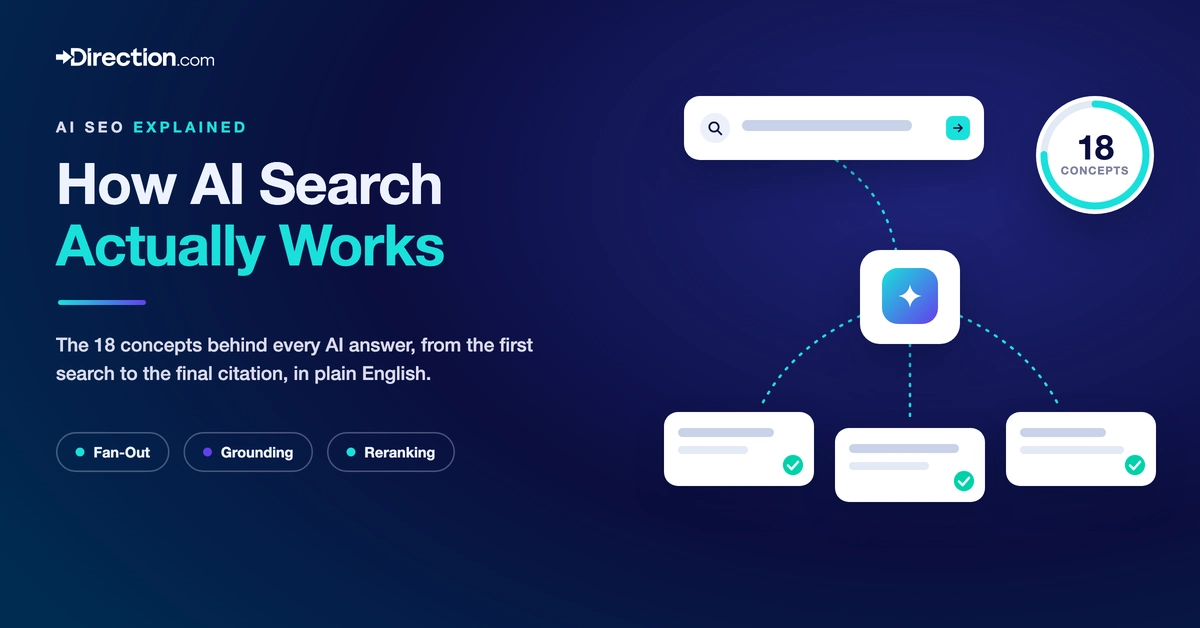
I’m going to introduce you to 18 AI SEO concepts, many of which I recently learned myself.
Because to understand how to get found in AI search, you first need to understand what’s actually happening when AI answers a question.
Once you understand that, it becomes much easier to see why certain things work and others don’t.
I’ll show you how AI finds information about brands, how it decides what information to use, ways to test it yourself, and what you can change on your website to give your brand a better chance of being found, cited, and recommended.
I’ve explained everything as simply as I can and created graphics for each concept, so you don’t need to know AI engineering or SEO lingo to follow along.
Ready for the fun?
How many searches does a search engine do when a searcher searches you?
Let’s say “Mrs. Jones,” A 52 year old woman in Scottsdale asks ChatGPT for the best dentist near her who does Invisalign and takes Delta Dental.
She only asked one question.
ChatGPT went and ran a whole batch of searches to answer it.
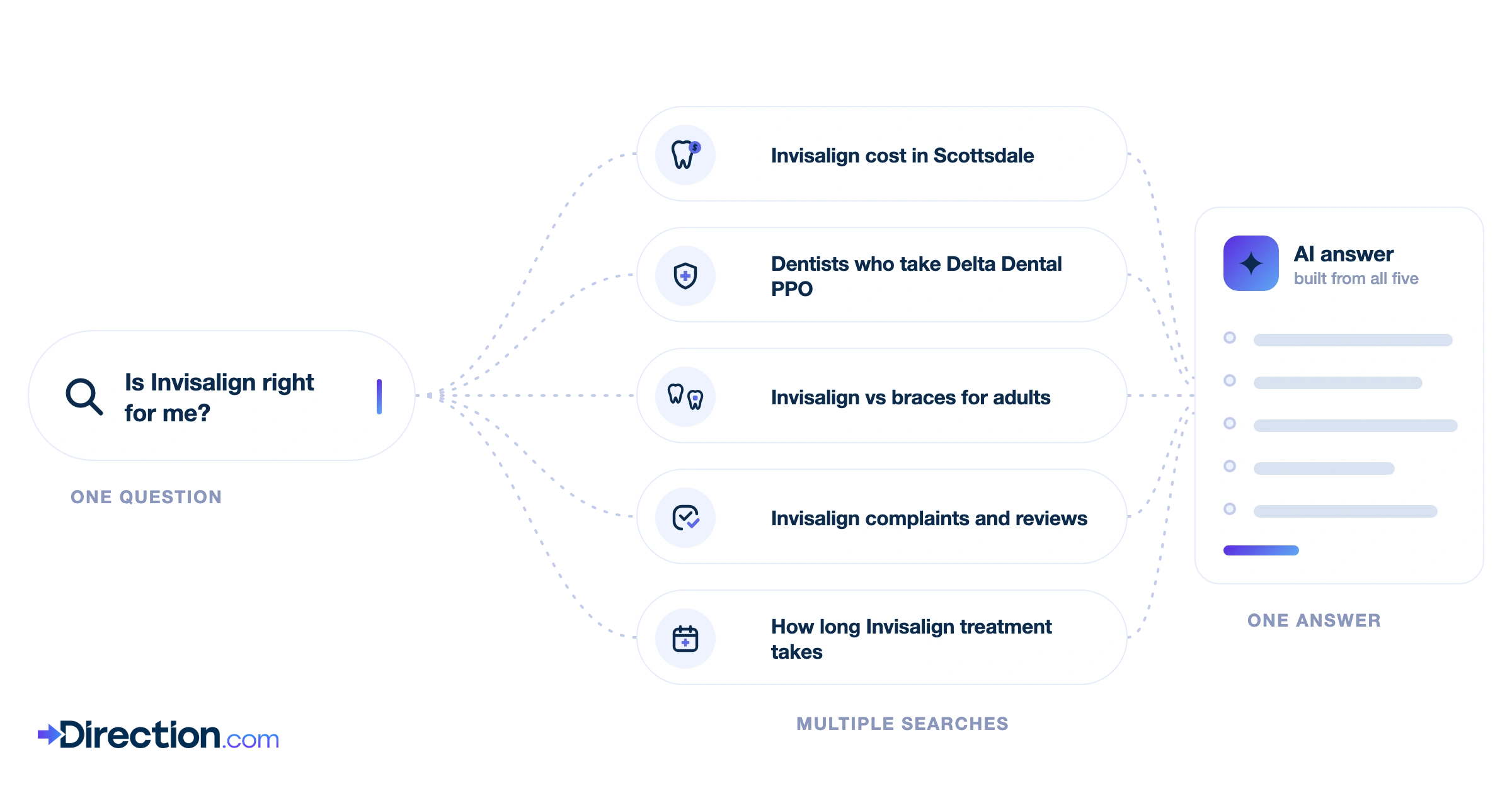
What is Query Fan-Out?
Fan-out means one question becomes a set of searches. Basically, ChatGPT and other AI tools will take one question and break it into a handful of smaller, related searches.
A question about Invisalign can turn into separate searches for cost, insurance, alternatives, treatment length, and reviews. The AI then writes its answer from whatever came up in those searches.
Here’s Google’s exact example of a Query fan-out from their AI optimization guide:

Do all LLMs use query fan-out?
You betcha.
ChatGPT does this too, rewriting questions into more targeted searches.
So what did Mrs. Jones’ question turn into?
Probably something like “Invisalign cost Scottsdale,” “Invisalign vs braces for adults,” “Scottsdale dentists that take Delta Dental,” and “Invisalign complaints.”
Now, if you take a look at your service page, and it says something like “we offer Invisalign” next to a stock photo, were any of those questions answered?
What searches should fan-out cover?
When we work with a new practice, we check which common patient questions its website answers.
I could name 20 with my eyes closed. But for simplicity’s sake, let’s just go with cost, insurance, how it compares with the alternative, who it’s right for, and how long it takes.
Answer all five on the page and now AI has five different reasons to pull it into a search. See where this is going?
But careful – don’t go HAM building separate bare-bone pages for every related question. Do that and you could get slapped by Google as a violation of its spam policy on mass-produced content.
Answer the questions on the pages you already have.
What is Grounding in AI?
I’d love to tell you ChatGPT memorized your six-chair practice in Chandler. Buuut… It didn’t.
AI grounding means the LLM connects its answer to information it retrieves from outside its own memory.
This is called retrieval-augmented generation, or RAG if you want to sound like you’ve been to a conference.
Google’s AI features use RAG to pull relevant, current pages from its search index before giving an answer.
This is where your website comes in. Yay!
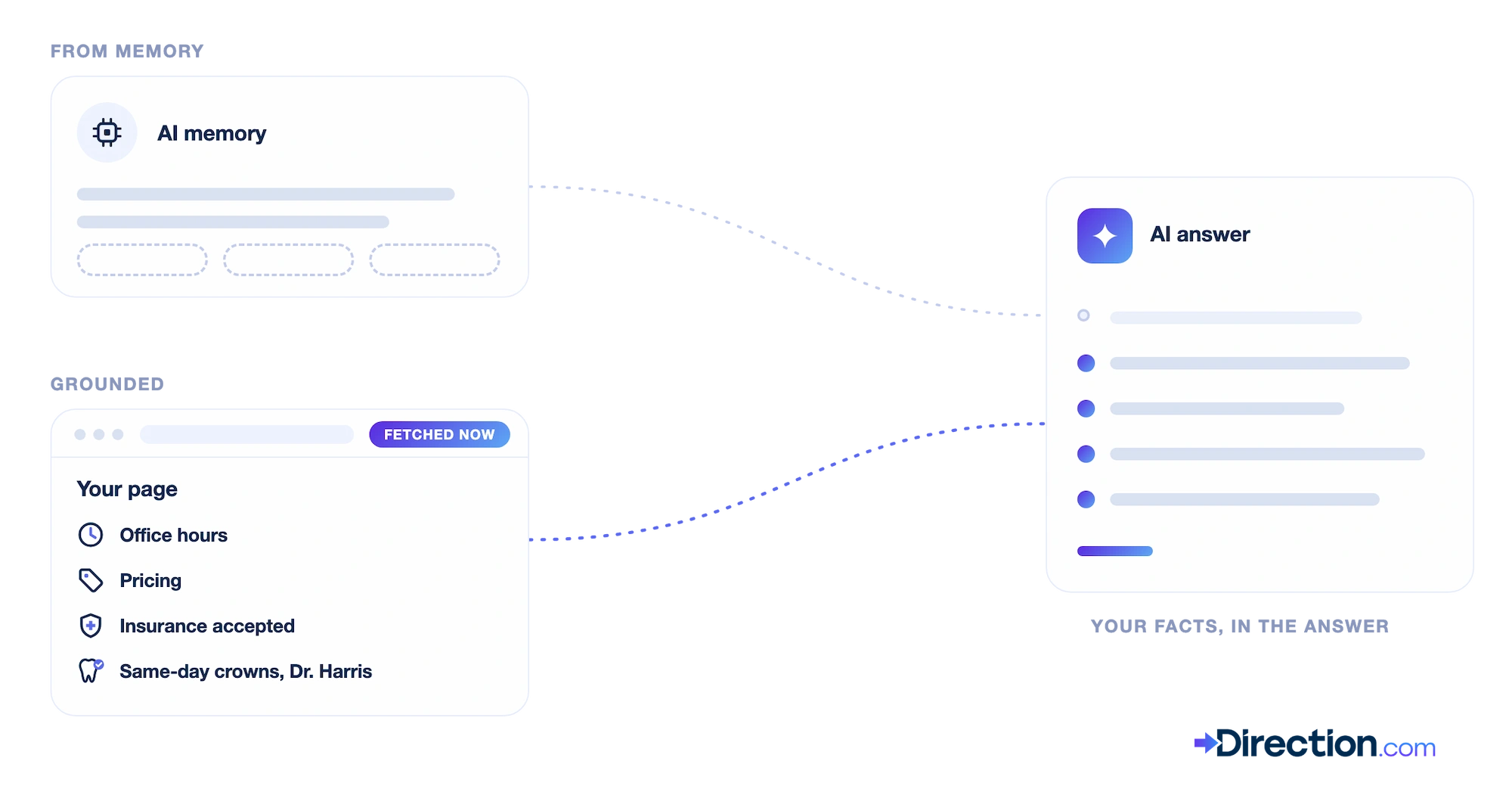
AI has general knowledge about dentistry, therapy, and medicine. But it may not know your current hours or that Dr. Harris does same-day crowns. Sorry, Dr. Harris.
For those details to show up in a grounded answer, AI needs to find them somewhere.
This is where trust and authority building comes into play in an essential way (which is built through links and reviews).
If your page sounds great, but I can’t find a single fact or piece of data worth quoting, welp, neither can AI.
And if your website doesn’t give it much to work with, information about your practice may come from somewhere else, like Zocdoc.
Yikes, when was the last time you updated that listing?
What makes a page quotable by AI?
When we rewrite a service page, we check for five things:
- Unique data. Think cost, treatment timelines, provider details, etc. Don’t say: “Affordable”. Instead say: “$3,800 to $6,200”.
- People with credentials. Don’t say: “Our experienced team”. Instead say: “Dr. Julia Harris, DDS, board-certified in oral surgery since 2014”.
- You as the source. Give AI facts it can attribute directly to your brand. Say: “At Optima Dental Surgery Center, our patients typically return to work about three days after ceramic dental implant surgery.” Don’t say: “The ADA says ceramic dental implant recovery takes 1-7 days”.
- Specific facts that stay accurate. Years in practice, procedures offered, hospital affiliations, technology used, and similar details give AI something concrete to work with. For information that changes, like hours, insurance, and prices, keep it current.
- A date and author name. “Reviewed September 2026 by Dr. Harris” makes it clear who reviewed the information and when.
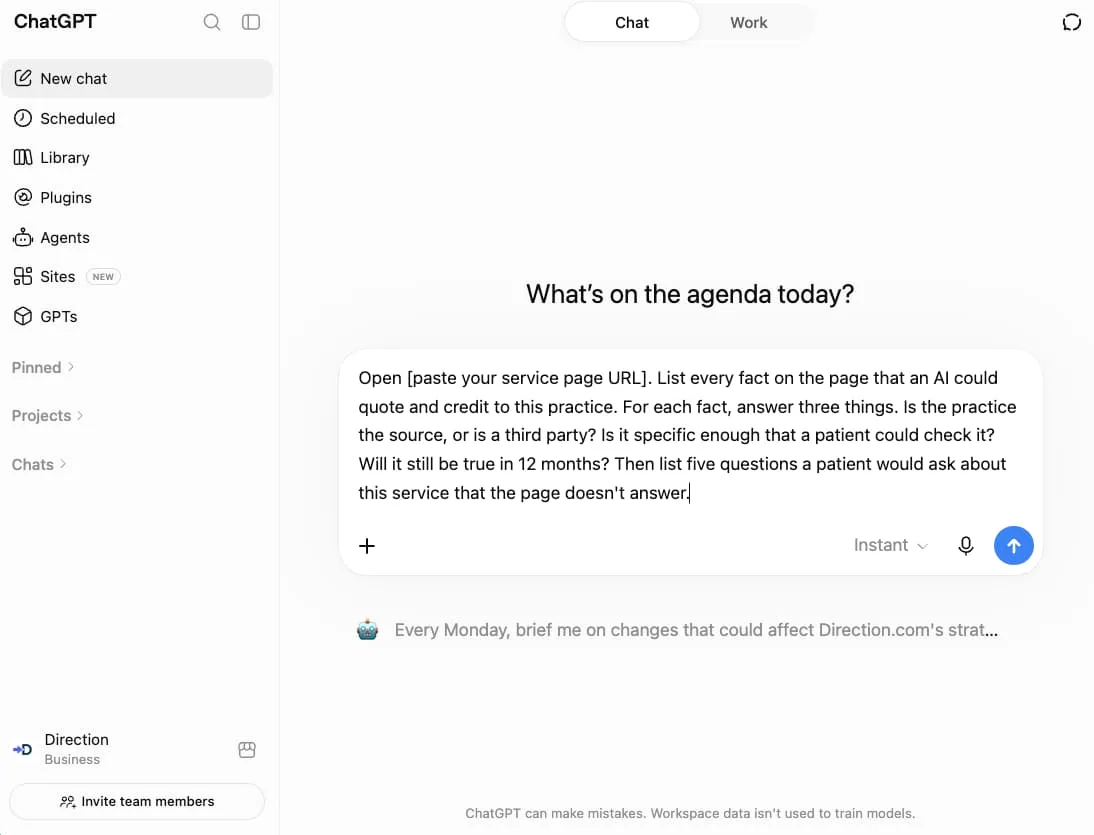
Check your pages in 10 seconds. Paste this into ChatGPT with web search turned on. It’s a trimmed-down version of the check our team runs when a new practice comes on.
What's the difference between retrieved, cited, and recommended?
Just because ChatGPT finds your page doesn’t mean it will cite it. And just because it cites your page doesn’t mean it will recommend your practice.
| Outcome | What it means | How you'd know | What drives it |
|---|---|---|---|
| Retrieved | The AI fetched your page while researching an answer | You can't see it in the answer. It only shows up in your server logs as a visit from OAI-SearchBot or ChatGPT-User | The AI can reach the page, the page loads fast, and a section on it matches the question |
| Cited | The answer linked to your page or quoted it | A footnote or link in the answer | A section that states a fact plainly enough to quote |
| Recommended | The answer told the patient to choose your practice | Your practice name in the answer, usually with a reason | Matching business details everywhere online, real reviews, and being an obvious local choice for that service |
Each one tells you something different about how AI sees your practice. And each one takes something different to achieve.
Retrieved just means you’re in the running, and cited gets a blog post a few extra visitors. Recommended is the ultimate win that gets leads in the door.
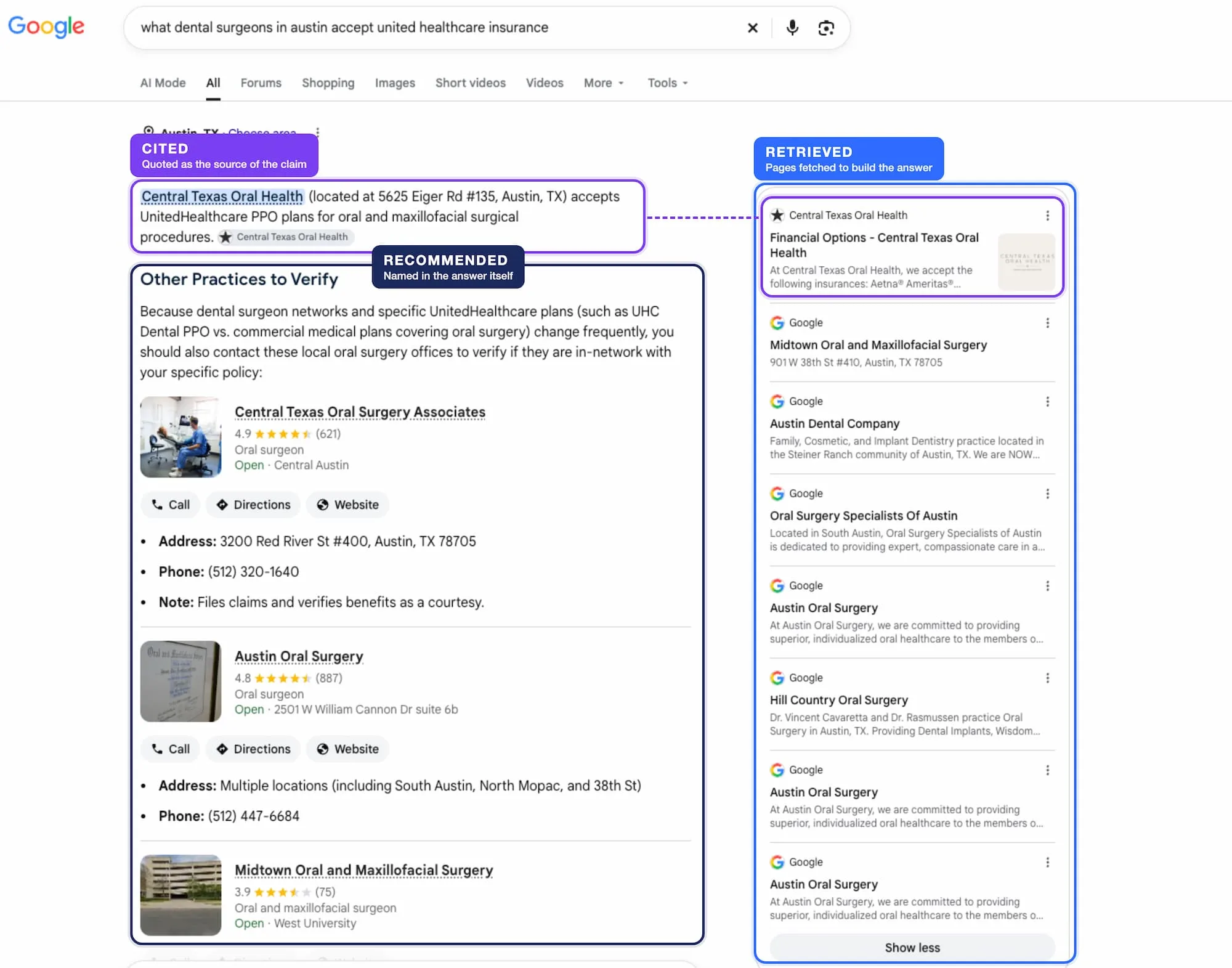
Each of the three happens for a different reason. A page can get fetched a hundred times and never get quoted. And a blog post can get quoted every week for “how long does implant recovery take” while the practice itself never gets recommended.
Why does that happen? Glad ya asked. The AI wants proof your practice is a real business, with a real address and real reviews, before it sends anyone there.
Most of that proof comes from your Google Business Profile, directories, and reviews.
So when an agency reports “mentions,” ask which one they mean.
How AI reads your page
Your 2,400-word service page is, well, one page.
To ChatGPT, it can become a bunch of smaller sections evaluated separately.
Basically, AI is trying to figure out which section could best answer a patient’s question without needing the rest of the page.
What is Chunking?
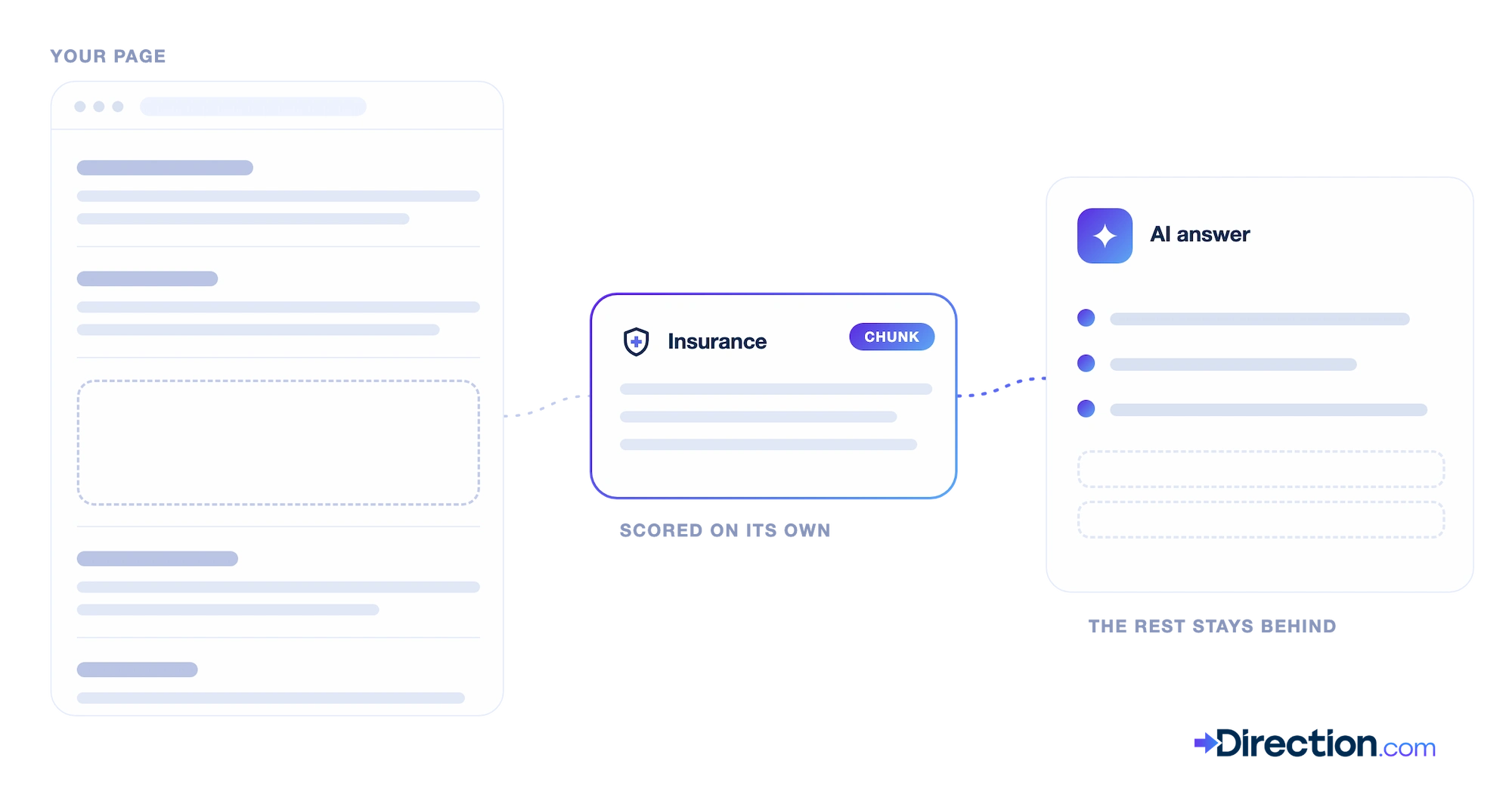
A chunk is a small piece of a web page that an LLM can retrieve and evaluate individually.
It might be a heading and the paragraphs underneath it. Which is why it’s called “chunking”. Fun word to say.
Anyway, that’s how a section on your page about insurance can win a search on its own.
That said, Google claims nobody needs to chop content into tiny pieces for Google to understand it. They have a point. Sure.
Still, a section that only makes sense after you’ve read the two sections above it is a weak section to any human reader, search engine crawler, or AI tool.
AI may retrieve one section of your page without relying on everything around it. So make each important section understandable on its own.
What is a Reranker?
A reranker takes the content found during retrieval and re-sorts it based on how well each piece matches the question.
The first pass might find a bunch of possible sources or sections. The reranker looks at those more carefully and moves the strongest matches toward the top.
The best matches then have a better chance of being used in the answer.
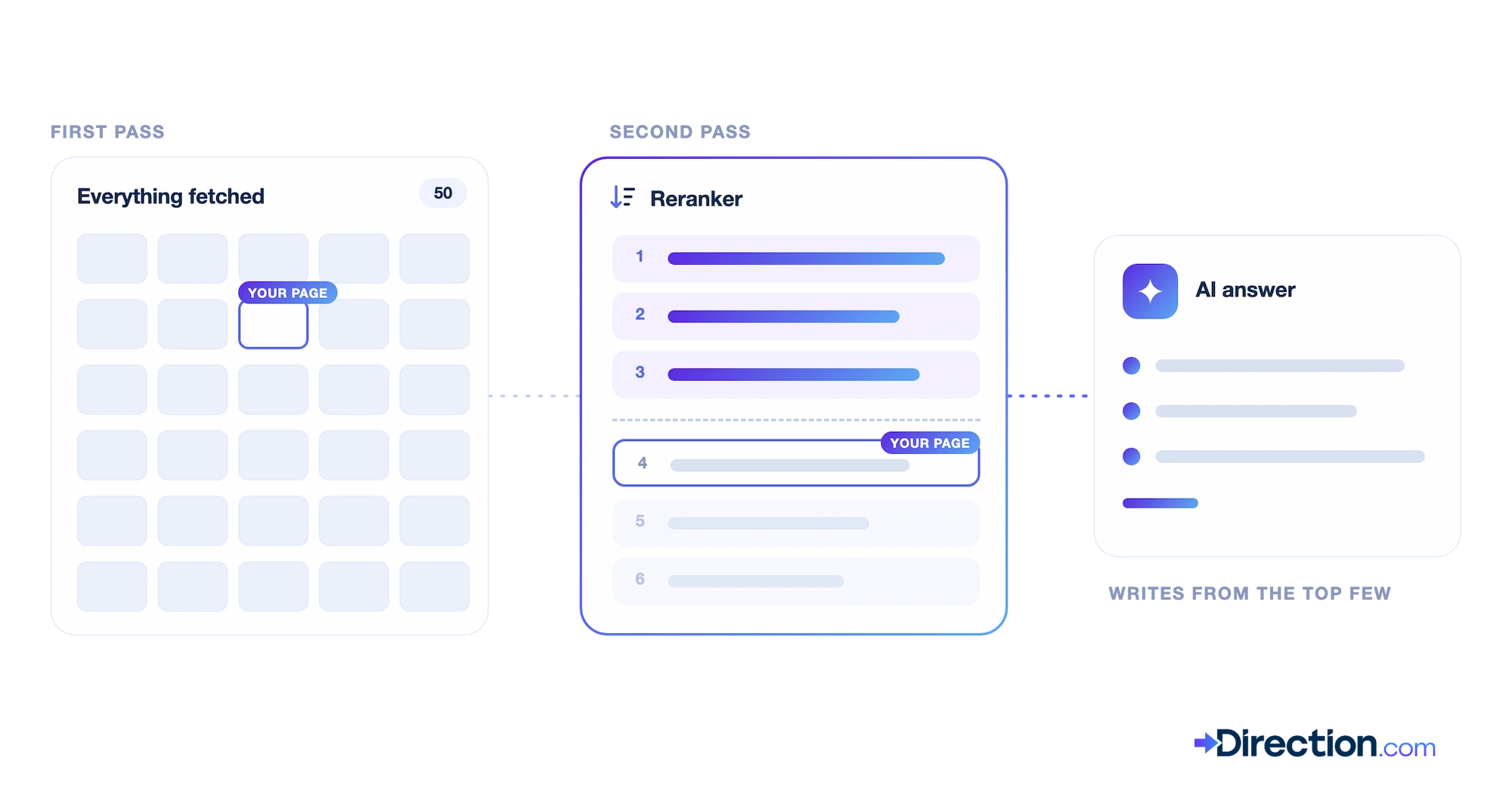
That’s why a page can get fetched and still never appear in the final answer. Your section got read and lost to a boring ‘ol Healthgrades page.
What is Semantic Relevance?
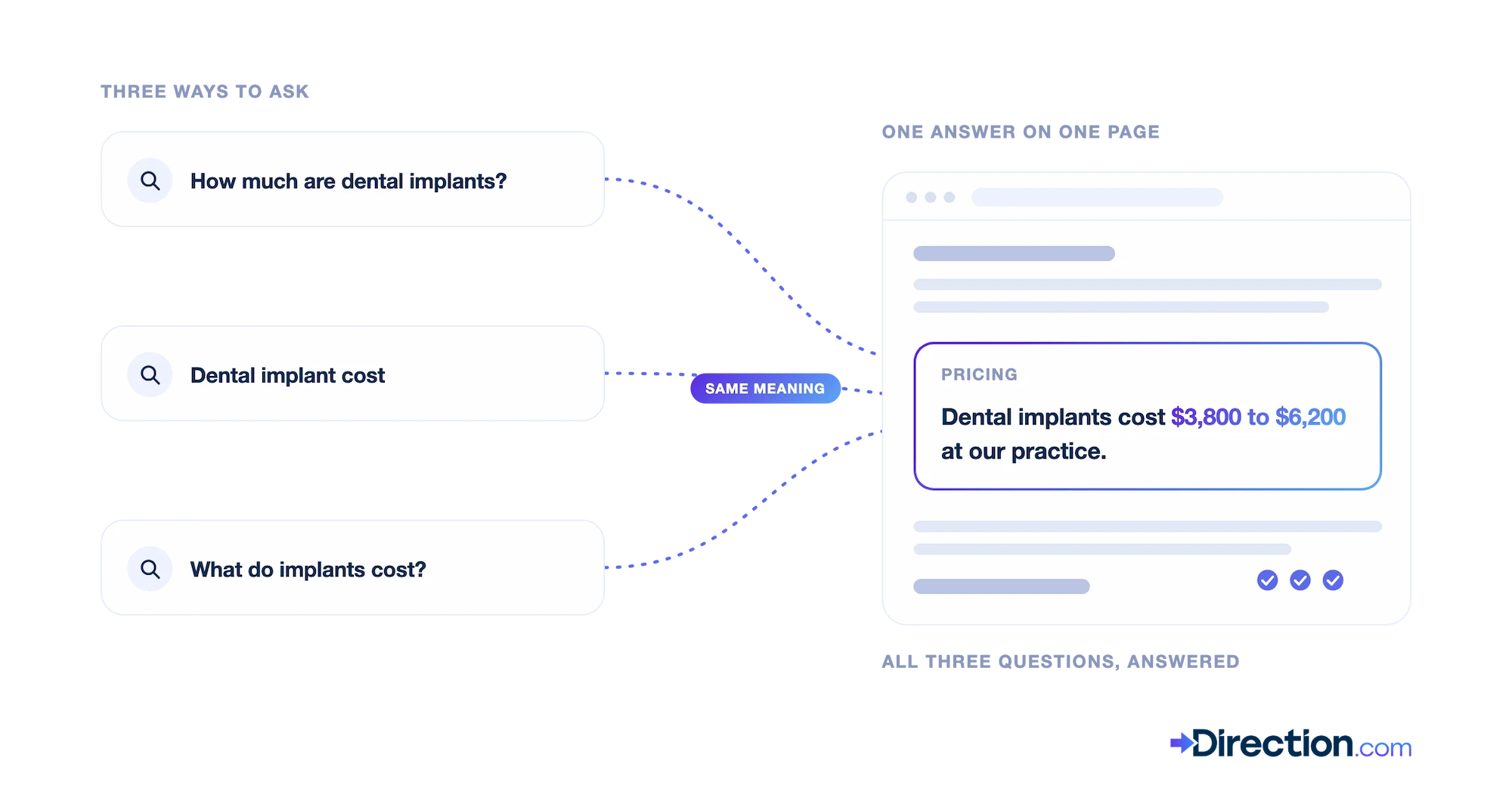
Semantic relevance means AI looks at what your content means, not just whether it contains the exact words someone searched.
“Dental implant cost,” “how much are dental implants,” and “price of dental implants” all mean basically the same thing.
You don’t need a separate page for every way someone might ask a question. Write one good answer that clearly answers what they want to know.
What is an Atomic Answer?
An atomic answer is a complete answer to a question that makes sense on its own.
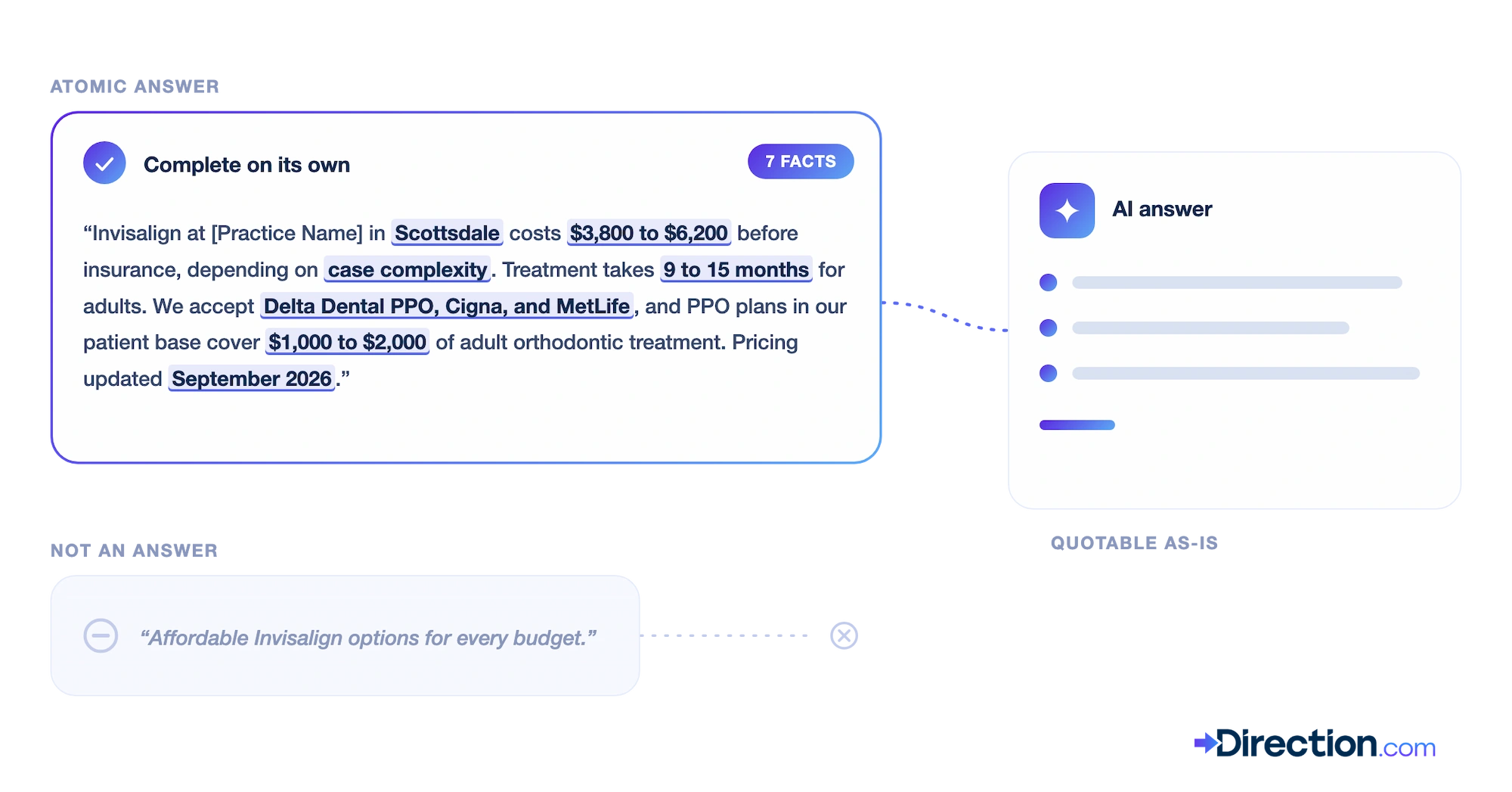
Below an example with seven usable facts in under 60 words for Craft Body Scan, a preventive health screening company:
Helpful: “A full body CT scan at Craft Body Scan in Scottsdale costs $2,495, takes under 10 minutes, and includes a coronary calcium score, chest CT, and abdomen and pelvic imaging. Board-certified radiologists read every scan. Results arrive in 5 to 10 business days. Preventive screenings are not filed with insurance; payment plans are available. Pricing updated September 2026.”
Not Helpful: “Affordable health scan options for every budget.”
What is Information Gain?
Information gain is how much new, useful information a piece of content adds beyond what the AI already found elsewhere.
SEO folks have started calling this information gain SEO. Same idea, another new label.
The team behind the GEO study presented at KDD 2024 tested nine kinds of content changes across 10,000 questions.
And, surprise, surprise… Adding statistics, quotes, and credible sources significantly increased how visible the content was in AI answers, with some improvements topping 40%.
What is Corroboration?
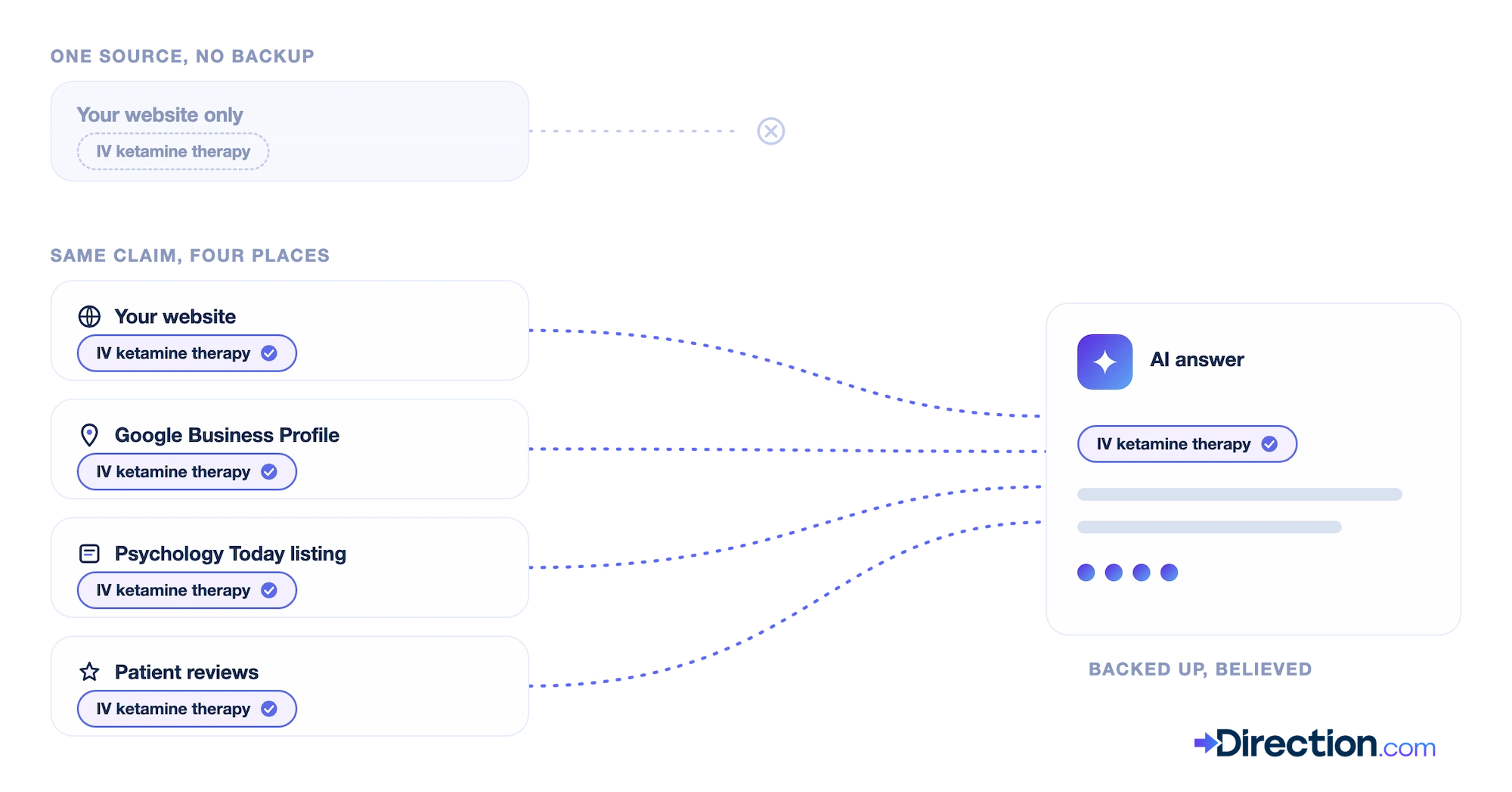
Corroboration is when the same information about your practice appears across multiple sources, giving AI more evidence that the information is accurate.
If your site is the only place online that says you offer a specific treatment, such as IV ketamine therapy, AI has less outside evidence connecting your practice to that service.
BUT, if the service also appears on your Google Business Profile, your Psychology Today listing, and in patient reviews, now multiple sources are telling AI the same thing.
What is an Entity?
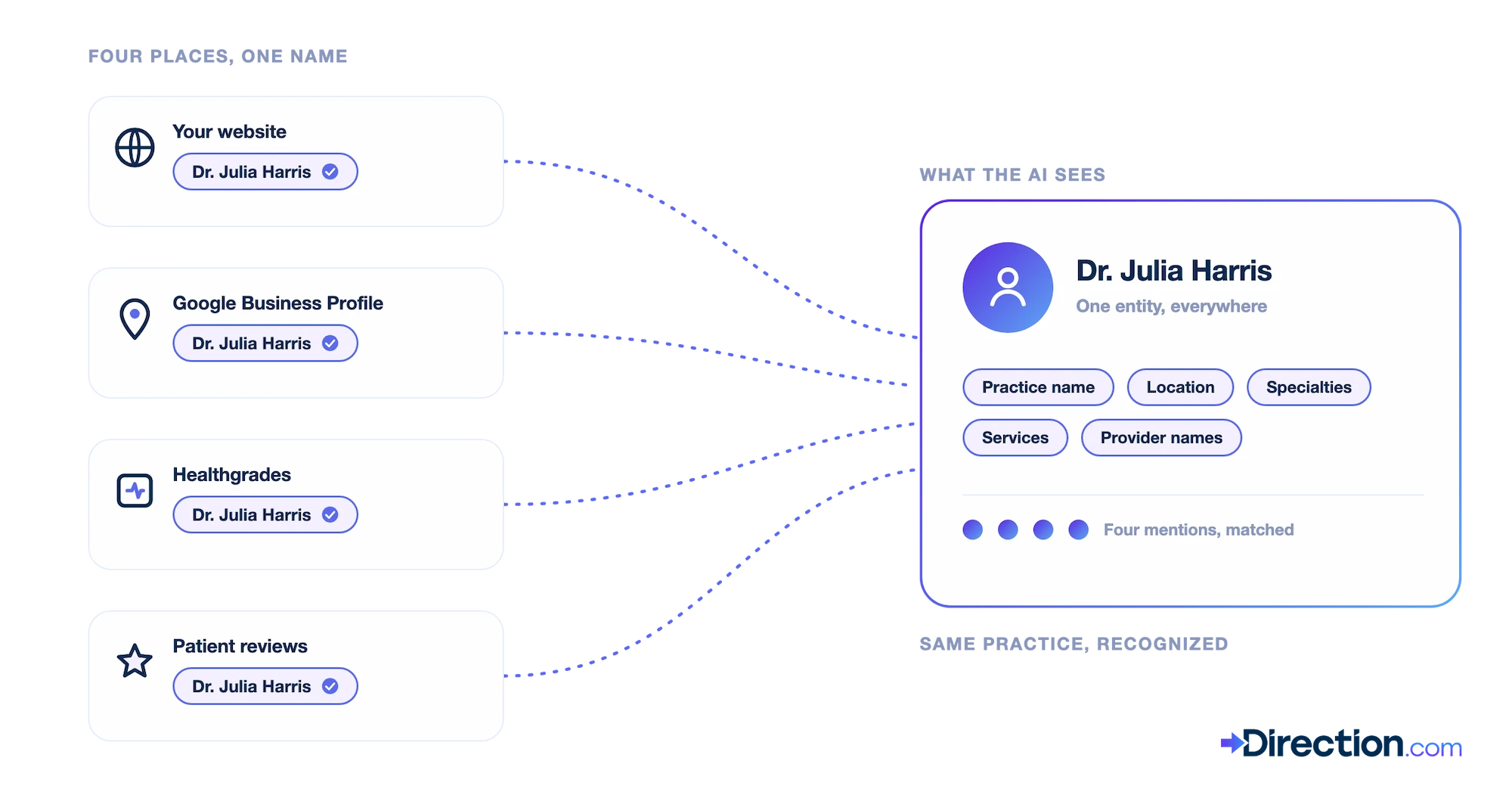
An entity is a person, business, place, or thing AI recognizes as being the same across different websites.
For example, AI needs to understand that Dr. Julia Harris on your website is the same Dr. Julia Harris on Healthgrades, your Google Business Profile, and other websites.
Keep your brand information consistent everywhere. The easier it is to connect those mentions, the easier it is to understand who you are and what you do.
What sources do LLMs pull from?
The source set is every page AI checked before answering, including pages it didn’t cite. It’s often larger than the list of sources you see in the final answer.
OpenAI also confirms this in their web search documentation. ChatGPT can consult more pages than it actually cites.
In other words, you can be in the source set without being cited. AI found your page, but something else made it into the final answer.
If you never show up in the source set, your site could have a technical issue, or AI simply isn’t finding your page relevant enough to retrieve.
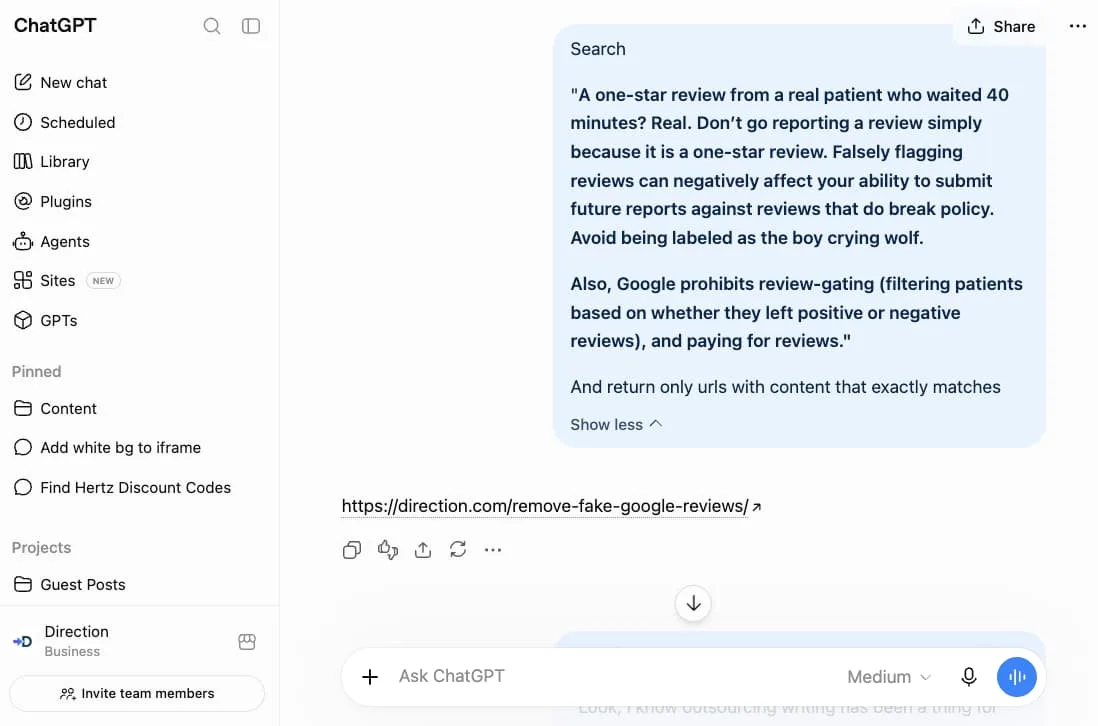
Here’s a super simple way to check if an LLM can read your content:
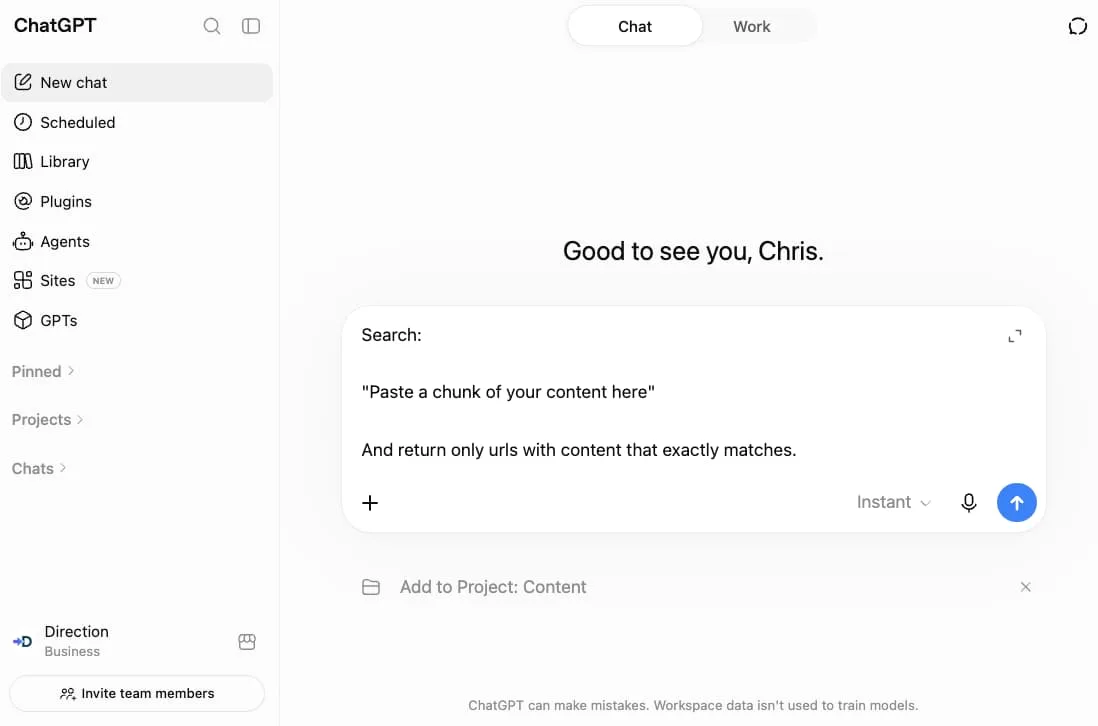
And if your URL gets pulled, congrats! But don’t get too excited. That doesn’t mean it’ll always get quoted. It just means your page can make it into the pool of sources AI considers.
What is Site Scoping?
Site scoping means searching for information only on your website.
For example, ‘site:yourpractice.com sedation dentistry cost’ can show whether Google has indexed pages from your site that relate to that question.
One of the first things we do for a new client is run scoped searches like this for each main service.
If ‘site:yourpractice.com sedation dentistry cost’ doesn’t pull anything, that’s a pretty good sign you should take a closer look at what your site actually says about sedation dentistry and cost.
Basically, if your page never answers the question, how can AI have anything to work with?
How to get your practice into an AI answer
You don’t rank in AI search the way you rank in Google. There’s no position 7. You’re either in the answer or you’re not. Information about your practice can reach an AI answer in a few different ways.
- The AI learned it during training.
- The information is available through an index or other retrieval system the AI can access.
- AI searches the web when someone asks a question.
What is Parametric Visibility?
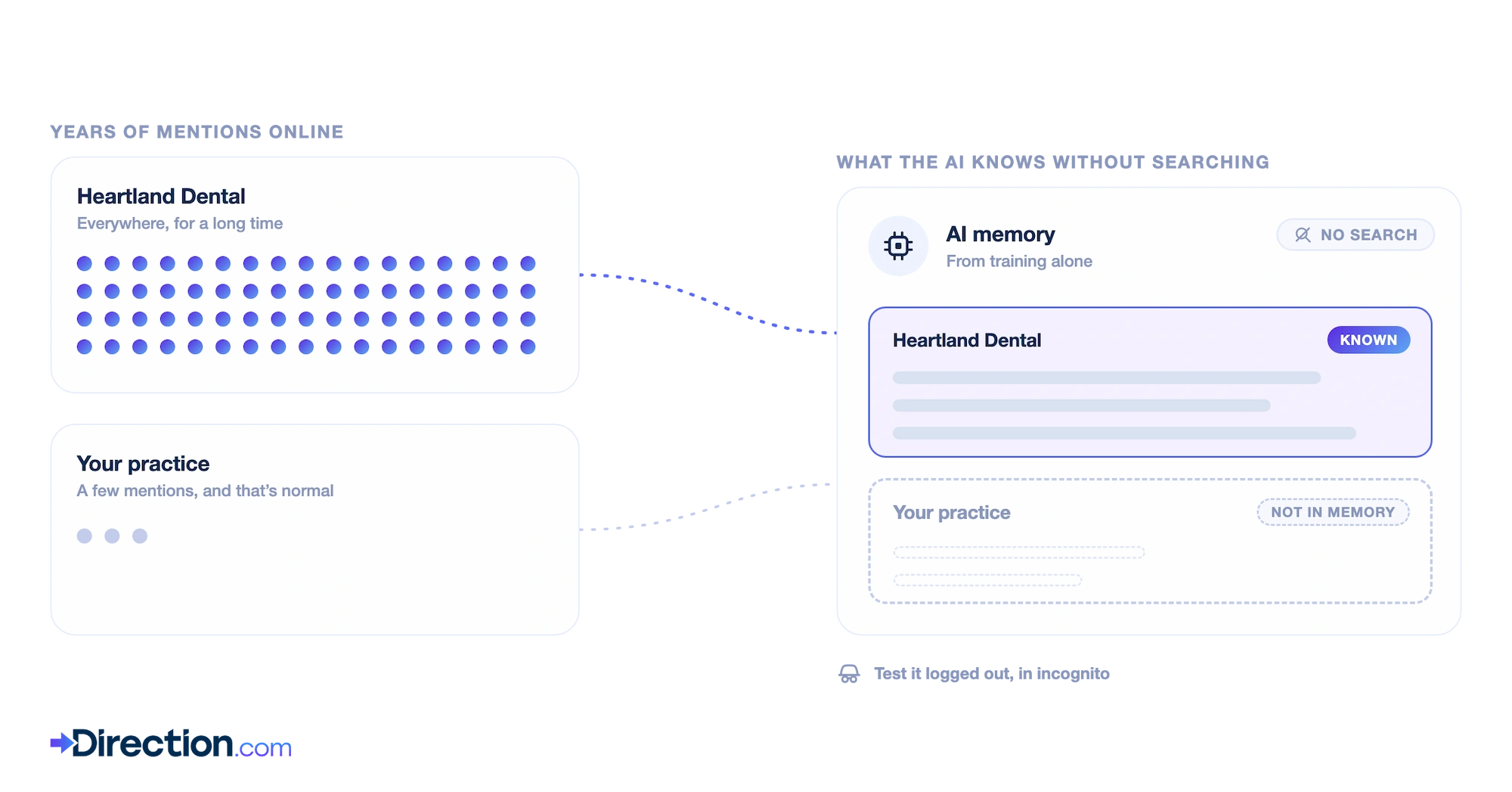
Parametric visibility is what an AI already knows about your practice from training, without searching the web.
For most local practices, that’s probably very little, and that’s normal. Large brands that have been written about online for years are more likely to appear in training data than a small local practice.
If you want to test this, start a new chat logged out with web search turned off and ask what it knows about your practice without searching the internet.
Training data and model memory
AI may already know something about your brand from information included in its training data.
For OpenAI, GPTBot collects content that may be used for training, while OAI-SearchBot supports ChatGPT search. You can allow one and block the other.
Getting GPTBot to crawl your website doesn’t mean your content will end up in a future model’s training data. There’s also no guarantee when, or if, an AI model will learn about your brand.
So be very cautious of anyone guaranteeing they can get your brand into AI training data.
How to get into ChatGPT's internal index
To appear in ChatGPT search, OpenAI needs to be able to access your website.
That sounds simple, but websites can block OpenAI without realizing it. Security settings can deny access, robots.txt can block OAI-SearchBot, and important service pages may be missing from your sitemap.
Have someone check your site’s robots.txt file and make sure OAI-SearchBot is allowed.
But allowing it is only the first step. You also want to make sure your important pages are accessible and readable if you want to get started on real ChatGPT SEO.
Test your indexability with this prompt (paste this into ChatGPT with web search turned on):
“Check whether my website is accessible and readable by AI search tools. Website: [YOUR URL]
Check the following:
- Can you access my homepage?
- Can you access and read my robots.txt file?
- Does robots.txt allow or block OAI-SearchBot?
- Find my XML sitemap and check whether my main service pages are included.
- Open three service pages and tell me whether you can read the main text on each page.
- Look for anything that could prevent OpenAI or other AI search tools from accessing my content.
Give me a simple PASS, WARNING, or FAIL for each check. Important: Do not assume that because you can access my site, OAI-SearchBot can. Clearly separate what you can verify from what would require checking server or CDN logs.”
What is External-search visibility?
External-search visibility is what AI can find by searching the web when someone asks a question. ChatGPT Search works with outside search providers and can rewrite your question into more targeted searches for them.
AI tools handle local searches differently. In a 2026 study by Javvo of local healthcare searches, Google showed an AI Overview on less than 2% of general provider searches, usually leaving those searches to its map results.
ChatGPT and Perplexity handled those searches differently. ChatGPT named about three practices per answer on average. Perplexity? About four.
What is Personalization?
Two people can ask AI the same question and get different answers.
Their location, how they word the question, details they provide, and previous conversations can affect which practices AI shows them.
That’s why searching for your own practice once isn’t a good test of your AI visibility. Test several patient questions multiple times and don’t rely on results from your personal account.
The freshness factor
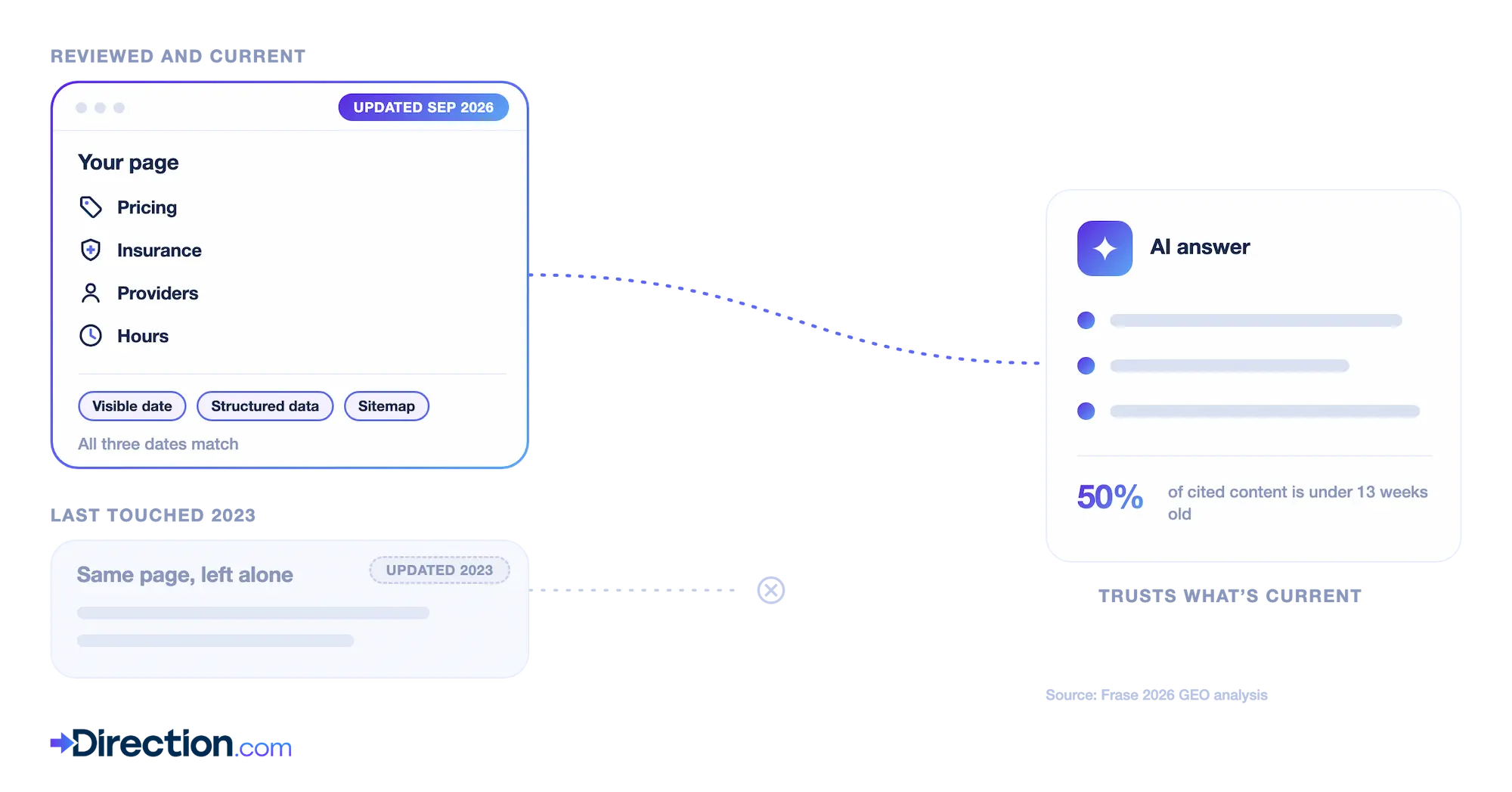
Freshness means keeping your information current so AI has up-to-date information to work with.
Side note: Google reads the dates on your pages too. Again, SEO and AI SEO have a lot in common.
According to a 2026 analysis by Ignis, roughly half of pages cited in AI answers were published or substantially updated within the previous 13 weeks.
In addition, Ahrefs analyzed nearly 17 million AI citations and found that AI assistants cited content that was 25.7% newer, on average, than content appearing in traditional Google results. ChatGPT showed the strongest preference for newer content.
Pricing, insurance, providers, hours, and services can change. If your page still shows outdated information, AI may find newer information somewhere else and use that instead.
Review important pages regularly and update them when something actually changes. Keep the visible update date, structured data, and sitemap date consistent.
What is Variance?
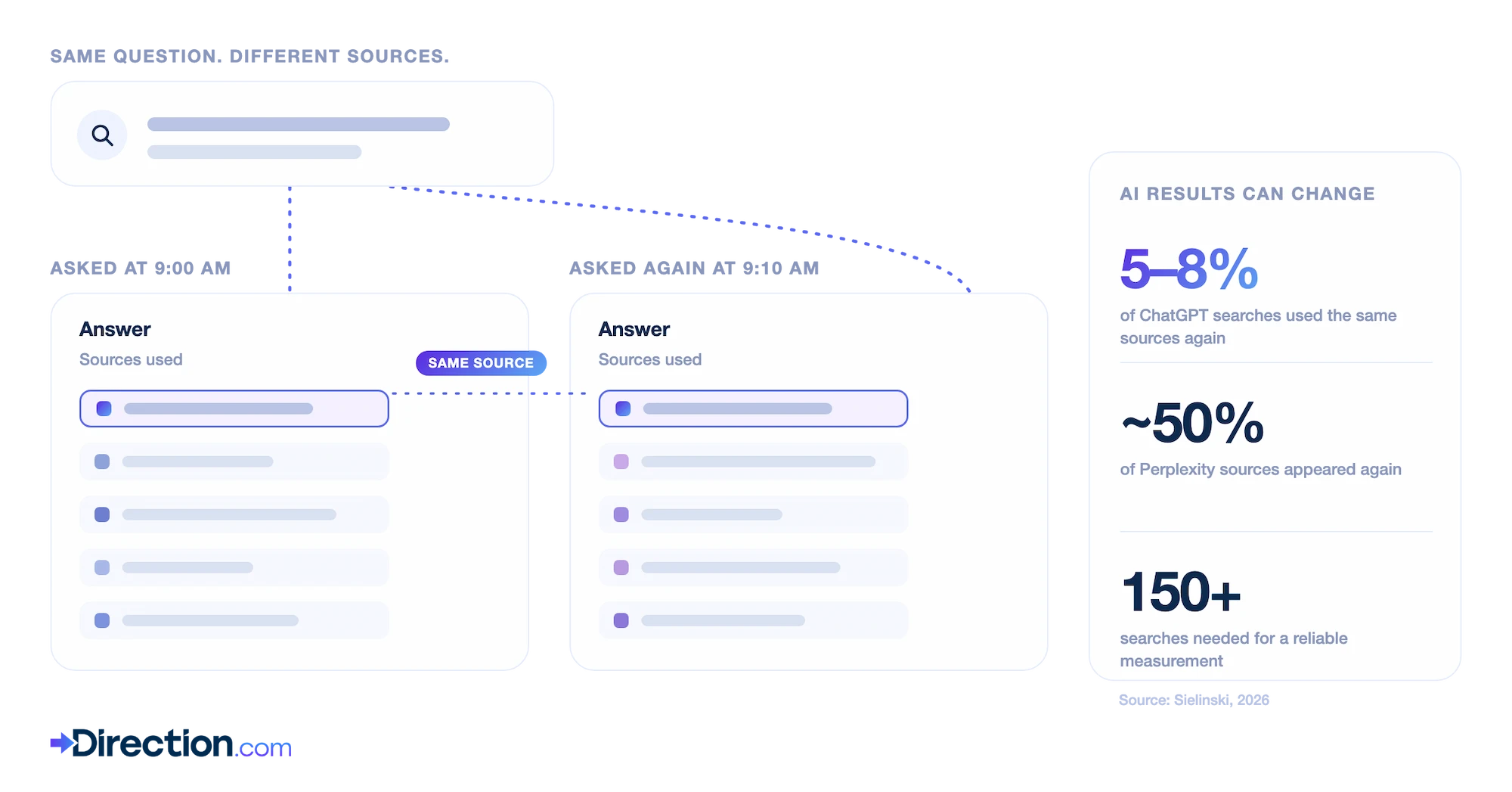
Variance is how much AI results change when you ask the same question again.
AI results aren’t fixed. Ask the same question twice and you can get different sources and recommendations. Ask at 9 AM and again at 9:10 AM, and you may get a different list of sources and practices.
How different can two answers to the same question be?
Ron Sielinski’s 2026 study of citation variability measured this across three AI search tools.
Two runs of the same question on OpenAI’s SearchGPT returned the exact same set of cited domains only about 5 to 8% of the time. On Perplexity, repeat runs shared about half of their cited domains.
The study also found that SearchGPT needed roughly 150+ queries to get citation-share estimates within a five-percentage-point confidence interval.
This is why I’m skeptical of AI rank tracking tools that treat a single AI result like a Google ranking.
LLM optimization is a routine, and the routine needs an AI SEO expert as its owner
First, find out what’s keeping you out. If AI can’t reach your site, fix the technical issue. If it finds you but doesn’t quote you, fix the content. If it quotes you but recommends competitors, work on your listings, backlinks, and reviews.
Or, have one experienced team handle it all. Here at Direction, we’ve helped healthcare practices get found online since 2016. We handle the technical work, content, backlinks, local visibility, ads, ongoing testing, and more.
FREE: We’ll make your most valuable service page worth quoting
Your page may already be getting found by AI. Now transform it into something worth recommending.
Send us your most valuable service page, we’ll rewrite the page around the facts and patient questions AI looks for based on our research, expertise, and years of data.
| What you get | What we do | Value |
|---|---|---|
| Page review | Find what AI can quote and what’s missing | $300 |
| Three ready-to-use answers | Answer cost, timeline, and who it’s right for | $1,200 |
| Patient question check | Find important questions your page doesn’t answer | $300 |
| Updated page date | Show AI and Google when the page was updated | $150 |
| Before-and-after test | See what AI can find before and after | $200 |
| Total | $2,150 FREE |
Send us the page you most want patients to find. We’ll take it from there. Claim your free rewrite.