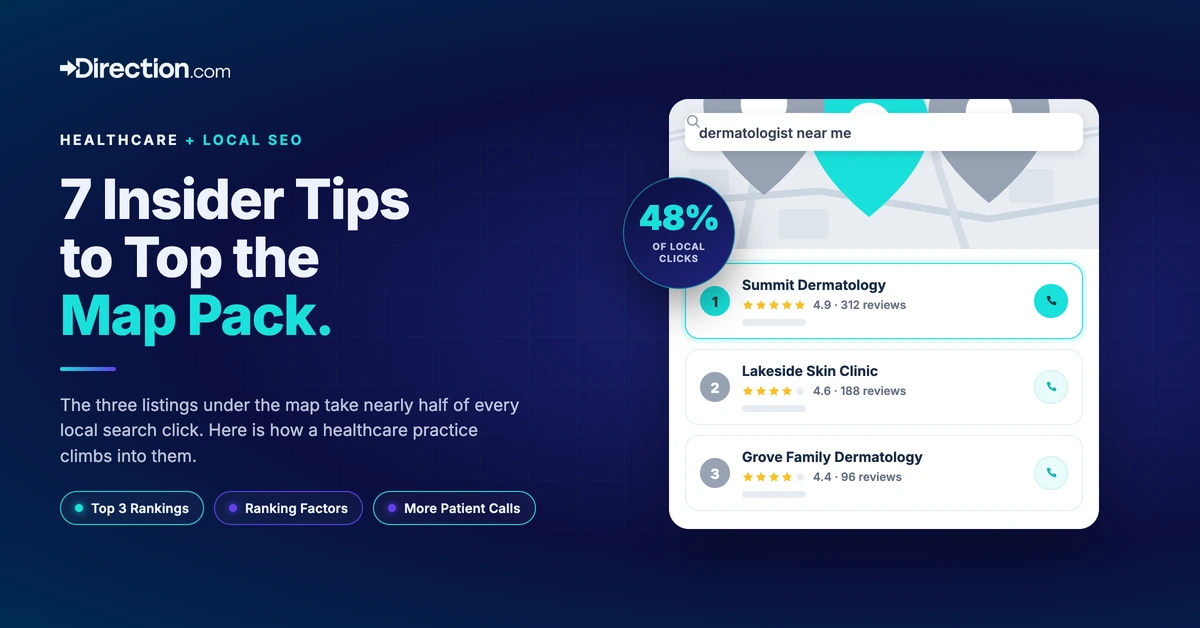
The Google Map Pack is the block of three local business listings Google shows under a map when there’s local intent behind a search. Google calls it the local pack, and you’ll also hear 3-pack.
First Page Sage’s September 22, 2026 report lists a 14.8% click-through rate for the first local-pack position. Its figures cover US search traffic across industries.
We audit local map ranking positions for every new practice, and across every market, the strongest profile usually wins, with clinical reputation close behind.
So, what do you work on to get moving up the map to #1, #2, or #3?
What is the Google Map Pack?
The Google Map Pack refers to the set of local business listings that appear in a prominent position on Google Maps and search engine results pages (SERPs).
A patient types “dermatologist near me” at 9 p.m. Google returns a map with three practices under it, each showing a name, star rating, review count, hours, and a call button.
She reads two reviews and taps call.
Those results are sandwiched between the paid ads and organic results, and it appears whenever Google reads local intent in a query. “Pediatrician in Frisco.” “Urgent care open now.” Each one triggers a pack, and the three practices inside it change with the searcher’s location.
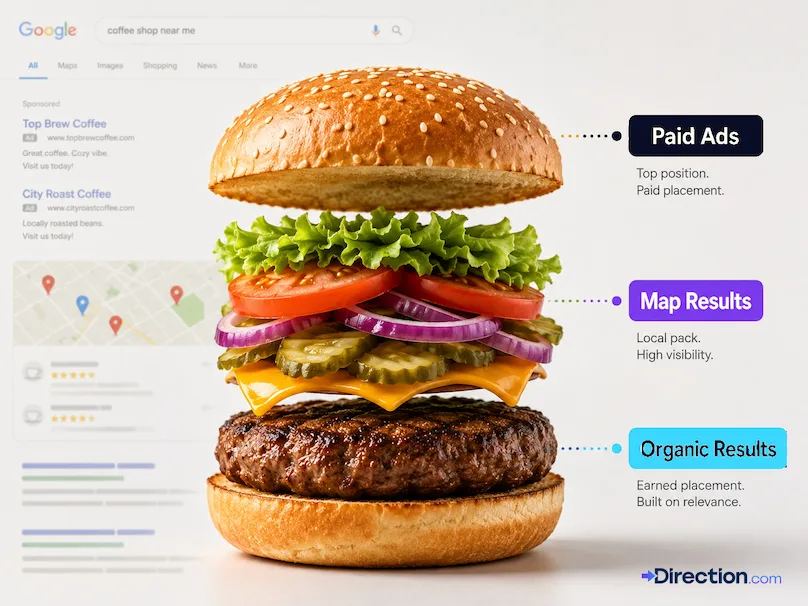
Why does the pack convert so well? The listing answers the three things a patient checks (rating, distance, and whether you’re open) before a website enters the picture at all. Every field pulls straight from Google Business Profile, and for the 9 p.m. dermatology patient the profile was the whole decision.
What Are the Reported Map Pack Click-Through Rates?
First Page Sage reports click-through rates for each local-pack position. The table below uses its September 22, 2026 figures.
The report lists a 14.8% click-through rate for spot one, followed by 12.6% for spot two and 11.9% for spot three.
I’ve watched practices keep the top organic spot and still lose call volume to the three competitors in the box.
| Position on the results page | Click-through rate |
|---|---|
| Map Pack, spot 1 | 14.8% |
| Map Pack, spot 2 | 12.6% |
| Map Pack, spot 3 | 11.9% |
Data from First Page Sage’s September 22, 2026 report. The publisher weights desktop and mobile figures to US query volume across its March 1 through August 31, 2026 dataset.
The Three Controlling Factors to Local Map Pack Ranking (According to Google)
Google names three pillars in its local ranking documentation. Relevance, distance, and prominence.
Relevance measures how well your profile matches what the patient typed. Distance is what it sounds like. Prominence is the fuzzy one (Google reads reviews, links, articles, and directory mentions to decide how established your practice is).
So which signal should your practice fix first? Google’s, of course, not going to tell you.
7 Google Map Pack SEO Factors (According to Data)
Sterling Sky analyzed 8,186 businesses across 200 cities in late 2025 to isolate what ranks a local pack. Joy Hawkins has tested this stuff since 2006, and profile decisions keep winning. Seven signals decide most of the healthcare packs I audit, and the first three sit outside your website entirely.
1. Primary Google Business Profile category
Your primary category is easily the strongest signal according to any study you look at. A dermatology practice filed under “skin care clinic” loses to one filed under “dermatologist.” We’ve corrected that exact dropdown for multiple practices this year alone.
2. Proximity to the searcher
Google measures the distance between the searcher’s phone and your front door, and nobody can move the building. What the work can change is whether you keep losing the nearby searches you should already win.
3. Keywords in the business title
Touchy one. The specialty in your legal name helps, while stuffed extra words violate Google’s guidelines. One practice paid for the stuffed version with six weeks of lost calls before Direction took over the account.
4. Review recency
Uberall ran the numbers on 64,000 Google profiles. Locations answering at least 32% of their reviews converted 80% better than the ones answering one in ten. Tebra’s 2025 patient survey found 45% of providers never respond to negative ones, so answering at all puts you ahead of nearly half your market.
5. Review responses
In the same survey, 80% of consumers said they’re likely to choose a business that answers all its reviews. Tebra’s 2025 patient survey found 45% of providers never respond to negative ones, so answering at all puts you ahead of nearly half your market.
6. Profile completeness
Most profiles we audit are missing correct hours (per their own website), services, photos, or booking links. Google’s own guidance credits a complete profile with 2.7 times higher perceived reputability and a 70% higher chance of a visit. The Google Business Profile work we do always starts here, before anything touches your website.
7. Being open when the patient searches
A profile that shows closed at 5:01 p.m. drops out of evening results, the same results a 9 p.m. patient search pulls. Hours drift. On new accounts, the listed schedule disagrees with the real one more often than it matches.
One warning before anyone treats that list as a weekend project. The signals interact, and the order of operations decides whether the same seven moves help or hurt your rankings.
A category change can drop a listing for two weeks while Google re-reads the profile. Direction has taken over accounts that panic-reverted mid-drop and reset the clock.
What Patients Check Before They Call
84% of patients read online reviews before choosing a new provider, and 51% read at least six of them, per rater8’s February 2025 patient report. Healthcare runs stricter than retail here.
rater8’s 2026 Patient Choice Report found 75% of patients won’t book a provider rated below 4.0 stars. Another 55% have walked away from a doctor over something they read online.
That walk-away number jumped 15 points in a single year, which tells you where patient patience is heading. Volume has a floor too.
BrightLocal’s 2026 survey found 47% of consumers pass on businesses with fewer than 20 reviews. Another 31% will only use one rated 4.5 or higher, and each threshold climbed from the year before.
The 2026 data reversed advice that agencies (Direction included) gave for years. Recency now beats the review total.
A review engine your front desk runs in ten seconds per patient outperforms a count that took eight years to build and then stopped. Responses go out the same week.
What About AI Overviews?
The map pack was supposed to be dead by now. That prediction circulated all through 2025, and the measurements went the other way.
SOCi’s 2026 Local Visibility Index measured 350,000 locations across 2,751 brands. The average location still landed in the 3-Pack 35.9% of the time, while ChatGPT recommended 1.2% of them. The patient asks AI what a dental implant costs, then books through the box with the map.
Patient trust is drifting, though, and the drift is worth watching. rater8’s 2026 report found AI tools now edge out Google search as an influence on how patients pick doctors, 36% to 34%. The same patients rated AI Overviews the most trusted part of Google for doctor research at 37%, with the map pack at 13%.
Read that twice if your whole local budget sits in the pack. And BrightLocal found 45% of consumers now use ChatGPT or similar tools for local recommendations, up from 6% a year earlier.
The patient’s path now runs across two surfaces, and your practice needs visibility on each. We always focus on this alongside every local campaign for that reason, feeding the same profile, reviews, and service pages into both.
What Hurts Map Pack SEO?
The fastest local rankings in the map pack collapse I’ve ever seen took an hour. A practice manager had no idea that changing the practice to a service area business (yeah, he thought that would get people from surrounding cities to want to drive there) would be a smart move. Turns out, doing that gets rid of your address. No address for a physician office? No bueno.
He called me 30 minutes later freaking out that he wasn’t ranking in the top 3 anymore after that change. And then he tried to put the address back and Google suspended the listing. The phones stopped ringing for six weeks while reinstatement crawled through review.
Nothing on the website changed. The listing was gone, and with it, a whole lot of would-be patients.
Another thing that’ll hurt your rankings is an old address stays live across 40 directories after a move.
Also, please don’t swap the primary category twice in a month. Each time you do that, it restarts Google’s read of the profile.
Inconsistency in reviews is bad too. Don’t try really hard one week, get 20 new reviews, then the rest of the month none.
Each of these is cheap to prevent and expensive to repair. Reinstatement alone takes weeks, and the rankings you lost take months longer to crawl back. The upkeep is weekly, boring, and exactly the work that slips when it belongs to whoever at your practice has spare time.
What the Map Pack Looks Like When a Specialist Runs It
A Google map pack position that survives a Core Update, an office move, and a manager change needs someone watching it weekly. The specialist makes the category and title calls once.
Review responses go out inside the week, since a third of consumers expect an answer to a negative review within three days, per ReviewTrackers. Someone rechecks the listing after any change to your hours, address, or providers.
This is all stuff we cover for the healthcare practices we work with, with the most important KPI being new patient appointments. Want a top ranking spot in your market? Book a discovery call.
What is the Google Map Pack?
The block of three local business listings Google shows under a map when a search has local intent. Each listing pulls from a Google Business Profile and shows the practice’s rating, review count, hours, and a call button. A patient can book without visiting your website.
What're the most important things to work on?
The primary Google Business Profile category is the most important factor in Sterling Sky’s local ranking research, followed by proximity and business-title keywords. After those, recent reviews, answered reviews, and a complete profile do most of the climbing.
How many Google reviews does a practice need?
75% of patients won’t book a provider rated below 4.0 stars, and 44% now set the bar at 4.5, per rater8’s 2026 report. Recency matters more than the total. Sterling Sky’s data shows this month’s review count outweighing the lifetime number.
What do AI Overviews change about the Map Pack?
Less than you’d think. SOCi’s 2026 Local Visibility Index found the average brand location still lands in the 3-Pack 35.9% of the time, while ChatGPT recommends 1.2%. Patients research with AI, then book through the pack, so the two surfaces work together.
How long does it take to rank at the top?
The range I see in most metros is 60 to 120 days, assuming the category and profile problems clear in the first month. Dense urban markets with 30 competing practices run longer, and a suspension or an address mismatch adds weeks.