Why Most Dental Practices Have No Idea If Their Marketing Works
When talking to dental practices who want to work with us, I always ask questions around what works for them, and how much they’re paying for their dental marketing efforts.
“We’re getting a lot of calls.”
“The website looks great.”
“I think Google Ads is working.”
None of that is measurement. It’s hope with a credit card attached.
I recently came across a Dental Economics survey which found that over 50% of dental practices don’t reliably monitor and evaluate their marketing results.
Even worse? Only 3% use call tracking software. Another 36% try but admit they’re inconsistent. The rest have no idea what’s working.
That’s a serious issue considering the average monthly marketing spend for dentists is about $5,000/month.
The fix isn’t even that hard.
The simplest approach is just setting up Google Analytics, Google Search Console, and CallRail. That’s the baseline for our clients, and just with that baseline, we are clearly able to track ROI for our dental clients.
Now, let’s jump into more exact metrics, calculations, and benchmarks that separate profitable marketing from expensive hopework.
Dental Marketing ROI Formulas That Actually Work
Here’s the most basic dental practice marketing ROI formula:
ROI = (Revenue from Marketing - Marketing Cost) / Marketing Cost × 100
Dental Marketing ROI Calculator
Find out if your marketing spend is paying off
Formula: (Revenue - Cost) ÷ Cost × 100
If you spent $3,000 on Google Ads last month and those ads generated $12,000 in new patient revenue, your ROI is 300%: ($12,000 – $3,000) / $3,000 × 100 = 300%
The American Dental Association recommends a slightly different formula for campaign-specific measurement:
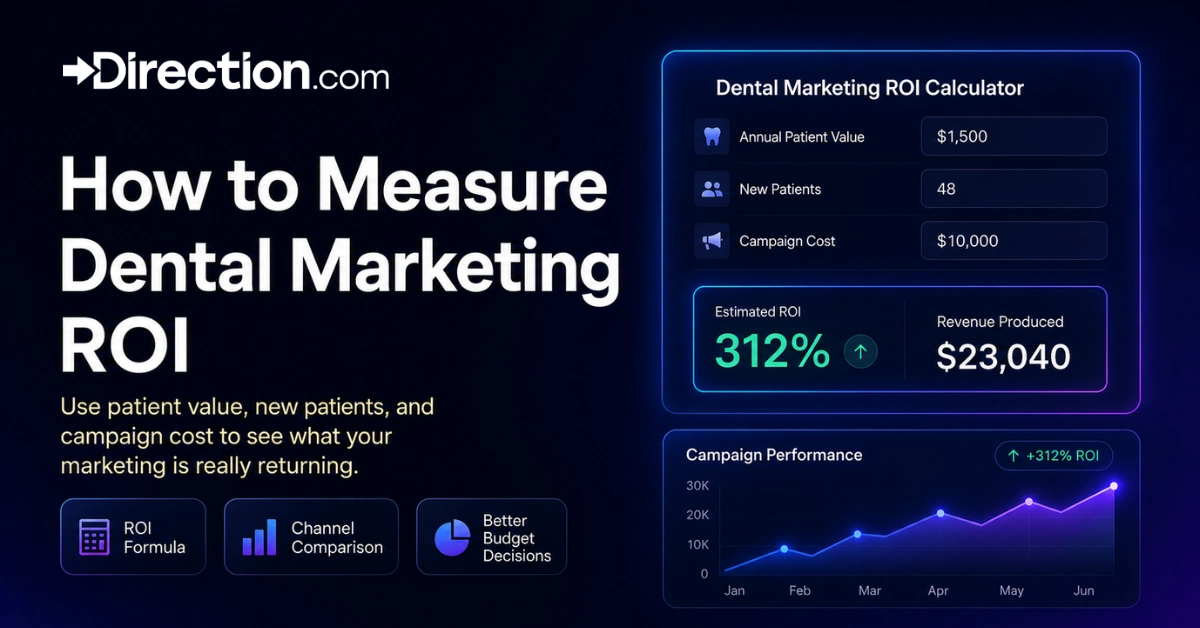
ROI = (Annual Patient Value × New Patients from Campaign) - Campaign Cost
With this calculation, if your average patient generates $1,500 annually, a campaign brought in 48 new patients, and you spent $10,000 on that campaign, the math looks like this: ($1,500 × 48) – $10,000 = $62,000 net return.
Dental Marketing Campaign ROI Calculator
Calculate the true return on your marketing campaigns
Formula: (Annual Patient Value × New Patients) - Campaign Cost
What "good" ROI looks like
Most dental marketing experts would agree that 300-500% ROI (a 3:1 to 5:1 return) as the benchmark for successful campaigns.
Below 300%, something needs attention.
Above 500%, you’ve likely found a channel worth scaling.
Calculate Patient Lifetime Value Before You Measure ROI
Patient lifetime value (LTV) is the total revenue a single patient generates throughout their relationship with your practice. This helps you figure out how much you can spend to acquire a patient and still make a profit. Here’s the formula:
LTV = Average Revenue Per Visit × Visits Per Year × Average Patient Retention (Years)
Example calculation: If your average patient spends $400 per visit, comes in twice per year, and stays with your practice for 8 years:
$400 × 2 × 8 = $6,400 LTV
A Delmain survey of thousands of dental practices found gross production per patient averages around $4,200. And industry data from Dandy puts average LTV at about $10,000.
The hardest data to measure is referrals. A satisfied patient who refers two friends over a decade adds significant value beyond their own spending.
Some practices calculate a “total LTV” that includes referral value, which can push the number to $15,000-$20,000 per patient.
How to Calculate Your Practice's Actual LTV
Pull these numbers from your practice management software:
- Average annual production per active patient – Total production divided by active patient count
- Patient retention rate – Percentage of patients who return within 18 months
- Average patient lifespan – Calculate by dividing 100 by your annual attrition rate (if 10% leave annually, average lifespan is 10 years)
- Referral rate – New patients from referrals divided by total active patients
Once you know your actual LTV, you can set a maximum patient acquisition cost. If your LTV is $6,000 and your profit margin is 35%, you have roughly $2,100 in gross profit per patient. Spending $300 to acquire that patient makes sense.
7 Metrics That Reveal Your Marketing Performance
ROI is the final score. Here are seven metrics that’ll show you how you got there and where to improve.
1. Cost Per Lead (CPL)
Cost per lead measures what you spend to generate an inquiry.
CPL = Total Marketing Spend / Total Leads Generated
If you spent $2,500 on dental PPC advertising and received 40 phone calls from potential new patients, your CPL is $62.50.
Digital marketing channels typically produce dental leads for $65-$135 each. External marketing like direct mail and radio runs higher, often $200-$400 per lead.
2. Cost Per New Patient (Patient Acquisition Cost)
Since not every lead becomes a patient (that would be fun though), cost per new patient accounts for that conversion gap.
Patient Acquisition Cost = Total Marketing Spend / New Patients Acquired
Using the same $2,500 spend: if 40 leads converted into 15 new patients, your patient acquisition cost is $166.67.
Most dental practices spend $150-$300 to acquire a new patient. Practices in competitive metro areas or targeting high-value procedures like implants may see $300-$500+.
3. Phone Call Conversion Rate
What if you could nearly double revenue by simply picking up the phone?
According to Peerlogic, out of every 100 new patients who call a dental practice, only about 2/3 of the calls are answered.
Despite the simplicity of online booking, there are lots of patients who still call to book appointments.
Here’s how to track call conversion rates:
Call Conversion Rate = Booked Appointments / Total New Patient Calls × 100
4. New Patient Volume by Source
To determine how all your new patients find you, track new patients by source category:
- Google Ads
- Organic search (dental SEO)
- Google Business Profile
- Social media
- Direct mail
- Referrals
- Insurance directories
Without source tracking, have fun trying to figure out which channels deserve more budget and which should be cut.
One practice might get 45 new patients/month from SEO at $78 each while Facebook ads produce 5 patients at $400 each. Clearly, there’s a winning marketing channel to focus and spend more in.
Not Sure How Much to Spend on Marketing?
Your budget should be based on your growth goals, not an arbitrary percentage. Learn how to calculate the right marketing investment for your practice.
See How to Set Your Dental Marketing Budget →5. Production Per Lead Source
Volume tells part of the story. Production value tells the rest.
A channel generating 20 new patients monthly looks strong until you realize those patients only schedule cleanings.
Another channel producing 8 patients monthly might generate 3x the production if those patients accept implants, crowns, and comprehensive treatment plans.
Track total production (not just new patient exam fees) attributed to each marketing source to know which channels attract the highest paying patients.
6. Treatment Acceptance Rate
Marketing brings patients in. Treatment acceptance determines whether they stay and spend.
Treatment Acceptance Rate = Accepted Treatment Value / Presented Treatment Value × 100
The average dental practice sees treatment acceptance rates between 60-85%. If your rate falls below 60%, the problem might not be marketing. You may be attracting the right patients but losing them during case presentation.
7. Patient Retention Rate
Acquisition costs money. Retention generates profit.
Retention Rate = (Patients at End of Period - New Patients) / Patients at Start of Period × 100
Dental practices lose 15-20% of patients annually (according to Dentrix). Practices with strong retention keep 80-90% of patients returning each year. High retention reduces the pressure on new patient acquisition and increases average LTV across your patient base.
A 5% improvement in retention can increase LTV by 25-30% over time because retained patients continue producing revenue without additional acquisition costs.
How to Track Where Your Patients Actually Come From
You can’t improve what you don’t measure. Attribution tracking means figuring out which marketing channel brought each new patient to your practice. Here are three ways to do it:
Option 1: Just Ask (Free)
Train everyone on your team to ask every new patient: “How did you hear about us?” Record the answer in your practice management software the same way every time.
Patients sometimes forget or give vague answers like “the internet.” But consistent tracking beats guessing.
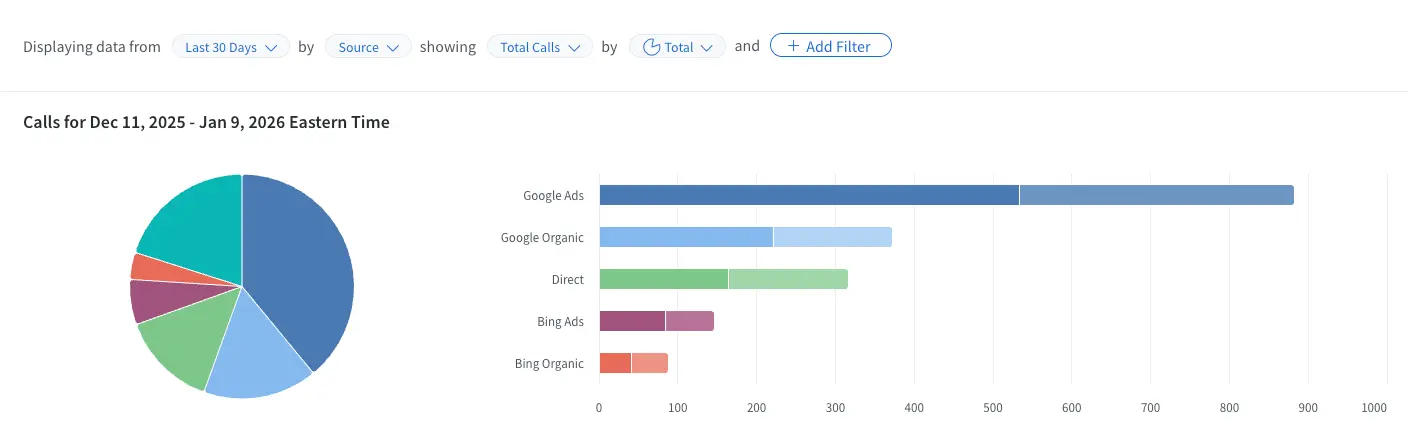
Option 2: Use Call Tracking ($45-$150/month)
Call tracking gives each marketing channel its own phone number. Google Ads gets one number. Your website gets another. Direct mail gets a third.
When a patient calls, you instantly know which channel drove that call.
CallRail is what we use here for our clients since it’s HIPAA-compliant and connects real easily to Google Analytics.
Option 3: Connect Tracking to Your Patient Records
Some platforms connect call tracking directly to Dentrix, Eaglesoft, or Open Dental.
Start with Option 1. It takes five minutes to set up. Add call tracking once you’re spending $2,000+ monthly on marketing.
8 Dental Marketing Channels That Deliver the Highest ROI
Where you spend matters as much as how much you spend.
The table below compares the primary dental marketing channels by cost, timeline, and expected return.
| Channel | Cost Per Patient | Time to Results | Typical ROI | Best For |
|---|---|---|---|---|
| 1. Patient Referrals | Near $0 | Ongoing | Highest | Practices with strong retention |
| 2. Google Ads (PPC) | $150-$500 | 60-90 days | 300-500% | Practices needing patients now |
| 3. SEO | $100-$250 | 6-12 months | 400-600% | Long-term organic growth |
| 4. Local SEO | $75-$200 | 3-6 months | 500-700% | Google Maps and "near me" searches |
| 5. AI SEO (GEO) | $150-$300 | 6-12 months | Emerging | Visibility in ChatGPT, Perplexity, Gemini |
| 6. Email Marketing | $5-$20 | 30-60 days | 500-800% | Patient retention and reactivation |
| 7. Social Media Ads | $200-$400 | 30-60 days | 150-300% | Brand awareness and promotions |
| 8. Direct Mail | $300-$500 | 2-3 campaigns | 100-200% | New movers and specific demographics |
Generally, my favorite channels for dental practices are digital since they’re the easiest to track ROI.
Tired of Marketing That Can't Prove Its Value?
We track every lead, every call, and every new patient back to the campaign that generated it. No vanity metrics or guessing.
Get real marketing ROI →Google Ads for Dentists
Google Ads can put your practice in front of people searching for dental care. MD Connect’s physician-marketing article reports that PPC drove 79% of visitors and 71% of referrals in its analysis. The article doesn’t identify the practices as a dental sample.
Local SEO for Dentists
Local SEO is the foundation of practice since your GBP shows up in every local search. For our clients, we update profiles weekly. Simple updates will generate more profile views, calls, and website clicks compared to profiles left untouched. It also compounds over time and costs far less per patient than paid ads once it’s working.
SEO for Dentists
Traditional SEO builds long-term organic visibility in Google search results. It takes longer than Local SEO to gain traction, but the payoff is significant. We focus our clients’ SEO efforts on high-intent service pages like “dental implants [city]” and “Invisalign provider near me.” These pages put you in front of patients actively searching for treatment.
AI SEO (also called GEO or Generative Engine Optimization)
ChatGPT is the channel we’re testing the most with right now. More and more patients are turning to ChatGPT, Grok, Perplexity, and Gemini for dentist recommendations. Getting your practice cited in those answers is marketing gold.
We’re already optimizing client content for AI citation, structuring pages so large language models can extract and reference the information. ROI data is still developing, but based on our internal data of Google Analytics across the board for our dental clients, they’re all getting more traffic month over month from AI. The practices investing here now will have a significant advantage in 2-3 years. This can’t be ignored.
Related: AI SEO for Dentists
Get your practice cited in ChatGPT, Perplexity, and Google AI Overviews before your competitors do.
Learn How AI SEO Works →Frequently Asked Questions About Dental Marketing ROI
What's a good ROI for dental marketing?
A good dental marketing ROI falls between 300-500%, which equals $3-$5 returned for every $1 spent. The American Dental Association considers this 3:1 to 5:1 return the benchmark for successful campaigns.
- Below 300% ROI: Campaign needs optimization or budget reallocation
- 300-500% ROI: Campaign is performing at industry benchmark
- Above 500% ROI: Channel is worth scaling with additional budget
Newer practices and new campaigns often see lower initial returns. SEO investments typically take 6-12 months before reaching full ROI potential, while PPC campaigns need 60-90 days before accurate measurement is possible.
You shouldn’t cut a campaign before giving it time to work. Calculate your ROI by channel quarterly using the formula above.
How much should a dental practice spend to acquire a new patient?
Patient acquisition cost for most dental practices ranges from $150-$300 per new patient. Competitive metro areas and high-value services like dental implants often push this to $300-$500+.
- General dentistry: $150-$300 per new patient
- Competitive markets: $300-$400 per new patient
- Specialty services (implants, cosmetic): $400-$500+ per new patient
The real question is whether acquisition cost makes sense against patient lifetime value. If your average patient generates $6,000 over their lifetime with a 35% profit margin, spending $300 to acquire them returns $1,800+ in profit.
Your acquisition cost should stay below 15-20% of your average patient lifetime value.
How long should I wait before judging if a marketing campaign works?
Depends on the channel. Google Ads needs 60-90 days for optimization. SEO requires 6-12 months. Direct mail needs 2-3 campaign cycles.
- Google Ads / Paid Social: 60-90 days minimum
- SEO: 6-12 months before judging results
- Direct Mail: 2-3 campaign cycles
- Email Marketing: 30-60 days per campaign
Pulling the plug too early kills campaigns that would have become profitable. Practices that abandon Google Ads before 90 days miss the optimization period where cost-per-lead typically drops 20-40%.
Set evaluation milestones at the start of each campaign and stick to them.
Start Measuring What Matters
Most dental practices waste money on marketing because they never connect spending to results.
You now have the formulas, the metrics, and the tracking methods to change that.
The practices that grow consistently are the ones who know exactly what each dollar produces and double down on what works.
If you want a team that tracks every lead and reports real ROI, let’s talk about your marketing.