
SEO Pricing and Packages for Healthcare Practices
Set your SEO budget around the work your practice needs
Review the pricing FAQ for the current full-scale digital marketing range. Ask for an SEO quote based on your services, local rivals, and the work your site needs.
Compare the scope below with your proposal. For the agency overview, visit our healthcare SEO services page.

How Your Monthly Fee Works
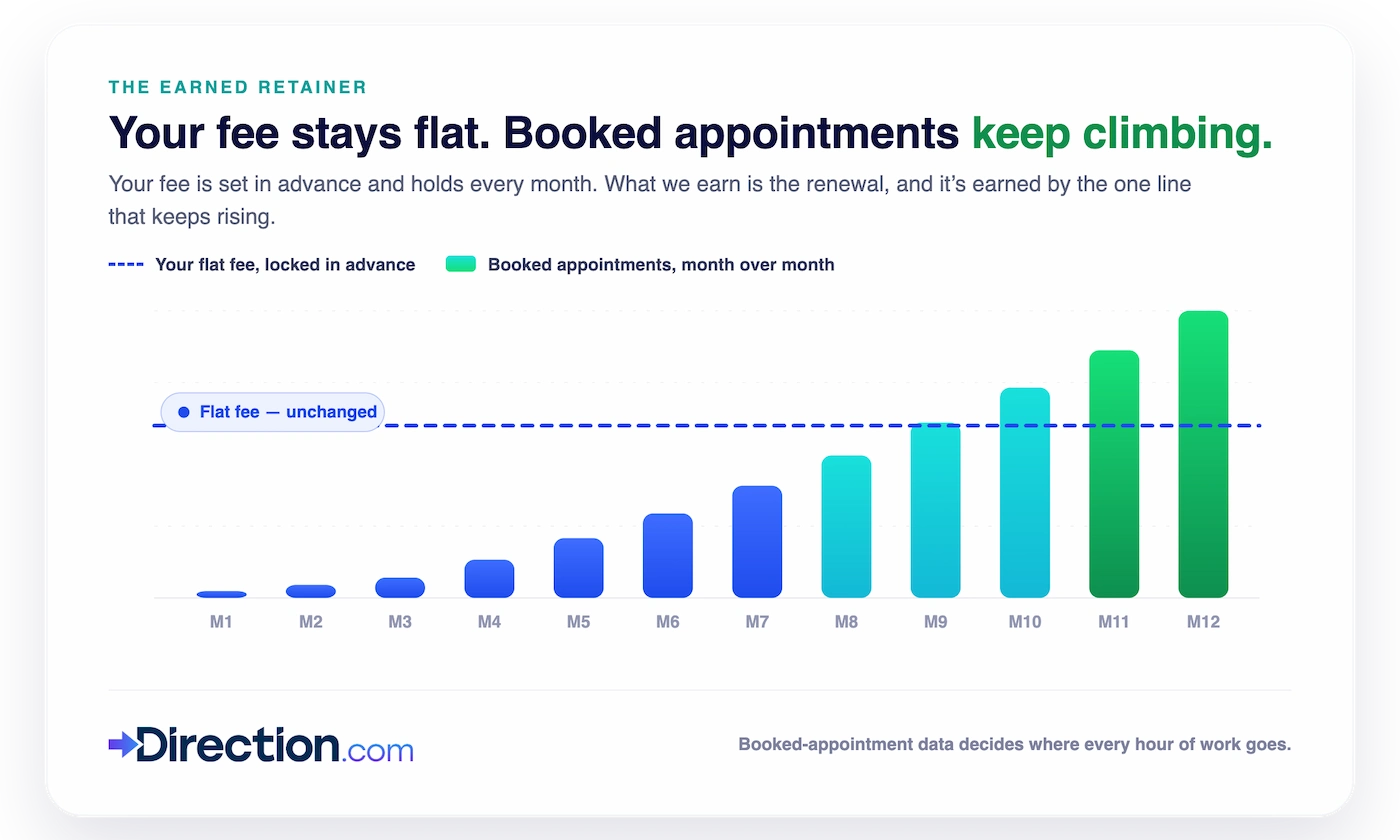
Your fee never changes with lead volume. What we earn each month is the renewal, and every hour of your campaign follows the booked-appointment data. No more paying, month after month, for activity reports with nothing behind them.
Why Most SEO Campaigns Stall (And How Ours Deliver)
The practices on our book mostly arrived from another agency, already paying for SEO and cooled on the results. Every handoff looks the same. A blog full of generic posts, tracking that never fired a form fill, and links from sites with no traffic of their own.
Search behavior has changed. Patients now check Google, ChatGPT, reviews, and more before booking. Generic blog posts and ranking reports no longer fill appointment books.
That’s why we prioritize the assets that actually influence buying decisions:
- High-converting service and procedure pages
- Content mapped to patient search journeys
- Clear brand positioning and competitive differentiation
- Site-wide conversion rate optimization
- Technical foundation that Google and AI engines trust
- Authority signals and case studies that AI systems cite
- Local signals and review velocity that win the map pack
We measure success the way you do: new patients, lead quality, and revenue produced.
Reporting to Review With Your SEO Proposal
Once your website tracking is fully configured, the primary measures of success are your lead volume, lead quality, and return on your spend. You’ll still see rankings, traffic, and search visibility in your report, as supporting indicators. The question that decides your renewal is whether the campaign produced qualified leads and profitable new patients.
To measure it all accurately, here are a few of the metrics we’ll need from you:
- Average value of a new patient
- Typical time from first contact to booked visit
- One-time versus repeat-patient value
- Characteristics of a high-quality lead
- Characteristics of a poor-fit lead
- Your close rates and patient lifetime value
Our goal is to give you clear, commercially meaningful reporting. For example:
What to Check in an SEO Package
Use the work below to review your SEO proposal. Confirm which tasks your fee covers and how often the team will work on your pages.
Ask about site repairs and new content first. Your quote should name the pages in scope, link work, local search tasks, and reports you’ll receive.
Research scope for your campaign
Every plan starts with the searches patients in your market make and the reasons behind them. Then we chart where your competitors rank against those terms and set the KPIs you’ll judge the campaign on.
Research turns scattered search data into your ranked build list, with each page tied to a revenue estimate.
We Build the Offer First, Then Market It
A stronger offer makes every visitor worth more to you than to the practice bidding on the same click. You can outbid them and outpublish them without touching your margin. For that reason, offer strategy comes before channel work in every campaign here, no exceptions.
The economics come first, then the marketing.
Revenue-Driven Funnel Mapping
Before touching a single page, we identify the service lines producing the most revenue for your practice. Then comes a map of every search your patients make on the way to booking those procedures, from early research through high-intent terms.
From there, the target keywords, secondary variations, volumes, and intents go into your build sheet. The blockers in front of your pages come out. The result is a prioritized build order that moves your highest-value service lines first.
Reverse-engineering Competition
Your competition has already bought the research, published the content, tested the title tags, and built the links. We review the results they achieved, then build a target list from the searches they rank for and you’re missing. Every decision after this phase traces back to that first pass.
Keyword Gap Analysis
We pull every term your three closest competitors rank for in positions 1 through 20, then subtract what you own. Each term’s score comes from search volume, commercial intent, and the margin on your procedure. Your output is a ranked target list.
SERP Intent Mapping
With a live read of the search results for each of your target terms, we document which page types Google is rewarding. A service page or a blog post?
Sometimes the answer is a listicle, a directory, or a video. Matching the page type to the SERP is the difference between your page reaching the top 10 and never getting close.
Backlink Source Mining From Competitor Profiles
We export the referring domains pointing at the competitor pages outranking you, then filter for sites that accept new placements. The link team receives named targets, each paired with the page on your site it should point to.
Content Depth and Entity Scoring
We compare ranking pages on subtopic coverage, medical entities named, schema present, and length. Their coverage minus yours becomes your page outline. The analysis runs on Ahrefs data plus live SERP reads, with a refresh each quarter.
Site repairs to include in your quote
Nothing new goes up until the audits run. First, can Google crawl and index your site? Then we check the conversion points fire, assign every live page on your site a target keyword, and mark candidates for refresh, merge, or removal.
Technical SEO Repairs
Your content can’t rank on a site Googlebot can’t crawl cleanly. Technical repairs come early because crawl problems limit every page you publish after them.
Crawl and Index Audit
We crawl every URL, compare the result against Google’s index, and fix or remove orphan pages, redirect chains, internal 404s, and duplicate parameter URLs. Practices with 300-plus pages routinely have a third of them consuming crawl budget your revenue pages need.
Core Web Vitals and Mobile Performance
We test the templates your patients load most, your homepage, service pages, and blog posts, against Google’s Core Web Vitals thresholds. Because the repairs happen at the template level, one fix carries across every page built on it. Inherited sites usually fail on mobile first, where your patients are.
Site Architecture and URL Structure
We organize your service, condition, and location pages into a hub-and-spoke structure, so link equity reaches the pages you need ranked. Short, mapped URLs follow, with redirects for anything that moves.
Schema Markup
We add MedicalOrganization, Physician, MedicalProcedure, FAQPage, and Review schema. Structured data is how answer engines confirm which entity you are and which procedures you perform.
Indexation Control
We set robots directives, canonical tags, XML sitemaps, and pagination handling so Googlebot spends its crawl on pages that can produce appointments for you. When your site is past repair, the first stop is healthcare web design.
On-page work in your SEO scope
With the foundation set, the build starts. New pages go live, links point at them, and movement lands in your weekly report, where you can check it against booked appointments. The pages and links from this phase keep producing bookings for you long after the month that paid for them.
On-Page SEO
On-page work assigns one job to each of your pages. When two pages target the same keyword, each ranks lower than a single page would.
Keyword Assignment and Cannibalization Control
Every page receives one primary keyword plus a defined set of secondary terms, documented in a keyword ownership map. When two of your pages overlap, we merge, redirect, or reposition one of them.
Header Hierarchy Rebuilds
We rewrite H1 through H4 so a patient skimming your headers alone knows what the page offers, who it treats, and what to do next. Each header also targets a secondary term under your primary keyword.
Title Tags, Meta Descriptions, and Click-Through Testing
We write your titles for the click, track impressions against clicks in Search Console, and rewrite whatever underperforms after 60 days of data.
Internal Link Placement
Each priority page receives inbound links from related pages using descriptive anchor text. The link audit finds the pages on your site with authority and no path to the service pages producing your revenue.
Conversion Elements on Service Pages
We place phone numbers, forms, insurance details, provider credentials, and appointment options where your patients look for them. A ranking that never books anyone is trivia. Practices that need volume faster run healthcare PPC alongside the organic campaign.
Content scope from brief to publish
We write nothing on a hunch. Every brief traces back to a term from your competitor capture, with format set by the live SERP and the outline set by depth scoring. Writers receive the target term, the intent, the entities, the links to place, and the conversion action.
Briefs Before Drafts
Each piece starts with a brief that lists your primary keyword, intent, subtopics, competing pages to beat, word count, internal links, and the CTA. Writers never guess at scope.
Writing and Review
Drafts pass review against your compliance requirements, and we source every outcome claim or cut it. Your providers approve anything clinical before it publishes.
Editing for Human Signals
Every draft written for your site clears an editing pass that strips AI phrasing patterns, repeated sentence structures, and filler. Nobody links to templated copy, much less reads it.
Publishing, Images, and Interlinking
We publish in your CMS, add compressed images with descriptive alt text, place the assigned internal links, and submit for indexing the same day.
Page types to discuss before signing
Different searches need different pages. Each type below does one job between your patient’s first search and their booked visit. We match the type to whatever the live SERP is rewarding for that keyword.
| Content type | Funnel stage | What it targets | Typical length |
|---|---|---|---|
| Procedure and service pages | Bottom | Commercial searches naming a treatment and a city | 1,200 to 2,000 words |
| Location landing pages | Bottom | City, neighborhood, and service-area searches | 800 to 1,500 words |
| Pillar guides | Middle | Broad head terms and topical coverage | 2,500 to 4,000 words |
| Supporting cluster posts | Middle | Long-tail subtopics linking back to the pillar | 1,200 to 1,800 words |
| Condition and symptom explainers | Top | Patients researching before naming a treatment | 1,500 to 2,500 words |
| Cost and insurance pages | Bottom | Pricing questions and coverage searches | 1,000 to 1,800 words |
| Treatment comparison pages | Middle to bottom | Treatment A versus treatment B, alternatives to X | 1,200 to 2,000 words |
| Competitor comparison pages | Bottom | Your practice versus a named competitor, competitor-alternative searches | 1,000 to 1,800 words |
| Listicles | Top to middle | Best-of and top-provider roundup searches | 1,500 to 2,500 words |
| Provider and credential pages | Trust | Branded searches and experience signals | 600 to 1,000 words |
| Case studies and results pages | Bottom | Patients checking proof before they call | 800 to 1,500 words |
| FAQ and answer pages | All stages | People Also Ask, voice queries, AI citations | 600 to 1,200 words |
| Asset type | Primary job | What it targets | Typical length |
|---|---|---|---|
| Original research and data studies | Link acquisition | Journalists, bloggers, and AI engines citing first-party statistics | 1,500 to 3,000 words plus charts |
| Press releases | Link acquisition | Announcements that earn referring domains and news citations | 400 to 800 words |
| Free tools and calculators | Email capture | Utility searches: cost estimators, eligibility checkers, self-audits | Interactive, plus 300 to 800 words |
| Advertorial landing pages | Paid conversion | Cold prospecting traffic needing education before an offer | 1,500 to 3,000 words |
| Trojan horse landing pages | Paid conversion | Non-brand paid search and Meta prospecting destinations | 1,000 to 2,000 words |
| Quiz funnels | Paid conversion | Self-selection across service lines, plus email and SMS capture | 6 to 10 questions |
Links and local search in your campaign scope
Publishing is the midpoint. Google and the answer engines reward pages that other credible sites reference, so the second half of your campaign builds those references.
Authority Building Through Contextual, Editorial Backlinks (Digital PR)
Link building here prioritizes contextual placements inside real editorial content, on niche-relevant sites already earning organic traffic from Google. We score every opportunity on topical relevance, real traffic, and long-term value to your profile, with Domain Authority as a supporting check.
The sourcing mix runs guest posts, journalist sourcing, resource page outreach, unlinked mention reclamation, and competitor monitoring. What you end up with is a cleaner, more durable backlink profile, one Google and the AI search systems trust.
Every Link Passes Our 100-Point SEO + AI Quality Review
When we audit the backlink profile you arrive with, the pattern is links placed once and never checked again. Here, before any placement goes live, it clears a 100-point pre-publication review.
We check relevance, brand identification, entity association, surrounding context, anchor quality, and technical cleanliness. We also confirm an AI system can tell exactly who your brand is. A human naturalness pass runs last, and the placement you get is a backlink inside a post that ranks on its own.
AI Search Visibility
We structure your content for citation in Google AI Overviews, ChatGPT, Perplexity, and Claude. That means direct answers in the opening lines, question-format headers, named medical entities, statistics with sources, and visible author credentials with review dates. For the full method, see the AI SEO page.
Google Business Profile and Local Signals
We manage your categories, services, service areas, photos, Q&A, and posts monthly, alongside citation cleanup across the medical directories. A name-address-phone consistency audit follows, with corrections to every listing that turns up wrong.
Brand Authority Through Online Reviews
Review volume and recency affect your map pack position and the choice a patient makes between two practices ranked side by side.
Distribution to Your Existing Audience
Published content goes to your email list and social profiles with copy written per channel. First-week engagement affects how quickly a page gets crawled and ranked.
Ongoing reviews of your SEO work
We review your numbers weekly and change your plan mid-campaign when performance justifies it. High-potential keywords, conversion path problems, and ranking shifts all show up in that weekly pass, months before your quarterly review would catch them.
Digital PR and Link Acquisition
We pitch your published assets to the referring domains found during competitor mining, leading with original research, since first-party numbers are what journalists cite. Every placement receives a named destination page and anchor text from a distribution plan, which keeps your anchor profile natural.
- Monthly Reporting Calls
Grade your investment
Every month, you meet the team on video or in person and walk the numbers, keyword movement, traffic by page, lead counts by source. And the revenue attached to them. Bring your requests to that call, and when your goals change, the next month’s plan changes with them.
Practices in Central Texas can also work with us in person through our Austin SEO agency office.
Real, sales-backed results,
Proven strategies.
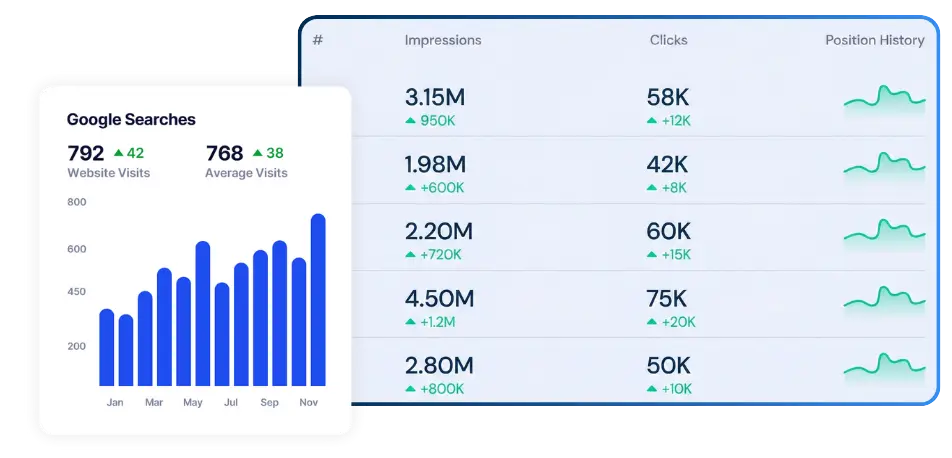
Craft Body Scan grew organic traffic 1,682 percent, with page-one rankings up from 27 to 9,136. Therapy Unlocked went from 29 leads a month to 50-plus, with 198 calls and 129 form fills in year one. Each case study lists the client, the timeframe, and the numbers you can verify.

Questions About SEO Pricing and Campaign Scope
How much does an SEO campaign cost?
Campaigns run from $3,500 to $25,000 and up for full-scale digital marketing services (including Ads, ad spend, email marketing, design, social, and more), with local campaigns sometimes lower. Where you land depends on your service line count, the competition in your market, and how fast you want to move.
Your fee is flat and set in advance. It doesn’t change with lead volume, so you can plan the spend.
How long until the campaign produces booked appointments?
Expect early movement inside your first 90 days and compounding results after month six. Technical repairs and on-page work tend to move first, while new content and links take longer to pay out. That compounding is the reason the average client relationship here runs 36-plus months.
Who reviews the clinical claims in our content?
You and/or your providers do, before anything publishes. Drafts pass a claims review first, where we source every outcome claim or cut it. Nothing clinical goes live without sign-off from someone licensed at your practice.
We already have an agency. What does switching look like?
The first month is an audit of what your current agency built. We keep the pages and links producing results, merge the ones targeting the same keyword, and remove what never ranked. Most of the practices on our book arrived exactly this way.
Will blogging alone grow a practice?
Not anymore, and it’s the first fix in any campaign this team inherits. Patients check Google, AI answers, and reviews before they call, and generic posts stopped producing leads for practices like yours the way they once did.
Blog content still earns topical coverage and AI citations. The revenue comes from service pages, cost pages, and comparison pages built for buying-intent searches.
What do you need from us to start?
About two hours a month, mostly at the start. Onboarding requires your service line priorities, access to your site and analytics, and a provider who can approve clinical claims. After that, your main time commitment is the monthly reporting call.
What SEO Is Like When an Expert Team Runs It
A campaign that holds rankings through the next Core Update needs someone watching your crawl, your SERPs, and your conversion data every week. A one-time effort slips within a quarter. Direction has run this work for healthcare practices since 2016, and the average client stays 36-plus months.
Before you compare packages, read what healthcare SEO is so you know which parts of the work each tier covers.
- 36+ months average client relationship
- 85+ five-star reviews, zero negative client reviews
- 10+ years in business, full in-house team
- Healthcare marketing is our specialty
or call 737-510-2477