SEO vs Google Ads for Healthcare: Which Drives Better Patient Acquisition (and When to Use Both)
Chris Kirksey
CEO, Direction.com
Last Updated: July 14, 2026
Table of Contents
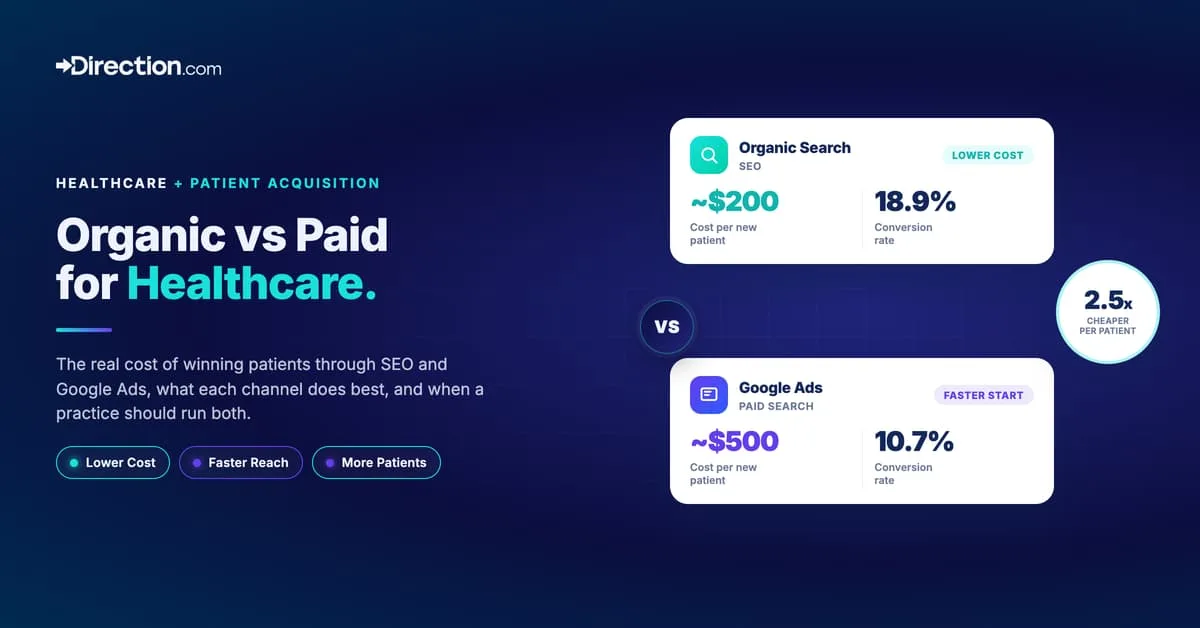
Healthcare practices spend an average of $370 to acquire a single new patient. But that number swings wildly depending on how you get them – organic search averages around $200 per patient, while paid search runs $342 to $500+. The question isn’t which channel is “better.” It’s how to use both strategically so your total patient acquisition cost drops while your appointment volume grows.
This is the decision most healthcare practices get wrong. They go all-in on Google Ads for instant results, or they invest in SEO and get frustrated waiting six months. The practices that win build both channels together – using PPC to fill the schedule now while SEO builds the compounding organic foundation that reduces paid dependency over time.
~$200
average patient acquisition cost via organic search
ThinkBasis, 2026
~$500
average patient acquisition cost via Google Ads
ThinkBasis, 2026
18.9%
organic conversion rate vs. 10.7% for paid ads
FirstPageSage, 2026
How SEO and Google Ads Work Differently for Healthcare
Both channels put your practice in front of patients searching on Google. The mechanics behind each are fundamentally different, and understanding that difference is what separates practices that spend wisely from ones that burn budget.
SEO (Organic Search)
How it works: Optimize your website so Google ranks it for patient searches. No cost per click.
Time to results: 3-6 months for traction, 6-12 for full impact
Cost structure: Monthly agency/team investment, no per-click cost
When you stop: Rankings persist for months or years
Best for: Long-term patient acquisition, trust building, content authority
Google Ads (Paid Search)
How it works: Bid on keywords so your ad appears above organic results. Pay per click. Google explains the auction and Quality Score system in detail.
Time to results: Days. Leads within 1-2 weeks of launch.
Best for: Immediate patient flow, new locations, high-value procedure promotion
The Real Cost Comparison for Healthcare Practices
The per-click cost of Google Ads is easy to see. The true cost of SEO is harder to measure but often much lower per patient over time. Here’s how the math works for a typical healthcare practice.
SEO Investment: $3,000/mo
Monthly organic visitors (Year 1): ~2,000
Conversion rate: 5-8%
New patients/mo: 100-160
Cost per patient: $19-$30
Compounds over time. Traffic doesn’t stop if budget pauses.
Mature SEO campaigns deliver 4-6x higher long-term ROI compared to sustained PPC. By month 12, your organic traffic is growing while your SEO cost stays flat. Your PPC cost per patient never drops below the market CPC unless you continuously optimize landing page conversion rates.
When Healthcare Practices Should Use Google Ads
Google Ads aren’t the enemy of SEO. They’re the complement. There are specific scenarios where paid search is the right choice for a healthcare practice – and trying to rely on SEO alone in these situations costs you patients.
You can’t wait 6-12 months for SEO to generate patients. PPC fills your schedule from day one while organic rankings build in the background.
High-value procedure promotion
Launching dental implants, cosmetic services, or a new specialty? PPC targets patients searching for that specific procedure immediately – before your organic content has time to rank.
Competitive metro markets
When 15+ practices compete for the same patient searches, organic ranking alone may not capture enough volume. PPC guarantees top placement while you build organic authority.
Keyword data for SEO strategy
PPC reveals which keywords actually convert patients – not just drive traffic. That conversion data directly informs which organic content to prioritize.
When Healthcare Practices Should Prioritize SEO
SEO should be the foundation of every healthcare practice’s patient acquisition strategy. Paid search is the accelerant. Here’s when organic investment delivers the highest return.
Reducing long-term patient acquisition cost
Every organic ranking you earn is a patient source you don’t have to pay per-click for. Practices running both channels typically see 30-40% lower overall acquisition costs than PPC-only practices.
Building trust and E-E-A-T authority
Patients trust organic results more than ads. Ranking organically for condition and treatment keywords positions your practice as an authority – which matters even more in YMYL healthcare categories where Google scrutinizes content quality.
Capturing informational searches
77% of patients Google symptoms before booking. Running ads for “what causes knee pain” isn’t cost-effective at $4.70/click. But ranking organically for those queries captures patients at the earliest research stage – for free.
Local pack dominance
Google’s local 3-pack appears for 46% of searches with local intent. Local SEO – Google Business Profile optimization, reviews, citations – is how you claim that space. Only one ad slot appears above the local pack.
The Integrated Strategy: How to Use Both Together
The practices seeing the lowest patient acquisition costs in 2026 aren’t choosing between SEO and Google Ads. They’re using PPC data to make SEO smarter, and SEO rankings to reduce PPC dependency. Here’s what that looks like in practice.
01
Use PPC conversion data to prioritize SEO keywords
Google Ads shows you which keywords actually drive appointments – not just clicks. Use that data to decide which service pages and blog content to build for organic. Stop guessing which keywords matter and let paid data tell you.
02
Reduce PPC spend as organic rankings grow
When you rank organically for a keyword you’re also bidding on, you can lower or pause PPC spend on that term. The organic listing captures the traffic for free. Shift that freed-up budget to new keyword targets.
03
Dual SERP presence builds trust
Appearing in both the paid ad and organic results for the same query increases perceived authority and total click-through rate. Patients see your practice twice on the same page – once at the top (ad) and again in organic results.
04
Test landing pages with PPC before building for SEO
PPC gives you fast feedback on which headlines, CTAs, and page structures convert. Use that data to build your organic service pages – so they convert from day one instead of needing months of A/B testing.
The AI Search Factor: What Changes in 2026
AI Overviews now appear in approximately 48% of Google searches, and they’re changing the calculus for both SEO and PPC. When an AI-generated answer sits at the top of the results page, it pushes both ads and organic results further down. For healthcare practices, this creates a new consideration.
Practices cited within AI Overviews see a 35% higher organic CTR. Practices not cited see their traffic drop. The content strategies that earn AI citations – structured, authoritative, question-answering content – are fundamentally SEO strategies. Google Ads can’t buy AI Overview placement. This makes organic content investment more valuable in 2026 than it was even a year ago.
At the same time, AI Overviews are increasing zero-click behavior (60% of searches end without a click). When clicks do happen, they tend to be higher intent. Both organic and paid clicks from searches with AI Overviews are more likely to convert because the casual browsers already got their answer from the AI summary. The patients clicking through are the ones ready to act.
Recommended Budget Split for Healthcare Practices
There’s no universal right answer, but the data points to a consistent pattern: practices should invest more heavily in SEO as the foundation and use PPC as the accelerant.
New Practice
Need patients now, no organic presence yet
40% SEO / 60% PPC
Shift toward SEO as rankings build
Established Practice
Steady patient base, growing organic
60% SEO / 40% PPC
Industry-recommended split for most practices
Mature Practice
Strong organic rankings, diversifying
70% SEO / 30% PPC
PPC for new services and geographic expansion
The goal over time is to shift more budget toward organic as your SEO compounds. PPC becomes targeted rather than broad – focused on new procedure launches, competitive keywords where you don’t yet rank, and geographic expansion into new markets.
Direction manages both SEO and PPC for healthcare practices, which means your campaigns share keyword data, conversion intelligence, and patient acquisition analytics across both channels. No silos, no wasted overlap. If you’re ready to build an integrated search strategy, schedule a strategy call and we’ll audit both your organic visibility and paid performance to show you where the highest-impact opportunities are.
About The Author
Chris Kirksey
Chris Kirksey is the CEO of Direction, breaking healthcare practices free from marketing agency failures & inconsistent patient acquisition through SEO that works | Former Army/NSA/CIA | Speaker, Author, Gen AI Geek | 1/2 🇨🇺 Full 🇺🇸
Your Rankings Need a Specialist, Not a GP.
Get real results from real healthcare marketing specialists. References on request.